
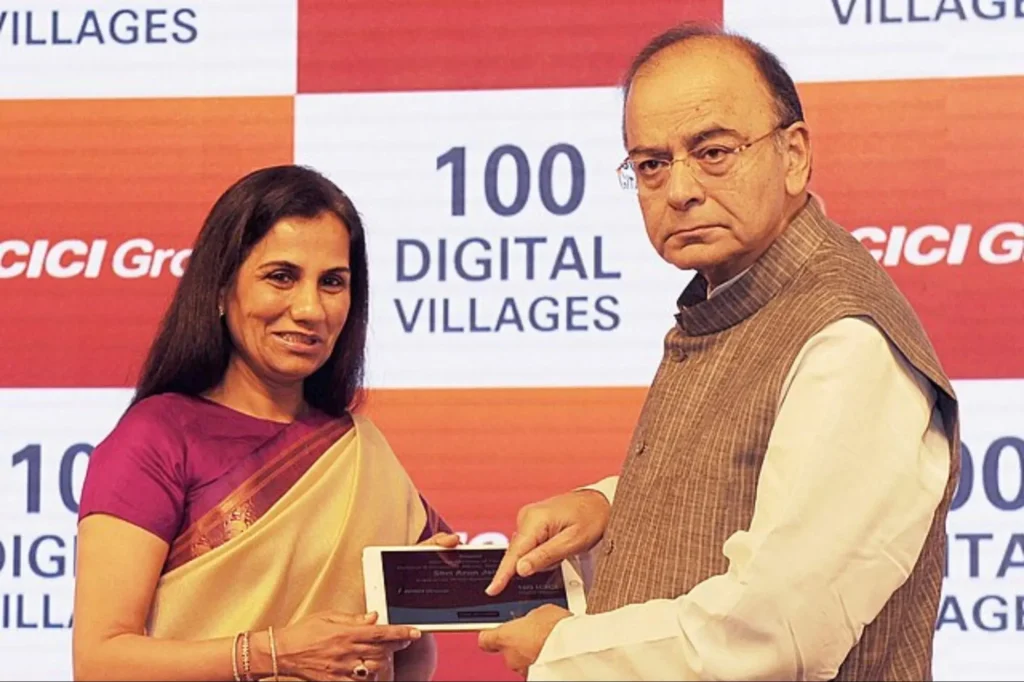
Banking Icon for nearly a decade, Chanda Kochhar was one of the most prominent faces of Indian banking.
As CEO and Managing Director of ICICI Bank, she played a major role in expanding the lender into one of India’s largest private-sector banks.
She was also awarded the Padma Bhushan and was frequently recognised among influential business leaders globally.
Her career changed dramatically after questions emerged over ICICI Bank’s ₹3,250-crore exposure to the Videocon Group.
The Videocon Loan
In 2012, Videocon sought financing from a consortium of about 20 banks led by State Bank of India.
The lenders collectively sanctioned loans of nearly ₹40,000 crore, with ICICI Bank’s share amounting to ₹3,250 crore.
Kochhar, who was heading ICICI Bank at the time, was part of the bank’s credit committee that approved its portion of the financing.
The controversy was not simply about whether the loan itself was commercially justified.
Questions were raised about whether Kochhar should have participated in the decision because of business connections involving her husband, Deepak Kochhar, and Videocon promoter Venugopal Dhoot.
The Business Connection
Before the Videocon loan, Deepak Kochhar and Dhoot had been involved in establishing NuPower Renewables.
A company associated with Dhoot had invested ₹64 crore in the venture.
Following the sanctioning of the ICICI loan, Dhoot allegedly transferred control of that company to a trust linked to Deepak Kochhar for ₹9 lakh.
Investigators later examined these transactions as part of the broader conflict-of-interest allegations.
The Kochhars have denied wrongdoing and maintained that the transactions were legitimate.
Conflict of Interest
The central corporate-governance question was whether Kochhar had adequately disclosed her connection to the parties involved and whether she should have recused herself from the loan decision.
An ICICI Bank investigation later concluded that she had violated the bank’s code of conduct by failing to disclose the conflict and by not recusing herself from the relevant decision-making process.
2018 Fallout
The controversy intensified in 2018 after allegations surrounding the Videocon loan resurfaced.
ICICI Bank initially stood behind Kochhar, but the bank subsequently appointed an independent inquiry headed by former Supreme Court judge Justice B.N. Srikrishna.
The inquiry concluded that Kochhar had breached the bank’s code of conduct.
ICICI Bank accepted her resignation, subsequently treating it as a termination for cause, and sought to recover certain bonuses and stock-related benefits.
Criminal Case
The matter later moved into the criminal-investigation arena.
The Central Bureau of Investigation and Enforcement Directorate investigated allegations including corruption, criminal conspiracy and money laundering.
Chanda Kochhar, Deepak Kochhar and Venugopal Dhoot were arrested in 2022.
The Bombay High Court subsequently granted them bail and criticised the manner in which the arrests had been carried out.
The accused have denied the allegations, and the criminal proceedings have continued through the legal system.
Videocon’s Collapse
The Videocon Group eventually collapsed under its debt burden and entered insolvency proceedings.
Lenders suffered substantial losses, with recoveries reportedly amounting to only a small fraction of the outstanding debt.
The failure of the loan therefore became an important part of the larger controversy, although the allegations against Kochhar centred primarily on disclosure, conflict of interest and corporate governance rather than simply the fact that the loan later turned bad.
The Bigger Lesson
The Kochhar Videocon controversy became a major corporate governance case in India.
It highlighted why senior executives must disclose potential conflicts of interest and distance themselves from decisions where personal or family relationships could create even the appearance of compromised judgment.
The episode also demonstrated that in banking, the question is not only whether a loan was approved but whether the people approving it followed the highest standards of transparency and governance.