
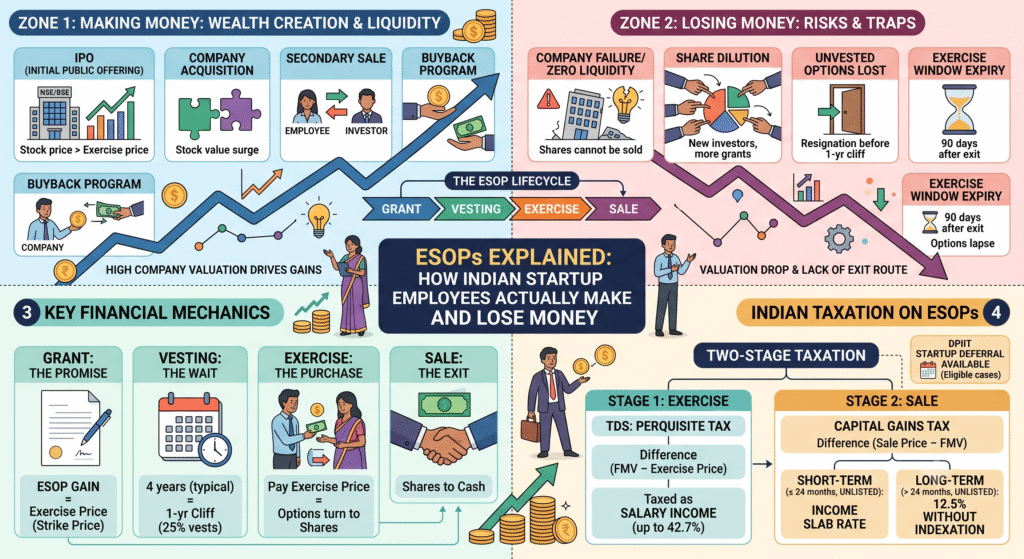
For many employees joining an Indian startup, the salary is only one part of the compensation package. Alongside cash pay, some companies offer Employee Stock Ownership Plans, commonly known as ESOPs.
The pitch can sound attractive: join a fast-growing startup today and potentially own a small piece of the company tomorrow.
But ESOPs are not guaranteed wealth. Their value depends on the company’s growth, the structure of the scheme, taxation, vesting conditions and whether employees eventually get an opportunity to sell their shares.
What Is an ESOP?
An ESOP gives an employee the right to acquire shares in a company, usually at a predetermined exercise price, subject to the terms of the plan.
Employees generally do not receive the shares immediately.
Instead, they receive stock options that become available over time through a process known as vesting.
This distinction is important because an option is not the same as cash or an immediately sellable share.
How Vesting Works
Startup ESOPs commonly use a multi-year vesting schedule.
A four-year structure, for example, may include a one-year cliff. Under such an arrangement, an employee may need to remain with the company for a specified period before receiving the first portion of the options, followed by additional vesting over subsequent months or years.
If an employee leaves before options vest, the unvested portion may generally be forfeited according to the plan’s rules.
The exact terms vary between companies.
The Exercise Price Matters
Suppose an employee receives 10,000 options with an exercise price of ₹50 per share.
If the employee later exercises all the options, the cost would be ₹5 lakh.
But the shares need to be worth substantially more than that for the transaction to create meaningful value.
If the company’s shares are worth ₹200 at a future liquidity event, the difference between the market value and exercise price would be ₹150 per share before considering taxes and other costs.
That is where the potential upside comes from.
Paper Wealth Is Not Cash
This is one of the most important points about startup ESOPs.
A company may raise money at a high valuation, increasing the implied value of employee shares. But employees cannot necessarily sell those shares immediately.
A private startup can have a billion-dollar valuation while an employee holding options has no immediate cash realization.
The actual financial outcome depends on a liquidity event such as an acquisition, buyback, secondary sale or public listing, subject to the company’s rules and applicable law.
When Employees Make Money
Employees can benefit when several things happen together.
The company grows substantially, the value of its equity increases, the employee’s options vest, and there is eventually an opportunity to sell or otherwise realize the value.
For example, an employee with 5,000 options at an exercise price of ₹100 could face a ₹5 lakh exercise cost.
If the eventual realizable value is ₹600 per share, the gross difference would be ₹25 lakh before taxes and other expenses.
The numbers are illustrative, not a guarantee.
How Employees Can Lose Money
ESOPs also carry significant risk.
A startup can fail, lose market value or raise additional capital at a lower valuation.
Employees may also leave before their options fully vest.
Even if options have vested, exercising them can require a substantial cash outlay.
There is also the possibility that an employee exercises options but later finds that there is no practical market for the shares.
In that situation, the employee has spent money without having an immediate route to recover it.
Dilution Is Another Factor
Startup employees should also understand dilution.
When a company raises additional capital and issues new shares, the percentage ownership represented by existing shares can decrease.
An employee may therefore hold the same number of shares while owning a smaller percentage of the company.
This does not automatically mean the employee loses money. If the new funding helps the company grow and increases its overall value, the value of the employee’s stake can still rise.
But percentage ownership and monetary value are not the same thing.
Taxes Can Change the Outcome
Tax treatment is another major consideration.
Depending on the structure and the employee’s circumstances, taxation can arise when options are exercised and again when shares are eventually sold.
The rules can be complicated, particularly for employees holding shares in private companies or dealing with cross-border structures.
Employees should therefore understand the applicable tax treatment before exercising significant options and consider professional advice where necessary.
What Employees Should Check
Before accepting an ESOP package, employees should ask:
- How many options are being offered?
- What is the exercise price?
- What is the vesting schedule?
- Is there a cliff?
- What happens to vested options after resignation?
- How long is the exercise window after leaving?
- What is the company’s current share or valuation information?
- Has the company conducted previous buybacks or secondary sales?
- What could future fundraising mean for dilution?
- What are the applicable tax implications?
The Real Value of ESOPs
ESOPs can become an important source of wealth when employees join companies that grow significantly and eventually create liquidity opportunities.
But they should not be treated as equivalent to salary.
Salary is immediate compensation. ESOPs are a potential future benefit carrying uncertainty.
The difference matters.
For startup employees, the smartest way to understand ESOPs is not to ask only, “How much could these options be worth?”
The more useful question is: What exactly am I receiving, what will it cost me to exercise, what could reduce its value, and how might I eventually turn it into cash?
That distinction separates an attractive-looking ESOP number from its actual financial potential.