
For years, one of the most discussed tax issues in India’s startup ecosystem was angel tax.
The provision became a major concern for startups raising money from investors because investments made at valuations above certain prescribed levels could create tax questions for the company.
The rules and exemptions evolved over time, and a major change eventually removed the angel-tax provision from the Income Tax Act.
For founders, however, understanding the history remains useful because valuation, documentation, and tax compliance continue to matter during fundraising.
What Was Angel Tax?
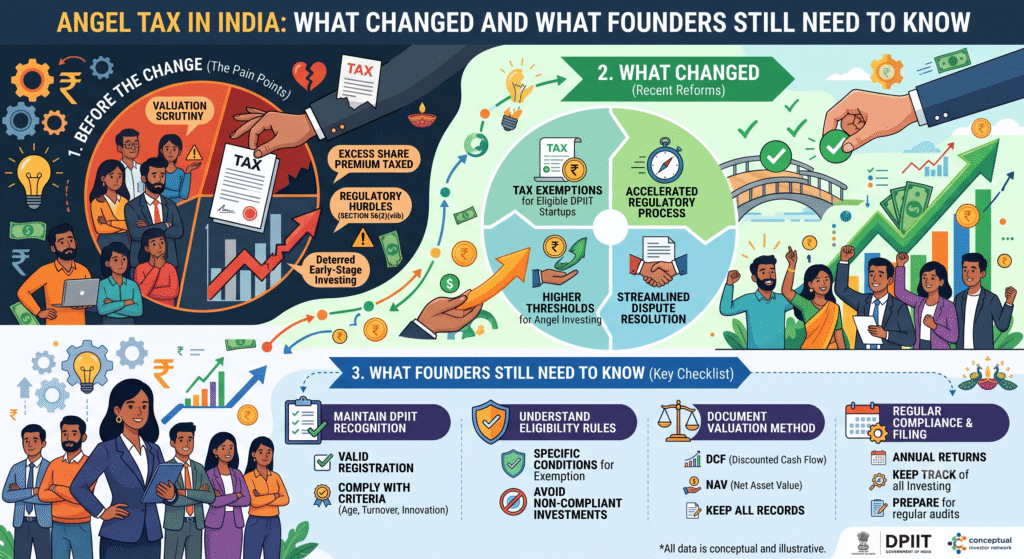
The term “angel tax” commonly referred to the tax treatment associated with Section 56(2)(viib) of the Income Tax Act.
Broadly, the provision applied when an Indian closely held company issued shares to investors for an amount considered higher than the prescribed fair market value.
The difference could, subject to the applicable rules and exemptions, be treated as income of the company and taxed.
The provision was originally introduced as an anti-abuse measure aimed at addressing concerns around unexplained or excessive share premiums.
Why Startups Were Concerned
Startup valuations are often based on expectations about future growth rather than current profits.
A young technology company may have limited revenue but could still attract investors at a significant valuation because investors are financing its future potential.
That created a practical challenge.
A founder might raise capital from an investor at a valuation agreed during a funding negotiation, while tax authorities could examine how the share price compared with the applicable fair-market-value framework.
This made valuation documentation particularly important.
The Role of Valuation
Valuation became one of the central issues in angel-tax discussions.
A startup raising money at a premium generally needed to maintain appropriate documentation explaining how that valuation had been determined.
Depending on the circumstances and applicable rules, valuation could involve methods prescribed under tax regulations and reports from qualified professionals.
The objective was to establish a defensible basis for the share price.
Exemptions Developed Over Time
The government introduced changes and exemptions over the years to reduce the impact on eligible startups and certain categories of investors.
Recognized startups could qualify for relief subject to specified conditions.
Rules also evolved regarding investments from different types of investors and the valuation methods that could be used.
This meant founders needed to examine the rules applicable to their particular financing rather than relying on general descriptions of angel tax.
The Major Change
A significant development came in 2024 when the government announced the abolition of the angel-tax provision.
The change was intended to remove a long-standing tax concern associated with share premiums received by eligible companies.
The abolition changed the fundraising landscape for startups because the specific tax mechanism that had generated many valuation disputes was removed.
Does That Mean Valuation No Longer Matters?
No.
Even without the former angel-tax provision, founders still need to document fundraising transactions properly.
Share issuances can have corporate-law, securities-law, tax and accounting implications.
A company should maintain clear records covering the investment agreement, share issuance, board and shareholder approvals, valuation documentation and capitalization table.
Good documentation remains important for future fundraising and due diligence.
Foreign Investment Is a Separate Question
Founders should also distinguish angel-tax rules from India’s foreign investment regulations.
An investment from a foreign investor can involve additional requirements relating to pricing, reporting, sectoral rules and other regulatory matters.
The abolition of the former angel-tax provision does not remove these separate obligations.
Companies raising money from overseas investors therefore still need to examine the relevant regulatory framework.
Why the Issue Mattered to Founders
The former provision became particularly significant because startups often raise money through multiple rounds.
A company could receive an investment at a valuation that appeared reasonable to founders and investors but later face questions about how that valuation was determined.
That uncertainty could create additional compliance costs and complexity during fundraising.
Removing the provision simplified one part of the process.
What Founders Should Still Do
Even after the abolition, founders should maintain a disciplined fundraising process.
Before issuing shares, they should understand:
- The agreed pre-money and post-money valuation
- Number and price of shares being issued
- Investor category
- Applicable corporate approvals
- Relevant tax treatment
- Foreign investment requirements, if applicable
- Valuation documentation
- Updated cap table
- Required regulatory filings
Professional legal and tax advice can be particularly important for complex transactions.
What Investors Should Look At
Investors should also examine the company’s fundraising records.
Important documents include previous financing agreements, share allotment records, valuation reports where relevant and the current cap table.
A clean history can make future transactions easier.
This becomes especially important when a startup is preparing for a larger institutional round, acquisition or public listing.
The Bigger Picture
The angel-tax debate highlighted a broader challenge in startup finance: how should tax systems evaluate rapidly growing companies whose valuations are based heavily on future expectations?
The abolition of the former provision removed one major concern from India’s startup fundraising environment.
But the fundamentals of responsible fundraising remain unchanged.
Founders still need credible valuations, accurate documentation, proper corporate approvals and compliance with applicable regulations.
The most useful lesson is that removing a tax provision does not remove the need for financial discipline.
For Indian startups, a well-documented funding round remains one of the strongest foundations for the next stage of growth.