
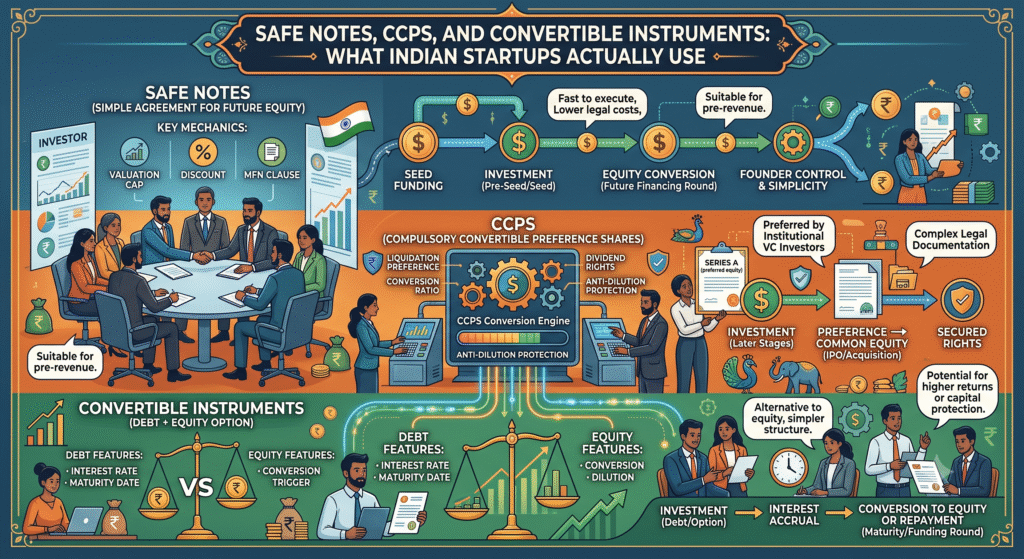
When an Indian startup raises its first outside capital, founders often hear terms such as SAFE, CCPS, convertible notes and preference shares.
To a first-time founder, they can sound interchangeable. They are not.
Each instrument has a different legal and economic structure, and the choice can affect valuation, dilution, investor rights, taxation and future fundraising.
Why Startups Use Convertible Instruments
Early-stage startups can be difficult to value.
A company may have a promising product, early customers and a strong founding team but limited revenue history.
Negotiating a precise valuation can therefore take considerable time.
Convertible instruments can provide a way for investors to put money into a company now while determining some aspects of the eventual equity conversion later.
What Is a SAFE?
SAFE stands for Simple Agreement for Future Equity.
It was developed as a startup financing instrument designed to allow an investor to provide capital that can convert into equity when a specified future financing event occurs.
A SAFE may include terms such as a valuation cap or discount.
However, founders should not assume that a standard Silicon Valley-style SAFE automatically works for an Indian company.
The legal, foreign-exchange, corporate and tax framework in India can affect how such instruments are structured.
Why Indian Founders Need to Be Careful With SAFEs
The biggest mistake is treating the word “SAFE” as if it has one universally applicable legal meaning.
An Indian startup and a US startup may use documents with similar commercial objectives but operate under very different legal frameworks.
For an Indian incorporated company, the instrument must be structured in accordance with applicable Indian corporate and regulatory requirements.
This is especially important when the investor is based outside India.
Convertible Notes
A convertible note is generally structured as a debt instrument that can convert into equity when specified conditions are met.
Instead of immediately determining the number of shares the investor receives, the note establishes terms under which the investment can later convert.
Conversion may be linked to a future financing round or another specified event.
This can be useful when founders and investors want to postpone detailed valuation negotiations.
India’s Startup Framework
India has specific rules governing convertible notes issued by eligible startups.
The applicable conditions can include requirements concerning the issuer, minimum investment amounts and the period within which conversion or repayment occurs.
The rules can also differ depending on whether the investor is resident in India or outside India.
Therefore, founders should verify the current regulatory requirements before using a convertible-note structure.
What Are CCPS?
Compulsorily Convertible Preference Shares, or CCPS, are preference shares designed to convert into equity shares according to predetermined terms.
They are widely used in Indian venture-capital and private-equity transactions.
CCPS can provide investors with specific rights while giving the transaction a clear path toward conversion into ordinary equity.
The investment documentation typically sets out matters such as conversion mechanics, voting rights, liquidation preferences and other investor protections.
Why CCPS Are Common in India
CCPS fit into India’s established corporate and investment framework.
For institutional investors, they can provide a familiar structure for investing in private companies.
They also allow parties to negotiate economic and governance rights through detailed transaction documents.
As a result, CCPS have become a common instrument in Indian startup financing, particularly as companies move into larger institutional funding rounds.
Preference Shares vs. Ordinary Shares
Ordinary equity generally represents straightforward ownership.
Preference shares can carry additional contractual rights.
These rights can include preferential treatment during liquidation, specific dividend provisions, conversion rights or other protections.
The exact rights depend on the company’s constitutional documents and investment agreements.
For founders, the headline ownership percentage therefore does not always tell the complete economic story.
Valuation Caps and Discounts
Convertible instruments often contain mechanisms that determine how the investment converts into equity.
A valuation cap sets a maximum valuation for calculating the conversion price in specified circumstances.
A discount can give the investor a lower conversion price than investors in a later financing round.
For example, if a note converts at a 20% discount to the next round’s share price, the note holder would receive shares at a lower price, subject to the instrument’s terms.
These mechanisms can materially affect founder dilution.
The Hidden Complexity of “Simple” Instruments
A financing document may appear simple because the valuation is postponed.
But the economic consequences can become complicated later.
Founders should model different scenarios before signing.
What happens if the next round is raised at a much higher valuation?
What if it is raised at a lower valuation?
What happens if there is no next round?
What happens if the company is acquired?
These questions can reveal how the instrument actually works.
Dilution Is Often Delayed, Not Avoided
Convertible instruments can postpone the moment when ownership percentages are determined.
They do not necessarily eliminate dilution.
When the instrument converts, the investor receives equity according to the agreed formula.
That can reduce the ownership percentage of existing shareholders.
Founders