
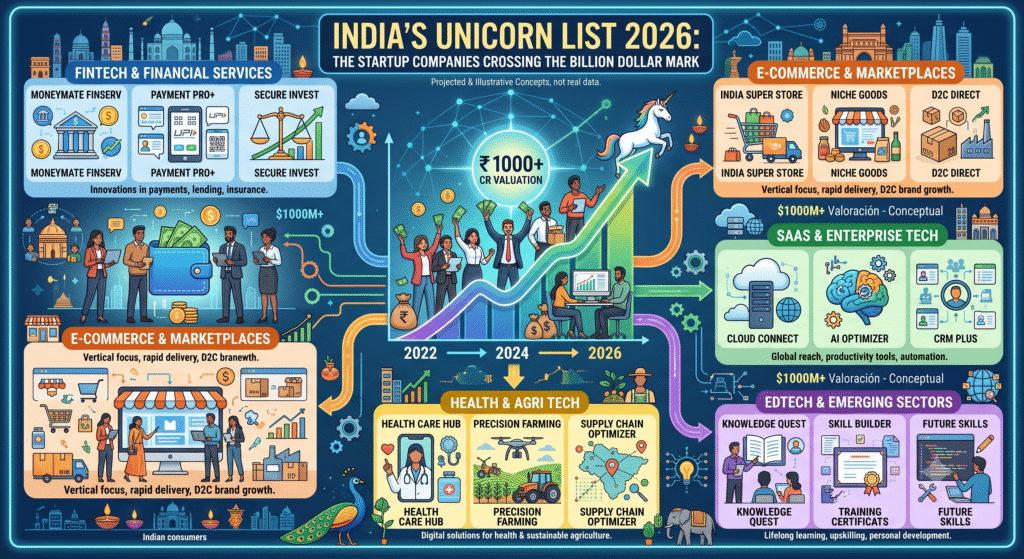
India’s startup ecosystem has evolved into one of the world’s largest markets for venture-backed businesses. Over the past decade, companies in fintech, e-commerce, SaaS, mobility, healthcare, logistics, and consumer technology have transformed from early-stage ventures into billion-dollar businesses.
A key milestone in that journey is unicorn status, a private startup valuation of at least $1 billion. India’s unicorn landscape in 2026 reflects not only the strength of its technology sector but also the changing priorities of investors, founders,, and consumers.
What Makes a Unicorn?
A unicorn is generally defined as a privately held startup valued at $1 billion or more.
The valuation typically comes from a funding round or another private-market transaction rather than from a stock-market price. This distinction is important because a unicorn valuation can change substantially when a company raises its next round or enters the public markets.
India’s unicorns now span a much broader range of industries than the original technology-focused startup wave.
Fintech Remains a Major Force
Financial technology continues to account for a significant portion of India’s unicorn ecosystem.
Digital payments, lending, insurance, wealth management, and banking technology have attracted substantial venture capital as millions of Indian consumers and businesses have shifted toward digital financial services.
Companies such as PhonePe, Razorpay, CRED, Groww, and others have demonstrated how technology can address large financial markets.
The sector has also matured. Investors are increasingly examining profitability, regulatory compliance, lending quality, and customer economics alongside user growth.
Ecommerce and Consumer Startups
E-commerce remains another major pillar of India’s unicorn landscape.
Businesses have emerged across online marketplaces, fashion, beauty, grocery, direct-to-consumer products, and specialized commerce platforms.
Companies such as Meesho, Lenskart, Nykaa, and other large consumer businesses have shown how India’s expanding internet population can support enormous digital marketplaces and brands.
The challenge for these businesses is increasingly shifting from acquiring customers to retaining them profitably.
SaaS Goes Global
Indian software startups have increasingly built businesses for international customers.
The SaaS sector has produced several unicorns and high-value technology companies serving enterprises across North America, Europe, and other global markets.
Freshworks helped establish the possibility of building a major global software company from India, while newer businesses have expanded into cybersecurity, developer tools, automation, artificial intelligence, and enterprise infrastructure.
For these companies, international revenue can reduce dependence on the domestic market while creating opportunities to compete directly with global software providers.
Mobility and Logistics
India’s complex transportation and delivery networks have created another major opportunity for startups.
Ride-hailing, electric mobility, fleet technology, logistics, and last-mile delivery companies have attracted significant capital as consumers and businesses increasingly expect faster and more convenient services.
The sector, however, remains capital-intensive. Fleet costs, fuel or charging infrastructure, driver economics, and intense competition can significantly affect profitability.
Healthtech and Education
Healthcare technology has also become an important part of India’s startup story.
Digital healthcare platforms have expanded access to consultations, diagnostics, medicines, and specialized services. Meanwhile, education technology experienced extraordinary investor interest before entering a period of restructuring and greater financial scrutiny.
The experience of edtech demonstrated that rapid user growth does not automatically translate into a sustainable business model.
AI Creates a New Pipeline
Artificial intelligence is becoming increasingly important to the next generation of Indian startups.
Businesses are emerging around AI infrastructure, enterprise automation, developer tools, customer service, cybersecurity, and specialized applications.
Unlike earlier startup cycles, the AI wave is closely connected to global markets. Indian founders can potentially build products for international customers from the beginning, particularly in software and enterprise technology.
From Unicorn to Public Company
Unicorn status is not necessarily the final destination.
Several Indian startups have already moved from private markets to public markets, creating a pathway from venture-backed companies to publicly traded enterprises.
For other unicorns, the next stage may involve larger private funding rounds, strategic acquisitions, or eventual IPO preparations.
The transition can require stronger governance, predictable financial reporting, and greater focus on sustainable earnings.
What the 2026 List Reveals
India’s unicorn landscape in 2026 reflects a startup ecosystem that is considerably more diverse than it was a decade ago.
The defining businesses are no longer limited to consumer internet companies. Financial technology, enterprise software, healthcare, mobility, logistics, e-commerce, and artificial intelligence are all contributing to the country’s billion-dollar startup universe.
At the same time, unicorn status should be viewed as a milestone rather than a guarantee of long-term success. Private valuations can rise or fall, business models can change, and companies can ultimately move toward an IPO, acquisition, or restructuring.
The 2026 unicorn list therefore offers more than a collection of billion-dollar names. It provides a snapshot of where Indian entrepreneurship, technology, and private capital have created the greatest concentration of value and where the next generation of billion-dollar companies could emerge.