
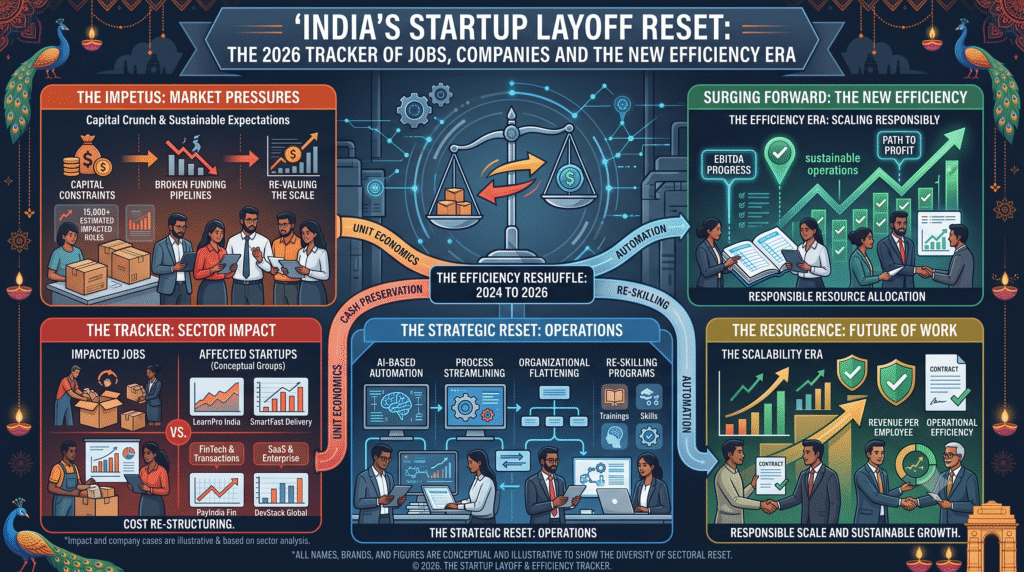
India’s startup ecosystem entered 2026 with a very different priority from the hiring frenzy of the previous decade. Growth at any cost has increasingly given way to profitability, automation and leaner operating structures, and that transition is showing up in employee numbers.
Data compiled from reported layoff events indicates that thousands of jobs have been cut across Indian technology and startup companies in 2026, with roughly 4,700 India based technology jobs captured across 25 tracked events by September. The figure is a floor because many companies do not publicly disclose the exact number of affected employees.
Q1 Starts With Major Cuts
The first quarter immediately highlighted the change in strategy.
Livspace, Flipkart and Zupee together accounted for roughly 1,700 layoffs during Q1 2026, compared with about 1,100 across three companies during the same period a year earlier.
Livspace was responsible for the largest portion, cutting close to 1,000 positions, or around 12% of its workforce. The company described the move as part of its transition towards an AI native organisation rather than simply a cost cutting exercise.
Livspace Leads the Wave
Livspace’s restructuring became one of the year’s most significant startup workforce reductions.
The home interiors platform said it was reorganising teams around AI and agentic technology. The move reflects a wider pattern: startups are increasingly asking whether technology can allow smaller teams to produce the same or greater output.
That represents a significant change from the earlier startup model, where rapid hiring was often treated as evidence of expansion.
Zupee and Gaming Under Pressure
Gaming has also faced considerable workforce pressure.
Zupee implemented significant job reductions during the year as India’s real money gaming industry continued to deal with regulatory and taxation challenges.
The gaming sector has experienced a particularly difficult environment as companies adjust their business models, control marketing expenditure and reassess customer acquisition economics.
Paytm Restructures Again
Fintech remains another important part of the 2026 layoff story.
Paytm undertook another workforce restructuring, with around 400 jobs reported affected in June. The company has simultaneously continued hiring in selected areas, illustrating an increasingly common pattern: layoffs are not necessarily a complete withdrawal from hiring but can represent a shift toward different skills and functions.
Krutrim Cuts as AI Strategy Changes
AI startup Krutrim also became part of the tracker.
The company reportedly conducted another round of layoffs in July, affecting around 20 employees. The cuts came after changes to its original AI strategy, including a greater focus on AI infrastructure and enterprise services.
Krutrim’s restructuring illustrates an unusual feature of the 2026 market: even AI companies are not immune from workforce reductions as investors and founders reassess where the strongest commercial opportunities lie.
SuperOps and Pocket FM
SaaS and digital media have also experienced restructuring.
Chennai based SuperOps reportedly cut around 60 employees, representing roughly 30% of its workforce, as it moved toward an AI first model.
Pocket FM also reportedly reduced its workforce by around 10%, reflecting continued pressure on digital content businesses to balance user growth with sustainable economics.
AI Is Changing the Layoff Equation
AI is increasingly appearing in explanations for workforce restructuring.
The objective is not always simply to eliminate jobs. Companies are redesigning teams around automation, AI assisted development, customer service tools and more specialised technical roles.
This means some traditional roles are shrinking while demand is growing for AI engineering, data, cybersecurity, cloud infrastructure and specialised product talent.
The Numbers Need Context
Layoff trackers should not be interpreted as a complete census of job losses.
Many startups conduct confidential restructuring exercises, offer voluntary exits or reduce contractor numbers without announcing the figures publicly. Conversely, some reported numbers are estimates rather than company confirmed totals.
The available data therefore represents reported layoffs, not every job lost in India’s startup ecosystem.
From Growth to Efficiency
The larger story behind the 2026 layoffs is the changing startup philosophy.
During the funding boom, startups often prioritised market share and employee growth. After the funding reset, the emphasis shifted toward unit economics, profitability and cash preservation.
Now AI is adding another layer: companies are asking how much work can be accomplished with smaller, more technology enabled teams.
The New Startup Workforce
India’s startup job market is therefore not disappearing. It is being reshaped.
The strongest demand is increasingly concentrated around AI, engineering, product, data, cybersecurity, cloud and revenue generating functions, while repetitive operational roles face greater pressure.
The 2026 layoff tracker ultimately tells a story larger than job cuts. It marks the transition of India’s startup ecosystem from growth fast to growth efficiently.
For employees, founders and investors alike, the new question is no longer simply how quickly a startup can build a large team.
It is how effectively a smaller, smarter team can build a sustainable company.