
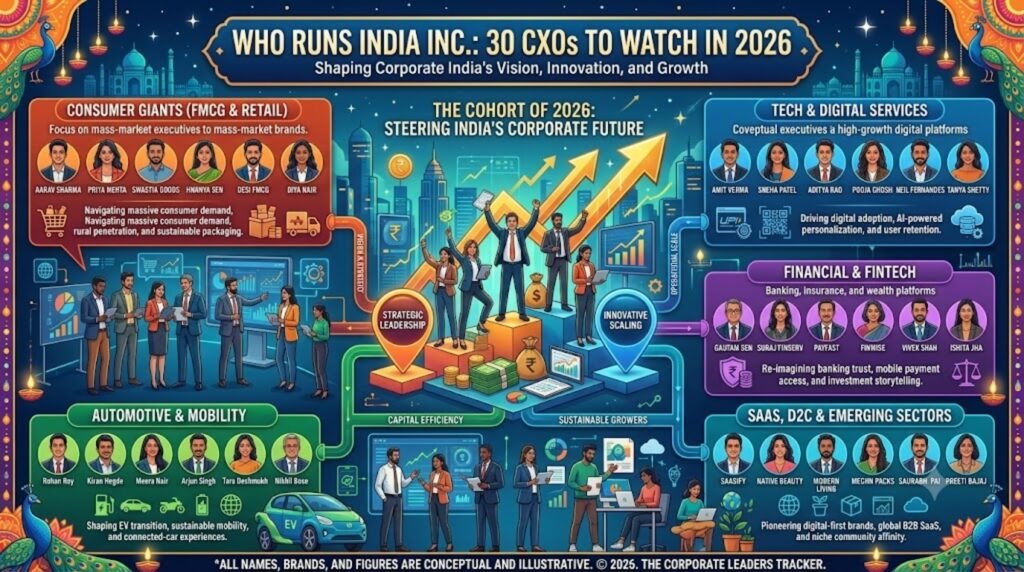
India Inc.’s leadership map in 2026 reflects a business environment being reshaped by artificial intelligence, digitalisation, global expansion, consumer growth, electric mobility, and tighter financial discipline.
The most closely watched executives are no longer responsible for only one function. CEOs are making technology decisions, technology chiefs are influencing business strategy, and finance leaders are increasingly involved in acquisitions, fundraising, and transformation.
Here are 30 named leaders whose decisions are particularly relevant to the direction of Indian business in 2026.
Technology and IT Services
1. Salil Parekh—CEO & MD, Infosys
Parekh is responsible for Infosys’ global IT services business, with artificial intelligence, cloud transformation, and large enterprise technology spending among the key areas shaping the company’s growth strategy. His challenge is to convert the AI boom into sustainable technology-services revenue.
2. C. Vijayakumar—CEO & MD, HCLTech
Vijayakumar leads HCLTech’s global technology services operations. His focus includes AI-led services, engineering and research, cloud transformation, and helping large enterprises modernise their technology infrastructure.
3. Mohit Joshi—CEO & MD, Tech Mahindra
Joshi is leading Tech Mahindra’s efforts to improve growth and profitability while expanding its role in digital transformation, artificial intelligence, telecom technology, and enterprise services.
4. Sandeep Kalra—CEO & Executive Director, Persistent Systems
Kalra leads Persistent Systems, a company focused on digital engineering, cloud, data, and enterprise modernisation. The company’s ability to capture AI-driven technology spending is a major growth opportunity.
5. Debashis Chatterjee—CEO & MD, LTIMindtree
Chatterjee heads LTIMindtree, where enterprise cloud migration, data, AI, and digital transformation are central to the company’s relationship with global clients.
Banking and Financial Services
6. Anup Bagchi—MD & CEO, HDFC Bank
Bagchi is taking over as HDFC Bank’s managing director and CEO in October 2026. His mandate comes at a critical point for India’s largest private-sector bank, with priorities including growth, technology-led banking, operational efficiency, and maintaining asset quality.
7. Sandeep Bakhshi—MD & CEO, ICICI Bank
Bakhshi has overseen ICICI Bank’s transformation toward a more diversified retail and digital banking model. His leadership remains focused on balancing loan growth, profitability, technology investment, and credit quality.
8. Amitabh Chaudhry—MD & CEO, Axis Bank
Chaudhry is responsible for Axis Bank’s retail, corporate, and digital banking expansion. The bank’s technology investments, customer acquisition, and ability to grow while maintaining financial discipline remain key areas to watch.
9. Sumant Kathpalia—MD & CEO, IndusInd Bank
Kathpalia’s leadership is centred on rebuilding confidence, strengthening the bank’s balance sheet, and maintaining customer relationships while navigating challenges in India’s competitive private-banking market.
10. Vibha Padalkar—MD & CEO, HDFC Life
Padalkar leads HDFC Life, one of India’s major private life insurers. Her focus includes expanding insurance penetration, strengthening distribution, and using technology to improve customer acquisition and servicing.
Conglomerates and Diversified Businesses
11. N. Chandrasekaran — Executive Chairman, Tata Sons
Chandrasekaran oversees the strategic direction of the Tata Group, whose businesses range from technology and automobiles to aviation, retail, and electronics. His leadership is closely tied to the group’s expansion in manufacturing and high-technology industries.
12. Mukesh Ambani—Chairman & Managing Director, Reliance Industries
Ambani oversees Reliance’s businesses in energy, telecommunications, retail, and digital services. The group’s continued investment in consumer platforms, technology, and new-energy businesses makes his strategic decisions particularly significant.
13. Gautam Adani—Chairman, Adani Group
Adani heads a conglomerate with major interests in ports, airports, energy, logistics, and infrastructure. Capital allocation and the expansion of physical infrastructure remain central to the group’s strategy.
14. Anish Shah—Group CEO & MD, Mahindra Group
Shah oversees Mahindra’s diversified portfolio, with automobiles and farm equipment forming major businesses alongside technology and financial services. Electric vehicles, premium SUVs, and international expansion are key areas to watch.
15. Sanjiv Puri—Chairman & MD, ITC
Puri leads ITC across cigarettes, packaged foods, hotels, paperboards, agriculture, and other businesses. His strategy involves reducing dependence on traditional tobacco while expanding ITC’s consumer and hospitality businesses.
Automotive and Consumer
16. Hisashi Takeuchi—MD & CEO, Maruti Suzuki India
Takeuchi leads India’s largest passenger-vehicle manufacturer at a crucial point for the automobile industry. Maruti’s response to electric vehicles, SUV demand, hybrid technology, exports, and changing customer preferences will be closely watched.
17. Sudarshan Venu—Managing Director, TVS Motor Company
Venu is responsible for TVS Motor’s expansion across motorcycles, scooters, and electric mobility. International growth and the development of connected and electric vehicles are important elements of the company’s strategy.
18. Rajiv Bajaj — Managing Director, Bajaj Auto
Bajaj leads the company’s motorcycle and three-wheeler business while overseeing its response to electric mobility and international competition. Bajaj Auto’s electric portfolio and overseas markets remain key growth areas.
19. Sunil D’Souza—MD & CEO, Tata Consumer Products
D’Souza heads Tata Consumer Products, whose portfolio includes beverages, packaged foods, and consumer brands. Expanding the company’s branded-food portfolio and increasing household penetration are central to its growth strategy.
20. Radhika Gupta—MD & CEO, Edelweiss Mutual Fund
Gupta leads Edelweiss Mutual Fund and has become a prominent figure in India’s asset-management industry. Her role is particularly relevant as mutual-fund participation expands beyond traditional investors and becomes more digitally driven.
New-Age Companies
21. Sameer Nigam—Founder & CEO, PhonePe
Nigam leads PhonePe, one of India’s largest digital payments platforms. The company’s expansion from payments into financial services and other digital offerings makes its ability to diversify beyond its core payments business a major focus.
22. Harshil Mathur—Co-founder & CEO, Razorpay
Mathur heads Razorpay, which provides payment and financial infrastructure to businesses. Its opportunity lies in moving deeper into business banking, payments, financial operations, and other enterprise-fintech services.
23. Vidit Aatrey—Co-founder & CEO, Meesho
Aatrey leads Meesho’s value-focused e-commerce marketplace, which targets consumers and sellers beyond India’s largest cities. Scaling transactions while maintaining sustainable economics is central to the company’s next phase.
24. Sriharsha Majety—Co-founder & Group CEO, Swiggy
Majety oversees Swiggy’s food-delivery business and its expansion into convenience-led services. The key leadership challenge is balancing rapid expansion with improving unit economics and building multiple sustainable revenue streams.
25. Kunal Bahl—Co-founder, Snapdeal; Co-founder, Titan Capital
Bahl combines operating experience in e-commerce with venture investing through Titan Capital. His role gives him exposure to both the established internet economy and the next generation of Indian startups.
Digital Economy and Entrepreneurship
26. Naveen Tewari—Founder & CEO, InMobi
Tewari built InMobi into a global mobile-advertising technology company. His leadership is relevant to the evolution of advertising technology as mobile usage, data, and artificial intelligence reshape digital marketing.
27. Bhavin Turakhia—Technology Entrepreneur and Founder
Turakhia has built technology businesses across internet infrastructure, software, and financial technology. His career reflects the transition of Indian entrepreneurs from domestic internet businesses toward globally orientated technology companies.
28. Nithin Kamath—Founder & CEO, Zerodha
Kamath leads Zerodha, one of India’s largest discount-broking platforms. The company has played a major role in expanding technology-led retail participation in equities and other financial markets.
29. Sairee Chahal—Founder, SHEROES
Chahal founded SHEROES as a digital community and support platform for women. Her work remains connected to the growth of online communities, professional networks, and digital services designed around women users.
30. Phanindra Sama—Founder, RedBus
Sama founded RedBus and helped demonstrate how an offline-heavy Indian travel market could be transformed through online ticketing. His entrepreneurial journey remains an important case study in India’s early internet economy.
What These Leaders Reveal
The 30 executives represent very different companies, but their priorities increasingly overlap.
Technology leaders are being pushed to deliver measurable business outcomes from AI. Bank chiefs are balancing digital growth with risk. Automotive executives are navigating electrification and changing consumer demand. Consumer companies are looking for new growth categories, while startup founders are moving from user acquisition toward sustainable economics.
The defining feature of India Inc. in 2026 is therefore not simply who occupies the corner office.
It is what those leaders are being asked to deliver.
Growth must increasingly come with profitability. Technology investment must produce measurable returns. Expansion must be supported by stronger governance, and companies must prepare for customers and competitors that are becoming increasingly digital.
That makes the CXO landscape an important indicator of where Indian business is heading next.