
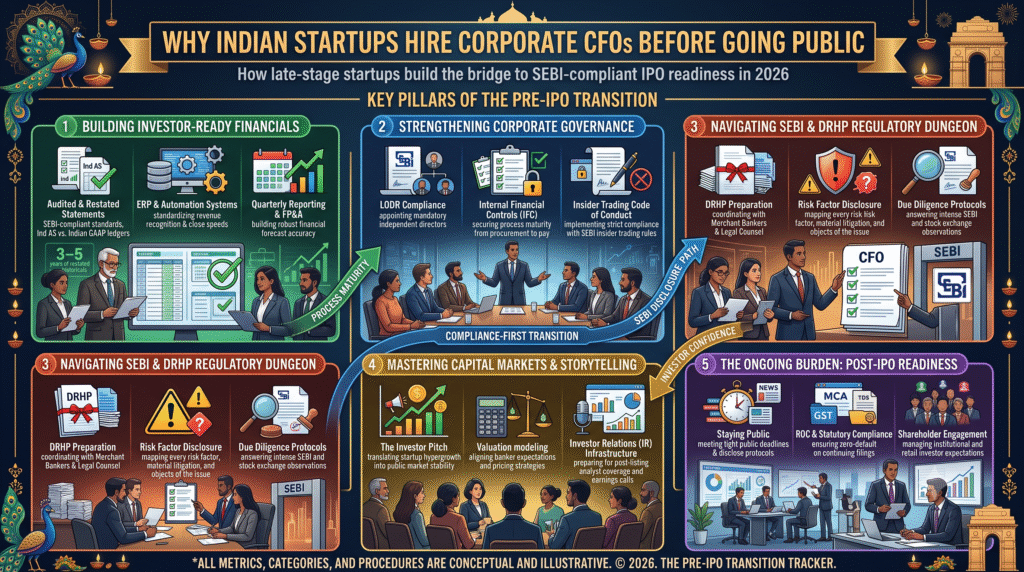
For Indian startups, preparing for an initial public offering is about far more than selecting investment bankers and deciding how much money to raise. Before a company can convincingly present itself to public-market investors, it must demonstrate that its financial reporting is reliable, its reporting systems are robust, and its business model can withstand sustained scrutiny.
That is why many startups approaching an IPO strengthen their finance departments by hiring experienced chief financial officers (CFOs), often executives with backgrounds in listed companies, large corporations, or investment banking.
The transition signals a fundamental change: a startup must evolve from a fast-growing private business into a company prepared for public accountability.
From Fundraising to Financial Discipline
During their early years, startups often prioritize product development, customer acquisition and revenue growth. Finance teams may focus primarily on cash flow, fundraising requirements, budgets, and investor updates.
As the business scales, these responsibilities become more complex. Multiple subsidiaries, international operations, employee stock options, acquisitions, and different revenue streams can make financial reporting significantly more demanding.
An experienced CFO brings structure to this complexity. The role includes building reliable reporting processes, strengthening internal controls, managing working capital, and ensuring that management decisions are supported by accurate financial information.
For a startup preparing to list, these systems need to be established well before the IPO process reaches its final stages.
Making the Books Investor-Ready
Public-market investors need to understand how a company earns money, where it spends capital, and whether its reported performance reflects the underlying business.
A corporate CFO typically works with finance teams and external auditors to improve the quality and consistency of financial statements.
This may involve reviewing revenue recognition, expense classification, related-party transactions, subsidiary accounts, and the treatment of exceptional items.
The objective is not merely to make the numbers look attractive. It is to ensure that investors can interpret the company’s financial position accurately.
Any unresolved accounting issue can complicate due diligence, invite regulatory questions, or undermine investor confidence. The Ministry of Corporate Affairs provides information on Indian company law and corporate reporting requirements.
The DRHP Test
A major milestone in an Indian IPO is the preparation of the Draft Red Herring Prospectus, or DRHP, when the company follows the applicable public-issue filing route.
The document contains extensive information about the business, financial performance, risks, ownership, and proposed offering.
The CFO is central to ensuring that financial disclosures are complete, consistent, and supported by appropriate documentation. This work involves close coordination with legal advisers, auditors, investment bankers, and other senior executives.
The Securities and Exchange Board of India (SEBI) sets the regulatory framework for public issues, including disclosure requirements under its Issue of Capital and Disclosure Requirements Regulations.
The CFO also helps management understand which financial trends may attract questions from analysts and investors.
A company experiencing rapid revenue growth, for example, may still face difficult questions if its losses are increasing or its cash generation remains weak.
Profitability Comes Under Scrutiny
Private investors may be willing to support a company for years while it builds market share. Public-market investors can have different expectations, particularly when valuations depend on the prospect of future profits.
This makes profitability, contribution margins, operating expenses, and cash flow central to IPO preparation.
A seasoned CFO can help distinguish between spending that supports sustainable expansion and costs that produce limited long-term value.
The executive may introduce tighter budgeting, improve procurement controls, review business-unit performance, and establish clearer financial targets.
However, the goal is not necessarily to achieve immediate profitability. It is to explain the company’s economics credibly and demonstrate that management understands the path toward sustainable financial performance.
Governance Beyond the Numbers
IPO readiness also requires stronger corporate governance.
As a company approaches listing, its board structures, approval procedures, compliance systems, and disclosure practices receive greater attention.
The CFO often works with the CEO, board, and legal team to establish clear financial authority, improve documentation, and ensure that significant transactions receive appropriate review.
This becomes especially important when a startup has complex promoter holdings, multiple subsidiaries, related-party arrangements, or significant employee stock-option obligations.
The Companies Act, 2013 provides the legal foundation for corporate governance, financial reporting and directors’ responsibilities in India.
Strong governance reduces the risk that operational shortcuts become public-market problems.
Managing Cash and Investor Expectations
A public offering involves decisions about valuation, issue size, use of proceeds, and the company’s financial outlook.
The CFO helps management build forecasts and assess how much capital the business needs. The executive may also evaluate whether funds should support expansion, technology investment, debt repayment, acquisitions, or working capital.
During investor meetings, the CFO can explain the assumptions behind financial projections and respond to questions about margins, costs, and cash generation.
Credibility matters. Overly ambitious projections can create expectations that become difficult to meet after listing.
Why Corporate Experience Matters
Startups frequently seek CFOs who have worked in large companies or navigated public-market reporting.
Such executives may bring experience in audit committees, regulatory disclosures, capital allocation, investor relations, and enterprise-wide financial controls.
But a corporate background alone does not guarantee success. The CFO must also understand the speed, uncertainty, and resource constraints of a startup.
The most effective leaders combine financial discipline with the ability to support innovation and growth.
Not Just an IPO Hire
Hiring a corporate CFO should not be treated as a last-minute compliance exercise.
The role can improve decision-making years before a company lists, helping founders understand cash requirements, unit economics, business risks, and the financial consequences of expansion.
For Indian startups, the appointment often marks a shift from founder-led financial management toward a more institutional operating model.
Ultimately, an IPO-ready company needs more than impressive growth figures. It needs dependable financial reporting, credible governance, and leaders who can explain how the business creates lasting value.
A strong CFO helps build that foundation—making the company better prepared not only to enter the stock market but also to operate under public scrutiny once it gets there.
Further Reading
India Code for the Companies Act, 2013 and other relevant legislation.
SEBI — Official regulatory framework for IPOs, disclosures and public-market compliance.
SEBI — Issue of Capital and Disclosure Requirements Regulations for rules governing public issues and offer documents.
Ministry of Corporate Affairs for company-law requirements, financial reporting and corporate filings.