
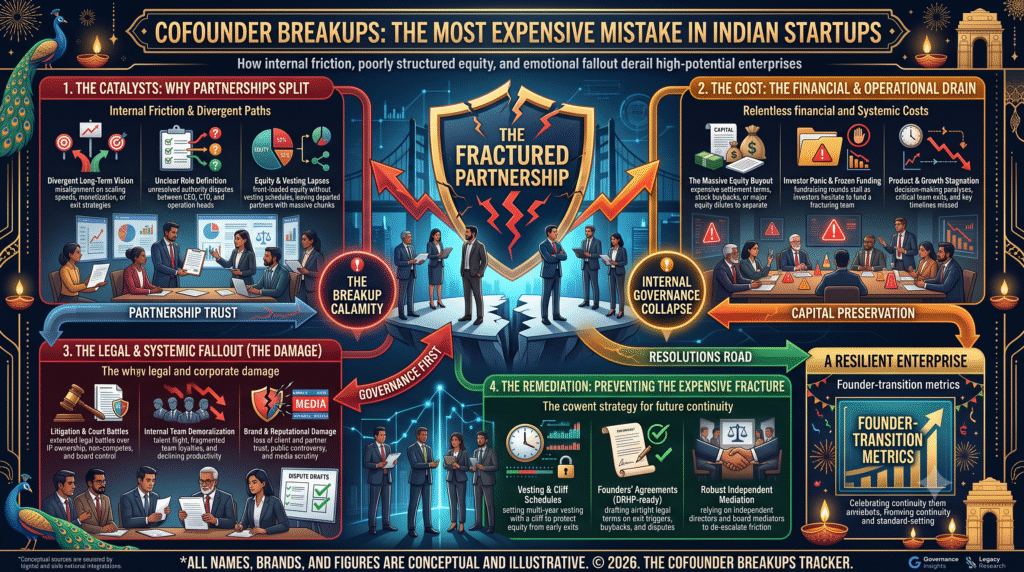
From BharatPe’s public boardroom battle to Zilingo’s leadership crisis, founder disagreements reveal how personal conflicts can become costly business problems.
Every successful startup begins with an idea, but turning that idea into a business often requires more than one person. One founder may understand the market, another may build the technology, and a third may bring the financial discipline needed to scale.
In the early days, trust can make formal agreements seem unnecessary. Responsibilities overlap, decisions happen over informal conversations, and equity is divided on the assumption that everyone will remain equally committed.
The trouble begins when those assumptions change.
Disagreements over strategy, ownership, salaries, fundraising and decision-making can turn a promising startup into a legal and operational battleground. In India’s venture-backed ecosystem, where investors back founding teams as much as business models, a cofounder breakup can damage confidence, delay fundraising and distract the company from its customers.
The most expensive founder conflict is often not the disagreement itself. It is the failure to establish how disagreements will be resolved before the stakes become enormous.
1. BharatPe: When a Founder Dispute Becomes a Corporate Crisis
One of India’s most visible founder conflicts involved BharatPe, cofounder Ashneer Grover and the company’s leadership.
Grover, who helped build the fintech company into a major player in merchant payments, left BharatPe in 2022 following a dispute with the board. The conflict involved allegations concerning governance and financial conduct, which Grover contested.
The dispute continued for more than two years before the parties reached a settlement in 2024. Under the settlement, Grover ceased to be associated with BharatPe, his shares were to be transferred to a family trust, and both sides agreed to withdraw their legal cases.
The episode demonstrates how quickly a disagreement involving a founder can become a matter of corporate governance, shareholder rights and public reputation.
For a growing fintech company, leadership uncertainty can affect employee morale, investor confidence and the ability to concentrate on business priorities. Even when a dispute is eventually settled, the time and attention consumed by it cannot easily be recovered.
2. Zilingo: When Strategic Differences Escalate
Fashion-technology startup Zilingo experienced a prolonged leadership crisis involving cofounders Ankiti Bose and Dhruv Kapoor.
The Singapore-based company built a technology platform serving fashion businesses and supply chains. It attracted significant investor attention and reached a reported valuation of nearly $1 billion in 2019.
However, disagreements between its founders and concerns about the company’s finances eventually became public. Bose was suspended in 2022 amid an investigation into alleged financial irregularities and was subsequently terminated. She disputed aspects of the company’s actions and the allegations against her.
Zilingo’s troubles illustrate how strategic disagreements can become more damaging when combined with questions about financial oversight and internal governance.
The case should not be reduced to a simple story of two founders falling out. The company’s difficulties involved several interconnected issues, including financial scrutiny, leadership decisions and investor confidence. Nevertheless, it shows why businesses need clear processes for addressing serious disagreements before they become public crises.
3. Why Founders Fall Out
Although every dispute has its own circumstances, several recurring causes appear across startup ecosystems.
Unequal effort, equal ownership
Two founders may begin with equal equity, but their contributions can diverge over time. One may work full-time while another takes a less active role. Without agreed vesting arrangements or clear exit provisions, resentment can grow.
Different ambitions for growth
One founder may want to raise large funding rounds and expand aggressively. Another may prefer slower growth, greater control or an earlier path to profitability.
Neither approach is necessarily wrong, but a company cannot operate effectively if its leaders repeatedly undermine one another’s decisions.
Control and decision making
Questions about who appoints executives, approves budgets, controls product direction or represents the company to investors can become contentious.
The risk is particularly high when founders assume that their titles or informal understandings automatically determine their legal authority.
Personal relationships and professional boundaries
Friends and relatives can make excellent business partners, but personal trust does not eliminate the need for written agreements. In fact, founders who know each other well may be more likely to avoid difficult conversations about money and control.
4. The Hidden Financial Cost of a Breakup
The most visible cost of a founder dispute is legal expenditure. The wider damage can be considerably more significant.
- Delayed fundraising: Investors may hesitate while ownership disputes, litigation or leadership uncertainty remain unresolved.
- Employee departures: Senior staff may lose confidence in the company’s direction and begin looking elsewhere.
- Lost execution time: Founders who spend months managing disputes have less time to build products, serve customers and develop revenue.
- Reputational damage: Public disagreements can affect relationships with investors, suppliers, partners and prospective employees.
- Ownership uncertainty: Disputes over equity, intellectual property or board authority can complicate transactions and strategic decisions.
These costs are not always reported as a single figure, making it difficult to calculate the financial impact of founder breakups across India’s startup ecosystem. But they can affect a company’s value long after the original disagreement has ended.
5. The Paperwork Founders Should Never Ignore
A founder agreement is not a prediction that a partnership will fail. It is a mechanism for protecting the company if circumstances change.
Before raising significant capital, founders should establish clear rules covering equity ownership, vesting, responsibilities, intellectual property, decision-making and exit procedures.
A practical agreement should address:
- Equity and vesting: How ownership is earned over time and what happens when a founder leaves early.
- Roles and responsibilities: Who leads product, technology, sales, finance and operations.
- Decision rights: Which decisions require agreement from all founders, the board or a designated executive.
- Deadlock resolution: How disagreements are escalated, mediated or resolved when neither founder will compromise.
- Exit and buyout terms: How shares are valued and transferred when a founder departs.
- Intellectual property: Ensuring the company has appropriate rights to its software, designs, trademarks and other assets.
Indian startups should have these documents reviewed by qualified legal professionals, with the terms aligned to their company structure, shareholder agreements and applicable law. A generic template may not address the circumstances of a particular business.
6. Investors Also Have a Role to Play
Founder conflicts are not solely a problem for entrepreneurs. Investors can influence how disagreements are managed through board composition, governance arrangements and the terms they negotiate during funding rounds.
Good governance does not mean allowing investors to dictate every operational decision. It means ensuring that authority is clear, financial reporting is reliable and disagreements have a structured path to resolution.
Investors should also examine whether a startup depends excessively on one founder, whether responsibilities are clearly divided and whether the leadership team can continue operating if a founder leaves.
A company that can survive a difficult leadership transition is generally better prepared for the uncertainties of growth.
The Final Lesson: Trust Needs Structure
Cofounder disagreements are not always fatal. Some startups survive leadership changes, redistribute responsibilities and emerge with stronger management systems. Others struggle because personal conflict becomes inseparable from the company’s ownership and operations.
BharatPe and Zilingo demonstrate different ways that founder tensions can intersect with governance, financial scrutiny and investor confidence. Their histories also underline the importance of distinguishing allegations from established findings rather than assuming that one party is automatically responsible for every problem.
For aspiring entrepreneurs, the lesson is straightforward: discuss difficult questions while the relationship is still healthy. Decide who owns what, who makes which decisions and what happens if someone wants to leave.
A strong founder partnership is not one in which disagreements never happen. It is one in which disagreements cannot easily destroy the company both founders worked to build.