
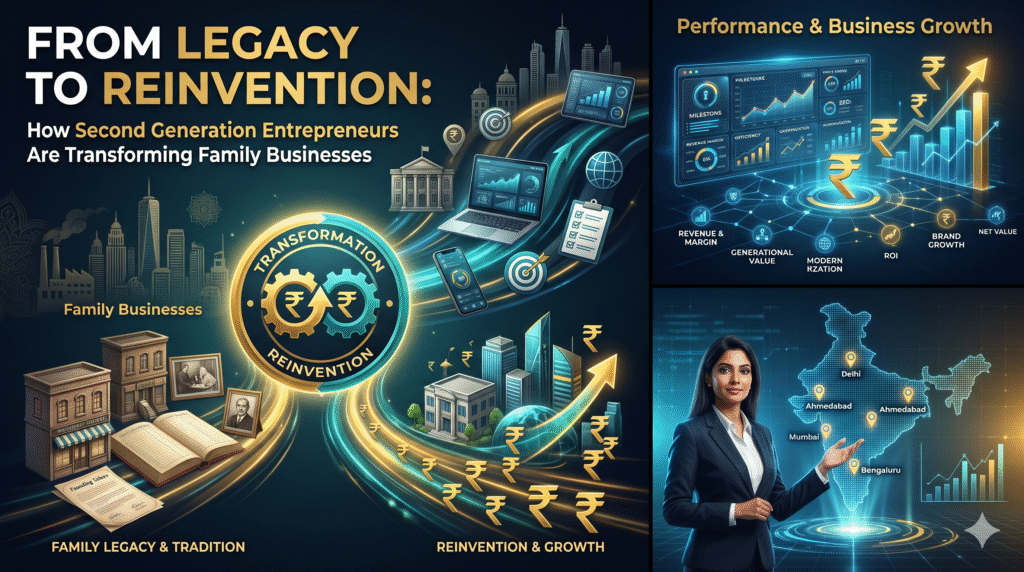
For India’s next generation of business owners, inheriting a company is only the beginning. The real challenge is preserving its strengths while preparing it for a changing market.
India’s family businesses have long played an important role in manufacturing, retail, distribution, textiles and services. Many were built over decades through personal relationships, customer loyalty and an intimate understanding of local markets. Today, a new generation is stepping into these businesses with a different ambition: not simply to maintain what their families created, but to rebuild it for the future.
Second-generation entrepreneurship involves balancing two responsibilities—respecting an established legacy and challenging the practices that may prevent a business from growing.
The Weight of an Established Legacy
Taking over a family business can provide advantages that first-time entrepreneurs often lack. An existing company may already have customers, suppliers, employees, physical assets and a recognised name. These foundations can reduce some of the uncertainty associated with starting from scratch.
However, an established business can also carry outdated systems, informal decision-making and resistance to change. Processes that worked when a company served a small local market may become inefficient as it expands.
The incoming generation must identify which parts of the legacy create genuine value and which need to evolve.
Moving from Traditional Operations to Modern Systems
One of the most important changes involves professionalising operations. Family businesses may depend heavily on spreadsheets, manual records or decisions made through informal conversations.
Second-generation leaders can introduce accounting software, inventory management systems, customer relationship tools and standardised reporting. Better data helps businesses understand cash flow, track performance and identify problems before they become expensive.
Digital transformation should not mean purchasing technology simply because competitors are doing so. The objective is to solve specific operational problems and improve measurable outcomes.
For eligible businesses seeking support and information, the official Ministry of Micro, Small and Medium Enterprises website provides resources relevant to India’s MSME ecosystem.
Building a Brand Beyond Personal Relationships
Traditional businesses often grow through trust built between founders and customers. The next generation must preserve that trust while creating a brand that can reach a wider audience.
This may involve developing a professional website, improving packaging, introducing consistent branding, using digital marketing and selling through online channels. Businesses can also explore marketplaces and direct-to-consumer models when these fit their products and economics.
The challenge is to modernise without losing the qualities that made customers loyal in the first place. A family-owned manufacturer, for example, may differentiate itself through reliability, product knowledge and service rather than competing only on price.
Professionalising the Family Structure
Business succession is not only an operational issue; it is also a question of governance. Family members may have different expectations about ownership, leadership, salaries and the company’s future direction.
Clearly defined roles, documented decision-making processes and transparent financial reporting can reduce misunderstandings. In larger businesses, independent advisers or professional managers may help introduce accountability and provide perspectives beyond the family.
Founders and successors should also discuss succession timelines, ownership arrangements and contingency plans before a crisis forces difficult decisions.
The official Ministry of Corporate Affairs website provides access to company-related filings and regulatory information that can help businesses understand their formal obligations.
Innovation Without Losing Identity
Rebuilding a family business does not always require entering an entirely new industry. Growth may come from improving an existing product, entering new regions, developing complementary services or serving a different customer segment.
Second-generation leaders should test new ideas carefully, using customer feedback and small experiments before committing substantial capital. Preserving a profitable core business can provide the stability needed to explore new opportunities.
They must also recognise that inherited reputation is not a substitute for execution. Customers continue to expect quality, competitive pricing and dependable service, regardless of who runs the company.
The Future of Family Entrepreneurship
India’s second-generation entrepreneurs face a distinctive opportunity: they can combine the experience and relationships accumulated by earlier generations with modern technology, professional management and fresh market thinking.
The strongest successors will neither reject tradition automatically nor preserve every old practice unquestioningly. They will understand why the business succeeded, identify what customers need today and build systems that make future growth possible.
Ultimately, inheriting a business provides a starting advantage not a guarantee of success. The real achievement is turning a family legacy into a stronger, more adaptable enterprise that can serve customers and create value for the next generation.