
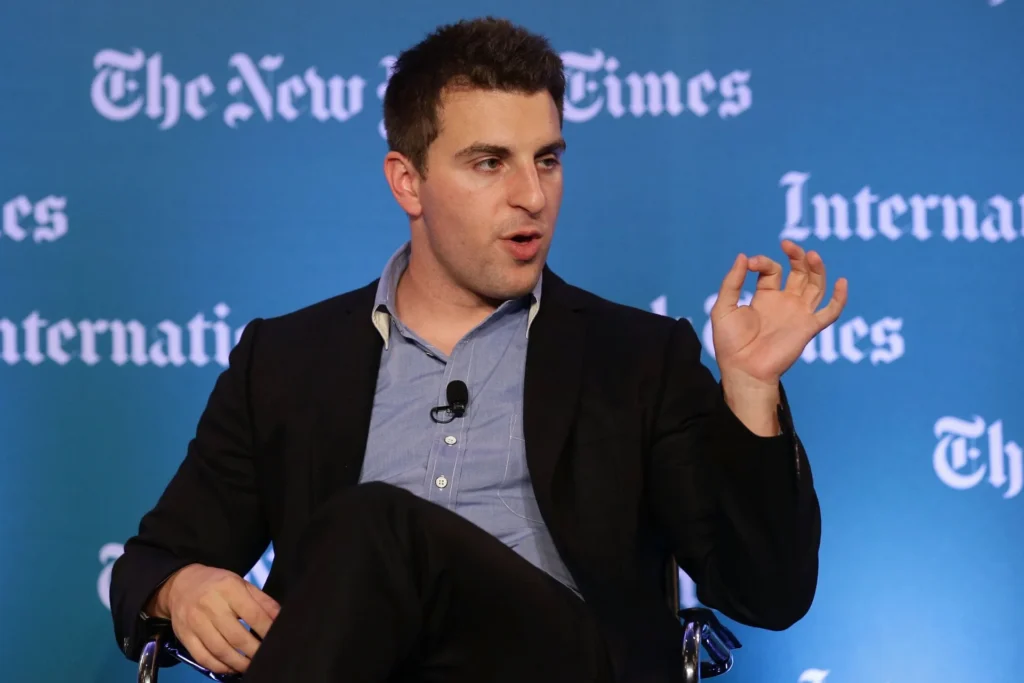
Airbnb began with an apartment, a few air mattresses and a financial problem. Its journey shows how an ordinary challenge can inspire a business that changes the way people travel.
An Idea Born From Financial Pressure
In 2007, Brian Chesky was living in San Francisco with his friend Joe Gebbia. Both were designers trying to establish themselves professionally, and paying rent had become a challenge.
When a design conference brought visitors to San Francisco and accommodation became difficult to find, the pair spotted an opportunity. They decided to offer visitors a place to stay in their apartment, using air mattresses and providing breakfast.
The concept was simple: people could earn money by sharing their homes, while travellers could find accommodation beyond traditional hotels.
That experiment became the foundation of Airbnb. Chesky’s journey from design graduate to entrepreneur is documented in the company’s official leadership profile.
From Air Mattresses to a Business Model
The founders initially called their idea Airbed & Breakfast. In October 2007, Chesky and Gebbia welcomed their first guests into their San Francisco home.
However, turning the experiment into a scalable business required more than providing sleeping space. They needed a website that connected hosts with travellers, enabled bookings and helped strangers feel comfortable staying in one another’s homes.
Nathan Blecharczyk, a software engineer, joined the founding team, bringing the technical expertise needed to develop the platform.
In March 2008, Airbed & Breakfast officially launched during the South by Southwest festival. The launch produced only two bookings, demonstrating how difficult it was to attract users to a new concept.
The founders continued refining the business and expanding their efforts to reach customers. In 2009, they shortened the company’s name to Airbnb as the platform expanded beyond air mattresses to include entire apartments, houses and other accommodation.
The Challenge of Building Trust
Airbnb faced a fundamental challenge: would people really allow strangers into their homes, and would travellers feel safe staying there?
Traditional accommodation businesses offered established systems for reservations and customer service. Airbnb needed to build confidence in a different model based on individual hosts and their properties.
The company developed profiles, reviews, booking systems and other features intended to make transactions more transparent. These elements helped users evaluate their options and gradually build confidence in the platform.
Chesky and his co-founders also recognised that the experience of hosting mattered as much as the technology connecting people.
Airbnb’s official company history describes how the business grew from its first three guests into a global hosting community.
Turning a Small Experiment Into a Global Platform
Airbnb’s growth required the founders to expand beyond their original assumptions. Instead of treating the business as a way to rent spare mattresses, they built a marketplace for different types of accommodation.
The company attracted investment, expanded internationally and continued developing its technology and services. Its model allowed individual property owners to participate in the travel economy without operating traditional hotels.
That approach also created new challenges, including customer support, property standards, local regulations and the need to balance the interests of hosts, guests and communities.
As chief executive, Chesky had to move beyond product design and learn to lead a rapidly expanding global organisation.
His background in design remained relevant: understanding user experiences became central to how the company approached its platform and brand.
Lessons for Aspiring Founders
Brian Chesky’s story offers three important lessons.
First, business opportunities can emerge from immediate, practical problems. Second, an interesting idea must be supported by a usable product and a system that earns customer trust. Third, founders must be willing to refine their original concept as they learn from the market.
Airbnb did not become a global platform simply because its founders rented out air mattresses. Its growth depended on developing technology, improving the booking experience and building a marketplace that could work at scale.
Final Word
Brian Chesky’s journey demonstrates that entrepreneurship often begins with an experiment rather than a perfect business plan. A temporary solution to a rent problem became the starting point for a company that transformed the accommodation industry.
For aspiring founders, the lasting lesson is to recognise unmet needs, test ideas in the real world and keep improving until a simple solution becomes a business people can trust.