
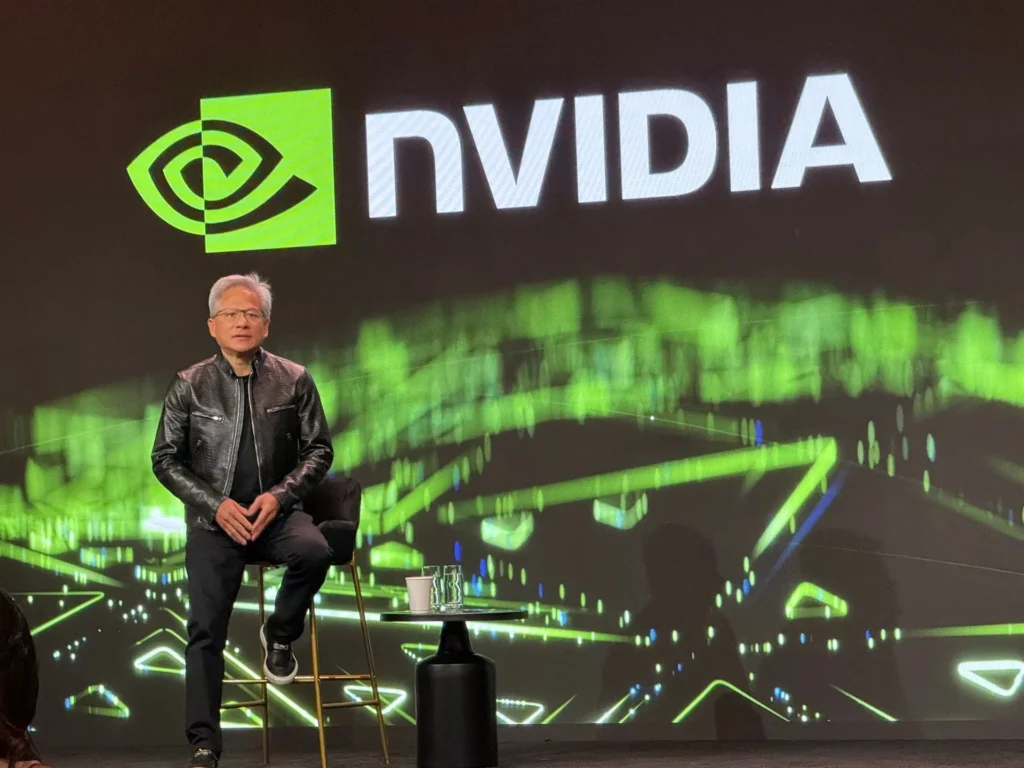
From a small graphics-chip startup to a company at the centre of the artificial intelligence revolution, Jensen Huang’s journey shows how long-term technological bets can reshape entire industries.
A Startup Built on a Bold Idea
In 1993, Jensen Huang joined forces with Chris Malachowsky and Curtis Priem to establish NVIDIA. Their ambition was to develop specialised chips capable of delivering more realistic three-dimensional graphics on personal computers.
At the time, computer graphics presented significant technical challenges. The founders believed that specialised hardware could perform demanding visual calculations more efficiently than relying entirely on conventional processors.
The company began with a focused mission: make computer graphics more powerful and interactive. What the founders could not have known was how far that technology would eventually extend beyond gaming.
According to NVIDIA’s official company history, the company was founded on April 5, 1993, and introduced the graphics processing unit, or GPU, in 1999.
The GPU That Changed the Direction of Computing
NVIDIA’s early business was closely connected to PC graphics and gaming. Its GPUs helped developers create increasingly sophisticated visual experiences, while the company continued investing in chip architecture and software.
However, Huang and his team saw that GPUs could be useful for more than rendering images. Their ability to perform many calculations in parallel made them valuable for scientific computing and other demanding workloads.
A major development arrived in 2006 with CUDA, NVIDIA’s platform for enabling developers to use GPU processing for general-purpose computing.
This decision helped expand the potential market for NVIDIA’s technology. Researchers could use GPUs for complex calculations, while developers gained tools to build applications beyond traditional graphics.
The strategy illustrates an important principle in technology entrepreneurship: a product designed for one market can become the foundation for entirely different industries when its underlying capabilities are applied creatively.
The Unexpected Connection to Artificial Intelligence
Artificial intelligence became one of the most significant applications of GPU computing.
Training advanced AI systems requires enormous amounts of computation. GPUs, supported by specialised software and computing infrastructure, became important tools for researchers developing deep-learning models.
In 2012, the AlexNet neural network demonstrated the potential of deep learning in image recognition, helping accelerate interest in the field. NVIDIA’s official innovation timeline identifies this period as a major milestone in its evolution.
NVIDIA’s opportunity was not created by a single product announcement. It emerged from years of investment in hardware, software and developer tools before modern generative AI became mainstream.
Building an Ecosystem, Not Just a Chip Company
One reason NVIDIA became influential in AI computing was its broader technology ecosystem. GPUs alone were not enough; developers also needed programming tools, compatible systems and infrastructure capable of supporting demanding workloads.
CUDA and NVIDIA’s wider software platforms helped create an environment in which developers could build applications around its hardware.
The company subsequently expanded into data-centre computing, robotics, automotive technology and other fields. Its evolution is documented on the official NVIDIA website.
For founders, the lesson is significant: creating a strong product can open a market, but building tools and infrastructure around it can make the business more useful to customers over time.
The Risks of Thinking Long Term
NVIDIA’s journey was not simply a matter of predicting the future correctly. Semiconductor development requires substantial research investment, engineering expertise and complex manufacturing partnerships. Technology markets also change, and products can become outdated as competitors introduce alternatives.
Huang’s leadership has involved continuing to invest in computing platforms while adapting to new applications and customer demands.
His professional background includes engineering degrees from Oregon State University and Stanford University, as detailed in NVIDIA’s official Jensen Huang biography.
Lessons for Aspiring Tech Founders
Jensen Huang’s story offers three valuable lessons.
First, foundational technology can create opportunities far beyond its original purpose. Second, long-term investment in software and developer communities can strengthen a hardware business. Third, successful founders must keep adapting as new markets emerge.
NVIDIA began by pursuing better computer graphics. Its wider impact came from recognising that the same computing technology could solve much larger problems.
For aspiring technology entrepreneurs, the central lesson is not to predict every future trend. It is to build strong technical foundations, invest consistently and remain open to applications that may not yet be obvious.