





India’s startup ecosystem has celebrated billion-dollar valuations, rapid expansion and entrepreneurs challenging established industries. But behind some of its most dramatic growth stories lies a difficult lesson: raising large amounts of capital and expanding quickly do not guarantee a sustainable business.
The crises involving GoMechanic, BharatPe and Singapore-based Zilingo exposed weaknesses in financial reporting, corporate governance and founder accountability. Although their circumstances and outcomes differed, all three cases raised questions about how investors, boards and senior executives monitor fast-growing companies.
Their experiences offer a warning for India’s startup ecosystem: growth must be supported by reliable numbers, transparent decision-making and effective oversight.
GoMechanic: When Growth Outran the Numbers
Founded in 2016, GoMechanic aimed to make vehicle servicing more accessible and affordable by connecting car owners with workshops through a technology-enabled platform.
The company attracted prominent investors, including Sequoia Capital India, Tiger Global and Chiratae Ventures. Its rapid expansion helped position it as a challenger to traditional automobile service networks.
The story changed in January 2023, when co-founder Amit Bhasin publicly acknowledged serious errors in the company’s financial reporting. He said the founders had been carried away by the pursuit of growth and accepted responsibility for their mistakes.
The admission triggered an investor-led review, a major restructuring and plans to lay off approximately 70% of the workforce.
According to Moneycontrol’s investigation into GoMechanic, the episode raised questions about how financial reporting problems had gone undetected during the company’s expansion.
GoMechanic’s business was subsequently acquired by a consortium led by Lifelong Group in a transaction reported in March 2023.
The episode demonstrated how unreliable financial information can undermine investor confidence, disrupt operations and threaten employees even when a startup has a recognisable brand and a substantial customer base.
BharatPe: A Governance Crisis at a Fintech Star
BharatPe built its business around digital payments and financial services for merchants. Its growth reflected the wider expansion of India’s fintech market and the opportunity to serve small businesses through technology.
However, the company became embroiled in a governance controversy in 2022 involving co-founder Ashneer Grover and other senior figures.
An investigation commissioned by BharatPe’s board and conducted by Alvarez & Marsal reportedly identified irregularities involving vendor transactions, invoices and recruitment-related payments. The findings placed pressure on the company’s leadership and contributed to Grover’s departure.
The dispute became one of India’s most closely watched startup governance episodes, highlighting the tension that can arise when founders exercise significant influence over a company’s operations and finances.
The Economic Times’ report on the investigation into BharatPe details the concerns raised during the inquiry.
BharatPe’s case differs from GoMechanic’s: it was not simply a story of a business collapsing after an admission of financial reporting errors. BharatPe continued operating, while the dispute exposed the importance of independent oversight, clearly defined financial controls, and transparent relationships between founders and boards.
Zilingo: A Billion-Dollar Valuation Under Pressure
Zilingo, founded in 2015 by Ankiti Bose and Dhruv Kapoor, sought to use technology to connect fashion businesses and supply chains across Asia. The Singapore-based company attracted international investors and reached a valuation approaching $1 billion in its 2019 funding round.
Its ambitions were substantial: digitise fragmented fashion supply chains, support smaller merchants and connect businesses with manufacturing and distribution partners.
But the company entered a serious crisis in 2022. Its board suspended CEO Ankiti Bose pending an investigation into alleged financial irregularities. Zilingo later terminated her employment following the investigation, while Bose disputed the dismissal and said she had been wrongfully terminated.
The company also faced financing pressures, with lenders seeking repayment of loans.
Reuters’ report on Zilingo’s CEO dismissal describes the dispute and the company’s stated reasons for its decision. Inc42’s investigation into Zilingo examines reported discrepancies in financial information and the broader difficulties facing the business.
The episode showed how quickly confidence can weaken when investors question a company’s accounts, leadership, and ability to meet financial obligations.
It also highlighted the importance of distinguishing allegations, investigative findings, and disputed claims rather than treating every accusation as an established fact.
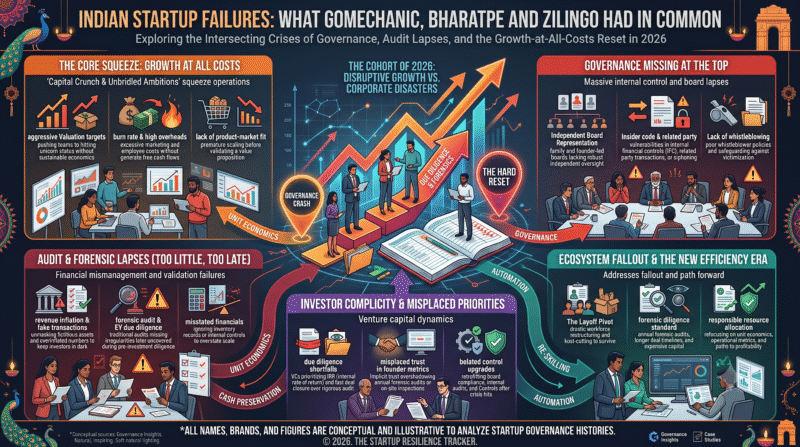
What Did the Three Cases Have in Common?
Despite operating in different industries, the cases revealed several recurring risks.
1. Growth became a dominant priority. Rapid expansion and ambitious valuations can put pressure on management to demonstrate progress. When growth targets overshadow financial discipline, warning signs may be overlooked.
2. Financial information became central to investor confidence. Investors depend on accurate reporting to assess revenue, expenses, cash requirements, and business performance. Discrepancies can undermine an entire investment thesis.
3. Governance systems faced scrutiny. Boards must be able to question management, examine unusual transactions, and ensure that financial controls operate independently of individual founders.
4. Founder accountability became unavoidable. Founders often drive a startup’s vision and culture. But once outside investors and employees depend on the business, leadership also requires transparency, documented decision-making, and acceptance of oversight.
These themes appear in wider analyses of startup governance, including this Nishith Desai Associates review of governance failures in Indian startups.
The Role of Venture Capital
Venture capital firms are expected to provide more than funding. They also assess financial performance, monitor governance and help portfolio companies build systems appropriate to their size.
However, investors cannot monitor every operational decision. Startups may expand rapidly across locations, business lines and legal entities, making it essential to maintain strong reporting processes and independent financial checks.
The cases also prompted questions about due diligence: how effectively can investors evaluate a business when its reported performance does not fully reflect its underlying position?
These questions matter to the wider ecosystem because confidence in individual companies can influence how investors assess other startups seeking capital.
Lessons for India’s Next Generation of Founders
The most important lesson is that governance should develop alongside the business.
Startups need reliable accounting, clear approval processes, independent audits where appropriate, documented related-party transactions and boards willing to challenge management assumptions.
Founders must also recognise that transparency is not a constraint on ambition. It is what allows employees, lenders and investors to make informed decisions about the company’s future.
For investors, a strong growth story should never replace scrutiny of cash flow, revenue quality, customer economics and internal controls.
Beyond the Hype
GoMechanic, BharatPe and Zilingo did not experience identical failures, and their outcomes were different. Yet their stories illustrate a common vulnerability in high-growth businesses: when the systems supporting a company’s expansion fail to keep pace, confidence can disappear quickly.
India’s startup ecosystem needs ambition, risk-taking and innovation. It also needs businesses built on accurate financial information, accountable leadership and credible governance.
The ultimate measure of a startup is not how quickly its valuation rises. It is whether the business can create lasting value while earning the trust of its employees, customers, investors and partners.