




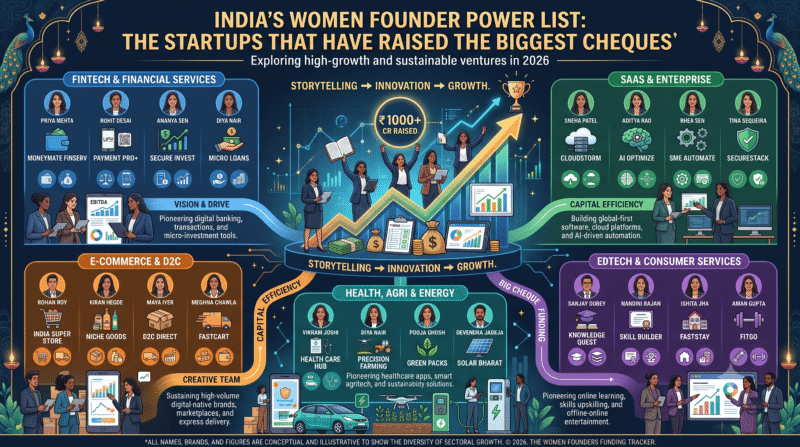
India’s startup ecosystem has produced a growing group of women entrepreneurs building companies across beauty, healthcare, fintech, fashion, deep tech, and consumer brands. While women remain under-represented in venture funding, several women-founded and co-founded startups have attracted substantial institutional capital and reached major scale.
The latest funding data shows that women co-founded Indian technology startups and raised around $1.1 billion in 2025. Funding was lower than the previous year, but investors became more selective, with larger average checks flowing toward companies showing stronger revenue potential.
Nykaa Sets the Benchmark
Nykaa, founded by Falguni Nayar, remains one of India’s most prominent examples of a woman-led consumer technology company reaching public market scale.
Nayar created Nykaa after a career in investment banking, building the company around beauty and personal care at a time when online shopping in the category was still relatively young.
Its success demonstrated that an Indian consumer startup founded by a woman could move from a niche digital business to a major listed company.
Pristyn Care’s Healthcare Bet
Healthcare has produced another significant women’s founder story through Pristyn Care, co-founded by Dr Garima Sawhney.
The healthcare platform has raised more than $181 million across six funding rounds, including substantial growth capital from major institutional investors.
Its business model combines technology with a network of hospitals and doctors, targeting patients looking for organised access to surgical care.
Mamaearth’s Consumer Rise
Mamaearth, co-founded by Ghazal Alagh, became one of India’s best-known digital-first beauty and personal care companies.
The brand built its early reputation around products positioned for families and consumers seeking toxin-free personal care. It later expanded into a broader beauty portfolio.
Mamaearth has raised more than $61 million in disclosed funding, according to startup funding databases.
Its journey also illustrated how women entrepreneurs have helped drive India’s rapidly expanding direct-to-consumer economy.
Fashion Creates Scale
Women entrepreneurs have also made a significant impact on India’s fashion and lifestyle economy.
Zivame, founded by Richa Kar, became one of the country’s best-known online lingerie platforms. The startup helped bring a previously fragmented and relatively private category into mainstream e-commerce.
The company attracted multiple institutional investments as it expanded its product range and customer base.
MobiKwik’s Fintech Journey
MobiKwik, co-founded by Upasana Taku, represents the contribution of women entrepreneurs to India’s fintech revolution.
Taku helped build the company through the transformation of India’s payments market, as mobile wallets and digital transactions became increasingly mainstream.
MobiKwik’s journey demonstrates that women-founded companies are not concentrated only in consumer categories. They have also participated in some of India’s most competitive technology sectors.
Women in Deep Tech
The next generation of women founders is increasingly appearing in deep technology.
Companies such as Pixxel, founded by Awais Ahmed and Kshitij Khandelwal, have brought Indian space technology into the global startup conversation, while women-led ventures across AI, climate technology, healthtech, and advanced manufacturing are attracting increasingly sophisticated investors.
The broader funding data shows that Bengaluru remains India’s largest funding hub for women-founded technology startups, followed by Gurugram and Mumbai.
The Funding Gap Remains
Despite these success stories, the overall capital gap remains significant.
Women co-founded technology startups and raised approximately $1.1 billion in 2025, but the number of funding rounds fell sharply from the previous year. At the same time, early-stage funding increased, suggesting investors are continuing to back promising women founders at the beginning of their journeys.
This distinction matters. A stronger seed ecosystem today could produce a much larger pipeline of women-led companies capable of raising major growth rounds tomorrow.
A New Generation Is Emerging
The funding landscape is also becoming more diverse.
Women founders are now raising capital across fintech, healthcare, beauty, consumer goods, AI, climate technology, food, and enterprise software. Recent 2026 funding activity has included companies such as Age Care Labs, SolarSquare, Anveshan, and other women-led businesses securing fresh institutional backing.
The breadth of sectors is significant because it challenges the old assumption that women entrepreneurs primarily build consumer or lifestyle companies.
From Representation to Scale
India’s women founders are no longer simply a diversity story. They are increasingly a capital allocation story.
The biggest success cases show that women-led companies can attract major investors, build national brands, reach public markets, and compete in technology-intensive industries.
The funding gap has not disappeared. But the trajectory is changing.
As more women founders reach later funding stages, the next chapter of India’s startup ecosystem could be defined not simply by how many women start companies, but by how many build large, durable, and globally competitive businesses.