





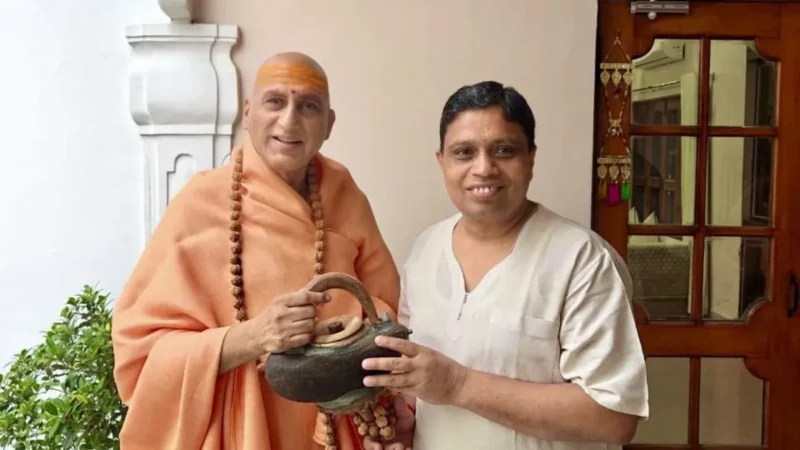
From studying traditional Ayurveda and medicinal plants to building a major consumer goods enterprise, Acharya Balkrishna’s journey is closely connected with the rise of Patanjali Ayurved. Working alongside yoga guru Baba Ramdev, he helped transform a small Ayurvedic medicine venture into a business spanning healthcare, food, personal care and wellness products.
Early Life: A Journey Rooted in Traditional Learning
Acharya Balkrishna was born on 4 August 1972. His parents were originally from Nepal, and he spent part of his childhood there before returning to India for his education.
He studied at a traditional gurukul in Kalwa, Haryana, under Acharya Baldevji. His education focused on Sanskrit, Ayurveda, yoga and India’s traditional knowledge systems.
Rather than following a conventional corporate education path, Balkrishna developed an interest in medicinal plants, herbal formulations and traditional healing practices.
This knowledge would later become an important foundation for the products and institutions associated with Patanjali.
Meeting Baba Ramdev: The Beginning of a Partnership
Balkrishna met Baba Ramdev during his years at a gurukul in Haryana. Their shared interest in yoga, Ayurveda and traditional Indian knowledge developed into a long-term association.
The two worked towards promoting yoga and Ayurveda through educational activities, public programmes and healthcare initiatives.
In 1995, they established the Divya Yog Mandir Trust, which became an important foundation for their wider activities.
The trust’s work eventually expanded into Ayurvedic healthcare, education, research and the production of traditional medicines.
From Divya Pharmacy to Patanjali
One of the early business foundations was Divya Pharmacy, established in Haridwar in 1995.
The venture focused on manufacturing Ayurvedic medicines and herbal products. Balkrishna’s knowledge of medicinal plants and traditional formulations played an important role in the development of its products.
As demand grew, the organisation began exploring ways to reach a much wider consumer base.
In 2006, Patanjali Ayurved Limited was established with the ambition of making Ayurvedic products and traditional Indian wellness offerings more accessible.
Balkrishna became closely involved in the company’s formation and development, eventually taking on a leading management role.
The company’s official website presents its range of Ayurvedic medicines, food products, personal care items and other consumer offerings.
Building a Brand Beyond Ayurveda
Patanjali’s expansion was not limited to traditional medicines.
The company entered India’s fast-moving consumer goods market with products across several categories, including:
- Personal Care: Toothpaste, soaps, shampoos and skincare products.
- Food and Beverages: Atta, ghee, honey, spices, juices and packaged foods.
- Healthcare: Ayurvedic medicines and herbal formulations.
- Home Care: Cleaning and household products.
- Wellness: Products connected with yoga and traditional lifestyles.
The company positioned many of its offerings around Ayurveda, natural ingredients and Indian manufacturing.
Baba Ramdev’s public profile and yoga-related activities helped bring considerable visibility to the brand, while Balkrishna played a central role in product development and business management.
Challenging Established FMCG Companies
Patanjali’s arrival created a new competitive dynamic in India’s consumer goods industry.
The company entered categories dominated by established multinational and Indian brands. Its pricing, distribution strategy and emphasis on traditional ingredients helped it attract consumers looking for alternatives.
Patanjali expanded its retail presence through company outlets, distributors, franchise networks and other sales channels.
Its growth demonstrated that a brand built around traditional Indian knowledge could compete in modern consumer markets.
A Business Standard profile examines Balkrishna’s role in the company’s rapid business expansion.
Expanding into Food and Industrial Businesses
As Patanjali grew, its business interests expanded into food processing and other industrial activities.
An important development came in 2019, when Patanjali acquired the bankrupt Ruchi Soya Industries through the insolvency process. Ruchi Soya was subsequently renamed Patanjali Foods Limited.
The acquisition gave the group access to a large edible-oil and food-processing business, expanding its presence beyond traditional Ayurvedic and personal care products.
Patanjali Foods now operates as a listed company with a broad food and consumer products portfolio.
Its official leadership page identifies Acharya Balkrishna as its Chairman and Non-Executive Director.
Research, Education and Social Initiatives
Balkrishna’s interests also extend to Ayurveda research and education.
He has been associated with Patanjali Yogpeeth, Patanjali Research Foundation and the University of Patanjali. These institutions focus on traditional knowledge, medicinal plants, yoga, education and research.
According to his official profile, he has authored numerous books and research publications related to Ayurveda, Sanskrit and medicinal plants.
His work has been directed towards documenting traditional knowledge and exploring its applications through research and educational institutions.
The Legacy of Acharya Balkrishna
Acharya Balkrishna’s journey is an example of how traditional knowledge can become the foundation of a modern business organisation.
Together with Baba Ramdev, he helped develop an ecosystem that connects Ayurvedic medicines, consumer products, education, research and food manufacturing.
From Divya Pharmacy in Haridwar to Patanjali’s wider business operations, his contribution has been closely linked to the company’s evolution.
His story highlights the business possibilities of combining cultural heritage, product development and large-scale distribution.
For aspiring entrepreneurs, the Patanjali journey offers an important lesson: a business can grow by identifying a distinct consumer need and building an organisation around a clearly defined product identity.