




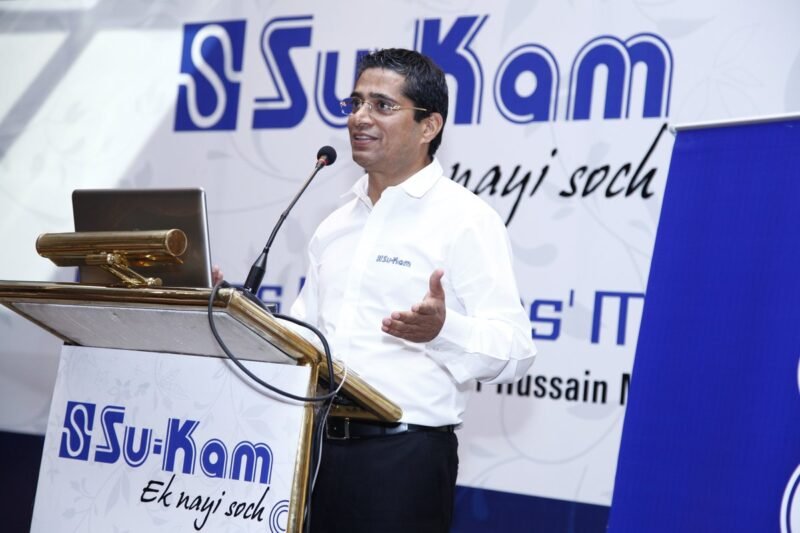
From selling pens and running a cable television business to building Su-Kam into a recognised inverter and solar power brand, Kunwer Sachdev’s journey is a story of spotting everyday problems and turning them into business opportunities. Known as the “Inverter Man of India”, he helped bring innovation and organised manufacturing to a market once dominated by local, unbranded products.
Early Life: Learning the Value of Hard Work
Kunwer Sachdev was born in November 1962 in Delhi, into a middle-class family. His father worked with the Indian Railways, and his early years were shaped by modest financial circumstances.
As a young boy, Sachdev helped his elder brother sell pens and stationery. The experience gave him an early understanding of sales, customer behaviour and the importance of earning money through hard work.
He studied mathematical statistics at Hindu College, University of Delhi, and later completed a Bachelor of Laws degree.
Although he did not begin his career as an electrical engineer, his curiosity about technology and manufacturing gradually drew him towards electronics.
The First Business: From Pens to Cable Television
Sachdev’s entrepreneurial journey began before Su-Kam became a household name.
In 1988, he started a cable television equipment business in Delhi. At the time, cable television was expanding across Indian homes, creating demand for amplifiers, converters and other electronic equipment.
He recognised an opportunity to manufacture and supply products locally rather than depend entirely on expensive imported equipment.
The business gave him practical experience in manufacturing, distribution, customer service and product development.
It also helped him understand an important principle: a successful business must solve a problem that customers experience regularly.
The Birth of Su-Kam
The idea for Su-Kam’s power backup business emerged from India’s unreliable electricity supply.
During the 1990s, power cuts were common in many Indian cities and towns. Households and businesses needed dependable inverters, but the market often offered products with inconsistent quality and performance.
Sachdev identified an opportunity to develop more reliable power backup systems.
In 1998, he established Su-Kam Power Systems as a dedicated power solutions business. He began with limited resources and used his existing manufacturing experience to develop products suited to Indian conditions.
His official founder website describes the company’s early journey, its development from a cable television business and its entry into the inverter market.
Innovation That Changed the Inverter Market
One of Sachdev’s major contributions was his focus on product innovation.
Su-Kam invested in research and development and introduced products designed to improve efficiency, performance and convenience.
The company became associated with innovations in sine-wave technology, home UPS systems, digital displays and inverter designs.
Its plastic body inverter range helped distinguish the brand from traditional metal-bodied products.
Instead of treating inverters as basic backup equipment, Su-Kam worked to make them more technologically advanced and visually appealing.
This approach helped the company develop a recognisable identity in India’s power backup industry.
Taking an Indian Brand to International Markets
As demand for reliable electricity solutions grew, Su-Kam expanded its product portfolio.
Its offerings included:
- Home and commercial inverters
- Uninterruptible Power Supply (UPS) systems
- Batteries and power storage solutions
- Solar power systems
- Hybrid solar inverters
- Industrial power backup equipment
The company also expanded internationally, exporting products to markets across Asia, Africa and other regions.
According to the company’s published history, Su-Kam developed an export presence in more than 90 countries.
Its growth demonstrated that an Indian manufacturer could build technology-driven products for customers beyond the domestic market.
Recognition and Business Achievements
Sachdev’s entrepreneurial journey received attention from business publications and industry organisations.
He was recognised as Entrepreneur of the Year at the Entrepreneur India Awards in 2011.
Su-Kam also became known for its research and development activities, patents and manufacturing capabilities.
A Business Standard profile is not about Sachdev; for his own business journey, an earlier Economic Times profile discusses Su-Kam’s growth through innovation, research and marketing.
The Challenges and Turning Point
Su-Kam’s expansion was followed by financial difficulties. In 2018, insolvency proceedings were initiated against Su-Kam Power Systems, and the company entered the corporate insolvency resolution process.
The Supreme Court’s March 2021 judgement records the proceedings, including the company’s liquidation order in April 2019.
Sachdev’s association with Su-Kam ended in 2019. He has subsequently clarified on his official website that he is not responsible for the company’s activities after his exit.
This chapter is an important part of the story: building a successful brand and sustaining a business through financial and operational challenges are two different entrepreneurial tests.
Beyond Su-Kam: Mentoring and New Ideas
Following his departure from Su-Kam, Sachdev shifted much of his attention towards entrepreneurship, mentoring and innovation.
His current public profile describes his work with founders, business leaders and organisations interested in entrepreneurship and clean energy.
His experience continues to be associated with India’s power backup and solar technology sector.
The Legacy of Kunwer Sachdev
Kunwer Sachdev’s journey began with small commercial ventures and developed into the creation of a recognised Indian power solutions brand.
He helped make inverter technology more visible to Indian consumers and encouraged greater attention to product design, research and manufacturing.
His story also offers a realistic lesson about entrepreneurship: innovation and rapid growth can build a powerful brand, but financial discipline and sustainable operations remain essential.
From selling pens in Delhi to building Su-Kam, Sachdev’s journey remains a notable chapter in India’s home-grown technology and manufacturing story.