
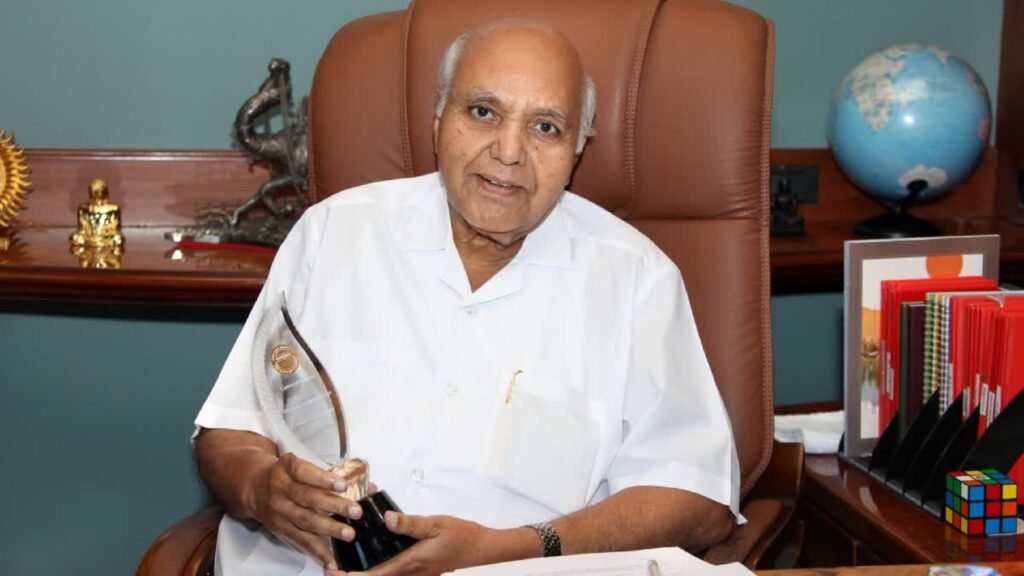
Cherukuri Ramoji Rao was born on November 16, 1936, in Pedaparupudi, Krishna district, in present day Andhra Pradesh. He came from a farming family and completed his education in Gudivada.
After his studies, he moved to Delhi and worked with an advertising agency. This early experience introduced him to marketing, communication and the power of reaching large audiences.
Rather than remain in a conventional job, Rao wanted to establish businesses of his own. He began exploring opportunities in finance, publishing and consumer products.
His entrepreneurial journey would eventually create one of India’s most diversified privately owned business groups.
The First Venture: Margadarsi Chit Fund
In 1962, Rao established Margadarsi Chit Fund, marking the beginning of his entrepreneurial career.
The business offered chit fund schemes that allowed members to contribute regular amounts and access pooled funds through an organised system.
Margadarsi gradually developed into an established financial services business, providing Rao with an early foundation for his future ventures.
He later entered publishing with Annadata, a Telugu magazine launched in 1969 for farmers. The publication reflected his interest in reaching audiences with practical, locally relevant information.
The Birth of Eenadu: A New Voice in Telugu Journalism
One of Rao’s most significant business decisions came in 1974, when he launched Eenadu, a Telugu-language daily newspaper, from Visakhapatnam.
At the time, regional journalism had considerable scope for expansion. Rao recognised that readers wanted news about their own towns, districts and communities rather than only national headlines.
Eenadu developed a strong regional reporting approach, bringing local news closer to readers.
The newspaper expanded to other cities, including Hyderabad and Vijayawada, and became one of the most influential Telugu publications.
Its success demonstrated the commercial potential of regional-language journalism and helped establish the foundation of the Ramoji media business.
The Eenadu newspaper continues to be a major part of the group’s media presence.
Expanding into Food and Entertainment
Rao did not restrict his ambitions to publishing.
During the early 1980s, the group entered the food business through Priya Foods, known for its pickles, spice products and other packaged foods.
The Priya brand developed a presence among consumers by combining traditional food products with organised manufacturing and distribution.
In 1983, Rao established Usha Kiran Movies, entering film production.
The production house went on to create films in Telugu and other Indian languages, becoming another important part of his entertainment business.
These ventures reflected a consistent strategy: identify an established consumer need and build an organised business around it.
The Television Revolution: Launching ETV
In 1995, Rao expanded into satellite television with the launch of ETV, initially focusing on Telugu-language programming.
The channel offered entertainment and programming designed for regional audiences. Its success encouraged the group to expand into additional languages.
Over time, ETV developed into a network of television channels covering news, entertainment and other programming.
The expansion helped establish the Ramoji Group as a major force in Indian regional broadcasting.
Its media activities subsequently extended into digital platforms, including ETV Bharat.
The group’s official website outlines its interests across print, television, digital media, entertainment and other businesses.
Ramoji Film City: Building a World of Cinema
Perhaps Rao’s most ambitious project was Ramoji Film City, established near Hyderabad in 1996.
His vision was to create an integrated filmmaking destination where production teams could access studios, outdoor locations, sets, technical facilities and post-production services in one place.
The facility was designed to reduce the time and logistical challenges involved in film production.
Spread across more than 2,000 acres, Ramoji Film City became a major destination for filmmakers and tourists.
It has hosted thousands of film productions in several Indian languages and developed into a major entertainment and tourism attraction.
The official Ramoji Film City website describes its infrastructure, history and recognition by Guinness World Records as the world’s largest film city.
Building a Diversified Business Group
Over the decades, Rao expanded his business interests into several sectors.
The Ramoji Group developed operations across:
- Media: Eenadu newspaper and ETV television network.
- Financial Services: Margadarsi Chit Fund.
- Food: Priya Foods.
- Film Production: Usha Kiran Movies.
- Film Infrastructure: Ramoji Film City.
- Hospitality: Dolphin Hotels.
- Retail: Kalanjali.
- Digital Media: ETV Bharat and other digital ventures.
This diversification helped create a business group with influence across media, entertainment, consumer products and hospitality.
Awards and National Recognition
Rao’s contribution to journalism, business and entertainment earned him several honours.
Some of his major recognitions included:
- Padma Shri (2000): Recognising his contribution to industry and public life.
- Padma Vibhushan (2016): India’s second-highest civilian award.
- National Film Awards: Recognition for his contribution to cinema through Usha Kiran Movies.
- Nandi Awards: Honours for his work in Telugu cinema.
His achievements were recognised across business, media and the film industry.
The Final Chapter and His Lasting Legacy
Ramoji Rao passed away on June 8, 2024, at the age of 87 in Hyderabad.
His death marked the end of an extraordinary entrepreneurial journey, but the institutions he established continue to operate across different sectors.
From Margadarsi and Eenadu to ETV and Ramoji Film City, his ventures demonstrate how a business can grow by entering different industries while maintaining a strong focus on communication, consumer needs and organised operations.
The Legacy of Ramoji Rao
Ramoji Rao’s story is not simply about building a newspaper or a film studio. It is about creating institutions that influenced how millions of people consumed news, entertainment and everyday products.
He recognised the importance of regional audiences, invested in media infrastructure and built businesses that extended far beyond his original ventures.
His journey from a farming family in Andhra Pradesh to becoming the founder of a major media and entertainment group remains an important chapter in Indian entrepreneurship.
His legacy lives on through the businesses, institutions and creative infrastructure he helped establish.