
The Tata Group is one of India’s most recognisable business empires, with interests spanning information technology, automobiles, steel, aviation, consumer products, hospitality and telecommunications. Yet its structure differs from that of many other large Indian conglomerates.
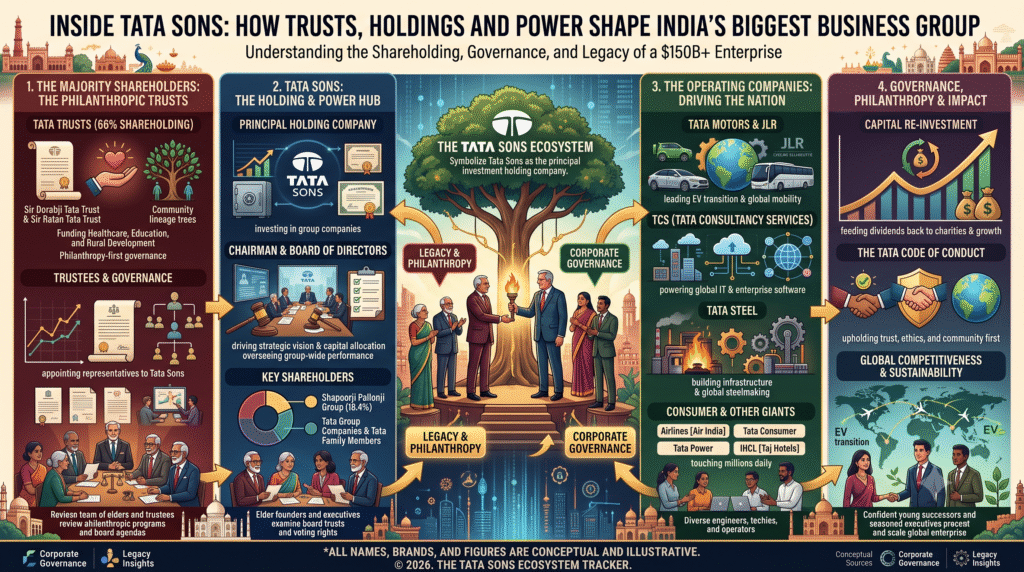
At the centre sits Tata Sons, the principal holding company of the Tata Group. Around it is a network of operating companies, major shareholders, charitable trusts and governance mechanisms that collectively shape how the group is controlled.
Understanding this structure requires looking beyond individual companies and examining the relationship between ownership, board authority and the Tata Group’s long-standing philanthropic model.
Tata Sons: The Centre of the Group
Tata Sons is the principal investment holding company and promoter of many Tata businesses. It holds stakes in companies across different sectors and helps provide strategic direction for the wider group.
Its importance comes from its ownership interests, its influence over major group companies and its role in decisions involving leadership, capital allocation and long-term strategy.
However, Tata Sons does not directly manage every factory, hotel, software business or retail operation. Listed and unlisted Tata companies have their own boards and management teams responsible for their operations.
According to the group’s official company and investor information, each Tata company operates independently under the guidance and supervision of its own board of directors.
This distinction separates group-level influence from the day-to-day management of individual businesses.
The Role of Tata Trusts
One of the most distinctive features of Tata governance is the substantial shareholding held by charitable trusts.
Tata Trusts collectively own approximately two-thirds of Tata Sons, making them central to the ownership structure. The remaining shares are held by other shareholders, including Tata-affiliated entities and individuals.
The trusts support philanthropic work across areas such as healthcare, education, rural development, livelihoods and scientific research.
Their shareholding connects the commercial performance of Tata businesses with the financial resources available for charitable activities.
This arrangement is central to the Tata Group’s identity, although it also means that questions about trust governance and representation can have implications for the wider corporate group.
Where Corporate Power Sits
Ownership and executive authority are not the same thing.
Tata Trusts exercise shareholder rights in accordance with applicable law and the relevant corporate documents. Tata Sons has its own board, which is responsible for the company’s governance and decisions within its legal authority.
The chairperson of Tata Sons has historically occupied an influential position because of the role in group strategy and leadership appointments. But the chairperson is not the owner of every Tata company and cannot simply disregard the legal responsibilities of individual boards.
Major decisions can involve several layers of authority, depending on the company, transaction and applicable regulations.
The Boardroom Structure
Tata Sons is governed by a board of directors. Its responsibilities include oversight of the holding company, its investments, financial position and strategic direction.
Individual Tata companies also have their own boards. A listed company must comply with applicable corporate law, securities regulations and disclosure requirements.
This creates a layered governance system: Tata Sons can exercise influence through ownership and group relationships, while operating-company boards retain their formal legal responsibilities.
The arrangement can help coordinate a diverse business empire, but it also requires clarity about where decision-making authority begins and ends.
Why the Cyrus Mistry Episode Matters
The removal of Cyrus Mistry as Tata Sons chairperson in 2016 exposed the tensions that can emerge in a large, trust-influenced conglomerate.
The dispute raised questions about board authority, the role of the chairperson, shareholder rights and the relationship between the holding company and the wider group.
The resulting legal battle became one of India’s most closely watched corporate-governance disputes. In March 2021, the Supreme Court of India set aside the National Company Law Appellate Tribunal’s decision that had ordered Mistry’s reinstatement.
The Supreme Court judgment in the Tata Sons–Cyrus Investments dispute provides a detailed account of the legal issues and the court’s reasoning.
The episode demonstrated that even a group with a long-established governance tradition can face disagreements over executive authority and institutional control.
It also reinforced the importance of formal corporate procedures, shareholder rights and judicial review.
The Importance of Leadership Succession
Leadership succession is especially significant in a group whose companies operate across many sectors.
The appointment of a Tata Sons chairperson can influence strategic priorities, investment decisions and leadership coordination across the group. Yet the chairperson’s role must operate within the authority of the board and the legal structures governing each company.
Succession therefore involves more than selecting an individual. It also requires maintaining relationships between the holding company, trusts, operating businesses and other shareholders.
The challenge is to preserve continuity without weakening accountability.
Balancing Philanthropy and Business
The Tata model links commercial ownership with philanthropic objectives, but these functions remain institutionally distinct.
Tata companies must operate as businesses, comply with their legal obligations and generate returns appropriate to their circumstances. The trusts, meanwhile, have charitable purposes and governance responsibilities of their own.
This creates a distinctive relationship between business success and social impact.
It also makes governance quality particularly important: clear decision-making, transparent processes and responsible stewardship help protect both the commercial group and the charitable institutions associated with it.
Why the Structure Matters
Tata Sons illustrates how control of a large conglomerate can operate through a combination of shareholding, board governance, leadership appointments and institutional relationships.
Its structure cannot be reduced to a single family member, chairperson or company. Power is distributed across several entities, each with distinct responsibilities and legal obligations.
For investors, employees and policymakers, understanding these relationships is essential to interpreting major Tata Group decisions.
Ultimately, the Tata model rests on a delicate balance: the trusts provide a distinctive ownership foundation, Tata Sons coordinates interests across the group, and individual companies operate through their own boards and management teams.
How effectively these institutions work together will continue to shape the governance and strategic direction of one of India’s most influential business groups.
Further reading
Supreme Court judgment on the Cyrus Mistry dispute
Tata Sons: Official company profile and governance philosophy