
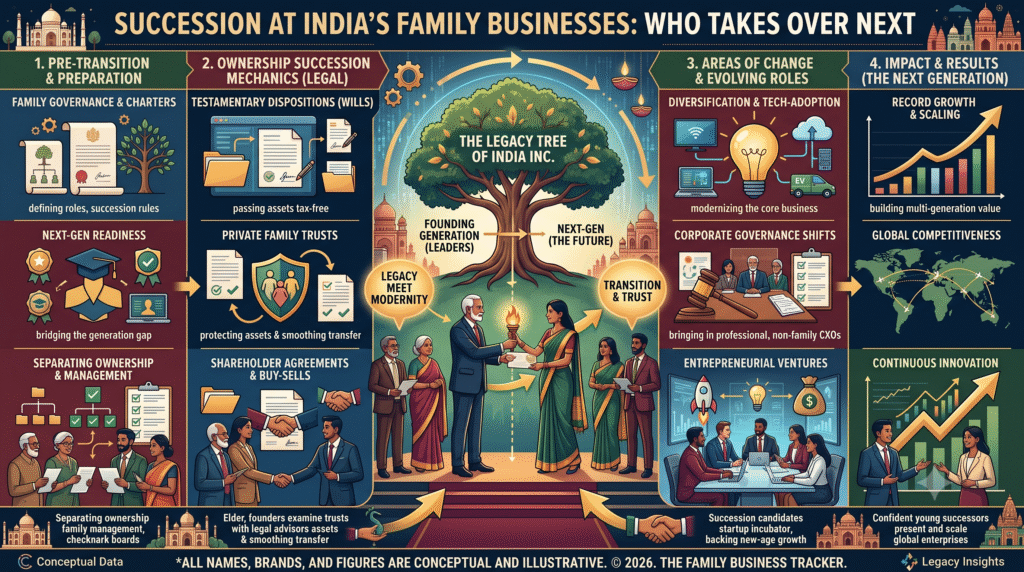
India’s family-owned businesses are entering a new phase of succession. Across some of the country’s largest business groups, the next generation is moving from education and early career roles into positions with direct responsibility for major companies, brands and investment decisions.
The transition is no longer simply about handing over the chairman’s office. Modern family businesses must balance family ownership with professional management, shareholder expectations, global expansion and increasingly complex governance structures.
For many groups, succession planning has therefore become a long-term business strategy.
The Reliance Next Generation
Reliance Industries has one of India’s most closely watched succession plans.
Mukesh Ambani’s children Akash Ambani, Isha Ambani and Anant Ambani have taken increasingly visible responsibilities across different parts of the group.
Akash has been closely associated with the telecommunications and digital business, including leadership responsibilities at Jio. Isha has played a prominent role in Reliance’s retail operations, while Anant has been associated with the group’s new-energy ambitions.
The structure indicates an approach in which responsibilities are distributed across major businesses rather than concentrated in a single successor.
The Adani Family
The Adani Group is also preparing for a generational transition.
Karan Adani, Jeet Adani and Sagar Adani have taken responsibilities across different parts of the conglomerate.
Karan has been closely associated with ports and infrastructure businesses, while Jeet has worked across areas including airports and strategic development. Sagar has held leadership responsibilities within the group’s energy-related operations.
The younger generation is therefore gaining experience through operating businesses rather than waiting for a formal succession announcement.
The Hinduja Model
The Hinduja Group presents a different succession structure because of its multinational and family-partnership model.
The younger generation has increasingly become involved in businesses spanning automobiles, financial services, healthcare, hospitality and other sectors.
The challenge for such groups is maintaining a common strategic direction across multiple family branches while professional managers continue to run individual businesses.
The Godrej Split Changes the Equation
The Godrej family’s restructuring of its business interests created a significant example of modern Indian family-business succession.
The separation of interests between the Godrej Industries Group and the Godrej Enterprises Group placed greater clarity around ownership and strategic control.
The next generation, including Nadir Godrej, Tanya Dubash, Pirojsha Godrej and Nisaba Godrej, has already taken important roles across the family’s businesses.
The restructuring demonstrates that succession can involve reorganising ownership itself rather than simply appointing a new family chairman.
The Bajaj Family
The Bajaj Group has also seen the next generation assume significant responsibilities.
Rajiv Bajaj leads Bajaj Auto, while other members of the family have roles across financial services and other businesses.
The group’s structure illustrates how family ownership can coexist with specialised leadership, with individual family members developing expertise in particular companies rather than managing the entire group collectively.
The Murugappa Approach
The Murugappa Group represents another long-established Indian family business with a multi-generational leadership structure.
The group operates across sectors including engineering, financial services, agriculture and consumer businesses.
Its succession challenge is particularly complex because the group includes numerous businesses and a large extended family. Professional management, family governance and clear allocation of responsibilities therefore become critical to maintaining continuity.
The TVS Family
The TVS Group has long relied on a structure in which different family branches operate individual businesses.
Sudarshan Venu, for example, leads TVS Motor Company, while other members of the extended family have leadership positions across separate TVS businesses.
This model reduces the need for one individual to control every company while allowing family ownership to remain an important part of the broader group.
The Future of Family Control
The next generation of Indian business families is entering leadership at a very different time from their predecessors.
Global competition is stronger, technology cycles are faster and investors expect greater transparency. Family businesses must also compete for professional talent while ensuring that family members are appointed on the basis of capability and clearly defined responsibilities.
This makes succession planning more than a question of inheritance.
From Heirs to Business Leaders
The strongest family businesses are increasingly preparing successors years before a formal transition.
Young family members are gaining experience outside the family group, working in operating companies, taking responsibility for specific businesses and learning how to manage professional teams.
For India’s largest family enterprises, the next decade could therefore be defined by a gradual transition rather than a single handover.
The question is no longer simply who inherits the business.
It is who has the capability to lead it.
As India’s family-owned companies grow into global enterprises, succession will increasingly depend on governance, competence and strategic vision alongside family ownership. The families that manage that balance successfully could determine the next chapter of India Inc.