




India’s family businesses have traditionally been built around promoters, relatives and generations of family leadership. But as these companies become larger, more complex and increasingly global, many families are turning to professional CEOs to manage businesses that can no longer be run through informal family decision-making.
The model can deliver impressive results when ownership and management understand their respective roles. It can also create serious conflict when a professional executive is given responsibility without genuine authority.
For Indian family businesses, the question is no longer whether an outsider can run the company. It is whether the family is prepared to let that person actually run it.
Why Families Hire Outsiders
The transition usually begins when a business reaches a scale where the founder or family cannot personally oversee every operation.
A professional CEO can bring specialised experience in areas such as international expansion, technology, capital allocation, restructuring and institutional management.
An external executive can also introduce systems that may be difficult to establish when relatives occupy important positions.
For a family-owned company preparing for an IPO, professional management can become particularly valuable because investors expect transparent reporting, formal governance and clearly defined accountability.
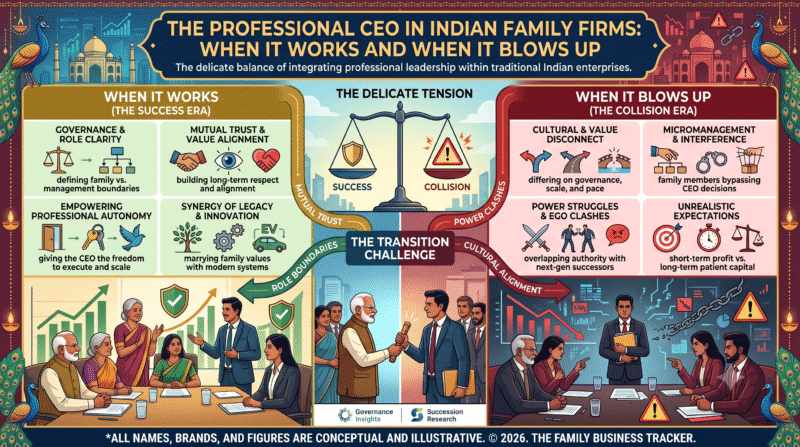
The Model Works With Clear Authority
The strongest professional-CEO arrangements usually begin with a clear division of responsibilities.
The family remains responsible for ownership, long-term purpose and major strategic decisions. The CEO receives authority over day-to-day operations, senior hiring, budgets and execution.
This distinction matters.
If the CEO is formally responsible for performance but every major decision still requires approval from family members, accountability becomes blurred.
Employees may also become uncertain about who actually has the final say.
The Shadow CEO Problem
One of the most common challenges is the presence of an informal family decision-maker.
A professional CEO may have the official title while a promoter, family member or chairman continues to intervene in operational matters.
This creates what can be described as a “shadow CEO” structure.
The problem is particularly damaging when instructions from the family conflict with the CEO’s strategy.
Senior executives may begin bypassing the CEO and approaching family members directly. Once that happens, organisational authority can quickly deteriorate.
When Culture Becomes a Barrier
Professional executives can also struggle when a family business has deeply embedded traditions.
Long-serving employees may have personal relationships with members of the promoter family. Decisions that appear straightforward from a corporate-management perspective can carry emotional or historical significance.
A new CEO may want to restructure a business, replace senior employees or shut down an underperforming division.
The family may support the strategy in principle but hesitate when the proposed changes affect people who have worked with them for decades.
The Succession Advantage
Professional CEOs can also make family succession easier.
Instead of forcing the next generation to immediately take control of a large organisation, families can allow professional managers to run the business while younger family members develop their own capabilities.
This creates time for the next generation to gain experience in finance, operations, technology and governance.
The professional CEO effectively becomes a bridge between generations.
Where the Model Blows Up
The arrangement tends to fail when the family wants professional management in appearance but not in reality.
Several warning signs can emerge:
- The CEO cannot hire or remove senior executives independently.
- Family members issue instructions directly to employees.
- Promoter relatives receive informal authority without defined roles.
- Strategic decisions are repeatedly reversed.
- Performance expectations are unclear.
- The board does not act independently.
- Family disagreements enter operational decision-making.
Under these conditions, even a highly experienced CEO can struggle.
The Board Matters
An independent and capable board can prevent many of these problems.
The board should define the CEO’s mandate, evaluate performance and act as a bridge between ownership and management.
It can also provide a structured forum for disagreements, preventing operational conflicts from becoming personal family disputes.
For larger family companies, this separation becomes increasingly important as ownership becomes more dispersed across generations.
India’s Next Family-Business Test
Professional CEOs are likely to become more common as Indian family businesses expand internationally and prepare for greater institutional scrutiny.
But hiring an outsider is only the first step.
The real test comes when the CEO makes an unpopular decision, challenges a family preference or proposes changes that affect long-standing relationships.
If the family backs the CEO when difficult decisions are required, professional management can unlock significant value.
If the family repeatedly overrides the executive, the title becomes largely symbolic.
The Real Question
The success of a professional CEO in an Indian family business ultimately depends on trust.
Families must trust the executive with genuine authority. The CEO must respect the family’s ownership role. The board must ensure that both sides remain accountable.
When those boundaries are respected, professional management can help a family business become more institutional, scalable and resilient.
When they are ignored, the company can end up with the worst of both worlds: a professional CEO who is accountable for results but lacks the power to deliver them.
For India’s next generation of family enterprises, that distinction could determine whether succession becomes a competitive advantage or a source of recurring conflict.