
Startup fundraising is often associated with rising valuations. A company raises a new round at a higher price, early investors see their holdings become more valuable, and employees may expect their stock options to gain worth.
But the opposite can happen.
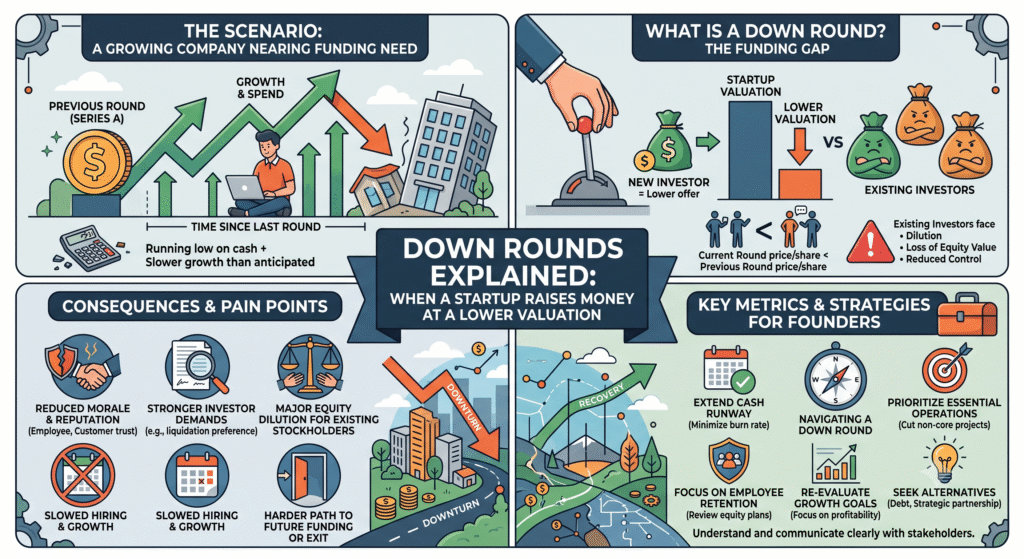
A down round occurs when a startup raises new equity financing at a valuation lower than that of its previous financing round. It can be a difficult moment for the company, but it does not necessarily mean the business is failing.
What matters is what caused the lower valuation and how the company responds.
What Is a Down Round?
Imagine a startup previously raised money at a valuation of ₹1,000 crore.
A few years later, it needs additional capital but investors are willing to invest only at a ₹600 crore valuation.
If the company accepts that financing, it has effectively raised a down round.
The lower valuation can result from weaker growth, changing market conditions, increased competition, higher interest rates, poor financial performance or a reassessment of the company’s prospects.
Sometimes, the broader startup market itself has changed.
Why Startups Accept Lower Valuations
Founders generally prefer higher valuations, but raising money at a lower valuation can still be preferable to running out of cash.
A startup may need capital to continue operations, develop products, expand its team or reach profitability.
If existing investors and new investors believe the company has a viable future, they may provide additional funding despite the lower valuation.
The immediate priority becomes extending the company’s financial runway.
The Impact on Founders
Founders can experience two different effects.
First, the value assigned to their existing shares may fall because the company’s valuation has decreased.
Second, the new funding can dilute their ownership percentage because additional shares are issued to investors.
For example, a founder who previously owned 30% of a company could own a smaller percentage after a new financing round.
However, dilution is not automatically negative. If new capital allows the company to survive and eventually grow, the founder’s smaller stake could still become more valuable in the future.
What Happens to Employees?
Employees holding ESOPs can be affected significantly.
If the new funding establishes a lower share price, existing options may be worth less than employees previously expected.
An employee who received options when the company was valued highly may now find that the difference between the exercise price and the new share value has narrowed.
In some situations, companies may introduce new option grants at lower exercise prices to retain employees.
The exact treatment depends on the company’s ESOP structure and board and shareholder decisions.
Existing Investors Face a Hit
Existing investors can also see the implied value of their holdings decline.
The impact can be complicated by investor protections negotiated when earlier funding was raised.
Some investors may have contractual provisions such as anti-dilution protections or other rights that can affect how a down round is structured.
These provisions can shift some of the economic impact between different shareholder groups.
New Investors Get a Different Entry Price
For new investors, a down round can provide an opportunity to invest at a lower valuation than earlier investors received.
However, a lower price does not automatically make the investment attractive.
New investors still need to assess the company’s revenues, cash position, growth prospects, competition, technology, management and path toward sustainability.
The valuation has fallen for a reason, and understanding that reason is critical.
Does a Down Round Mean a Startup Is in Trouble?
Not necessarily.
A down round is a financial signal, but it does not tell the entire story.
A startup could raise at a lower valuation because the broader technology market has corrected after a period of unusually high valuations.
Alternatively, the company could be facing serious operational problems.
The circumstances behind the fundraising are therefore more important than the label itself.
The Psychological Impact
Fundraising can influence a startup’s internal culture.
Employees who joined during a high-valuation period may feel disappointed when the company’s valuation falls.
Recruiting can also become more difficult if prospective employees focus heavily on previous valuation figures or expected equity returns.
Founders may have to communicate clearly about the company’s financial position and explain why the new funding is necessary.
A Chance to Reset
A down round can also force a startup to become more disciplined.
Companies may reduce unnecessary spending, focus on core products, improve unit economics and prioritise profitability over rapid expansion.
The new valuation can establish a more realistic financial baseline.
For some startups, that reset becomes an opportunity to build a healthier business.
What Stakeholders Should Understand
For founders, the key issue is balancing ownership with the need for capital.
For employees, understanding the current value, exercise price and terms of ESOPs becomes especially important.
For investors, the focus is on whether the lower valuation reflects temporary market conditions or deeper problems within the business.
And for the company itself, the central question is whether the new capital provides enough time to reach sustainable growth.
The Bigger Picture
Startup valuations can rise quickly during periods of abundant capital and fall just as quickly when investors become more cautious.
A down round is therefore best understood as a change in the price investors are willing to pay for a stake in a company.
It affects founders, employees and investors differently, but the long-term outcome depends on what happens after the funding.
The lower valuation is the starting point, not necessarily the final chapter.
For startup stakeholders, the most important questions are how much ownership changes, what protections apply, how much capital the company receives and whether the business can use that capital to build sustainable value.