
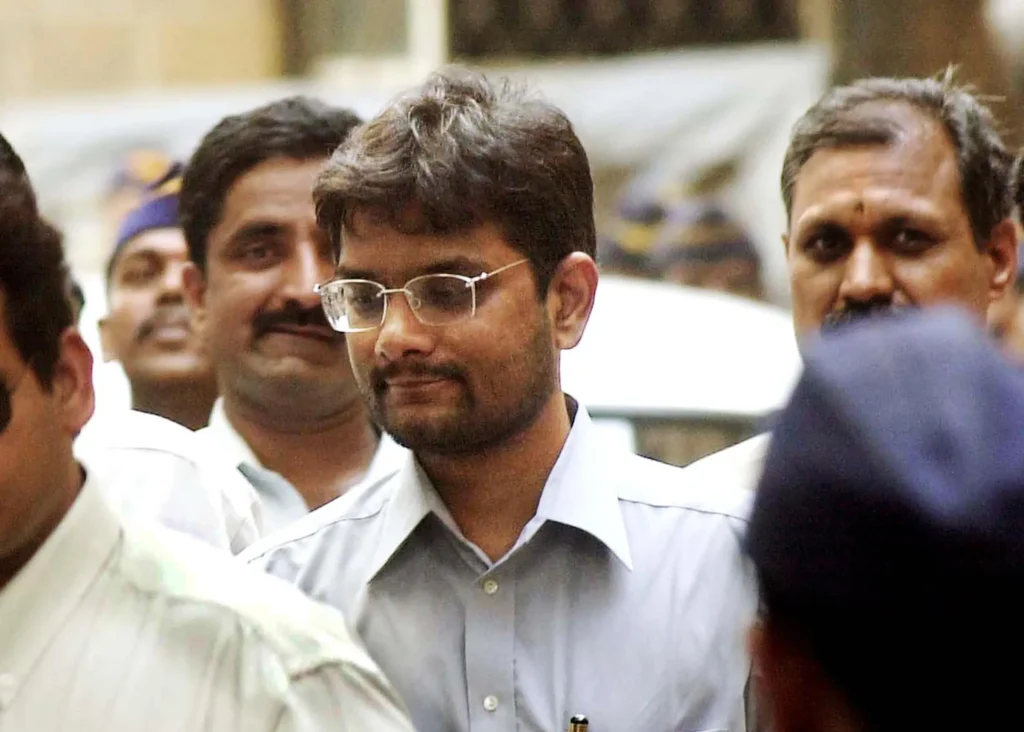
The Ketan Parekh stock market scam of 2001 was not simply a story of inflated share prices. Investigations found a network involving brokers, companies and banking channels that helped create artificial volumes and prices in several stocks. At the centre of the financing controversy was Madhavpura Mercantile Cooperative Bank (MMCB), an Ahmedabad based cooperative bank.
The ₹40,000-Crore Myth
Ketan Parekh is often associated with the figure of ₹40,000 crore. But that number refers broadly to the market capitalisation or paper wealth wiped out when the stocks associated with his operations collapsed not money that Parekh personally walked away with.
The actual financial irregularities were far smaller, while the damage to investors and the financial system was much wider.
The K-10 Stocks
Parekh became closely associated with a group of stocks popularly known as the K-10 stocks.
These included companies such as Zee Telefilms, HFCL and Global Telesystems.
SEBI investigations found that entities connected with Parekh had engaged in activities including synchronised trades, circular trading and creation of artificial volumes and markets in several securities.
Creating Artificial Demand
The basic strategy involved buying and selling shares through interconnected entities and brokers.
Instead of relying entirely on genuine investor demand, the transactions could create the appearance of heavy trading activity.
SEBI found that such activity contributed to artificial volumes and price movements in several stocks associated with the Parekh group.
In the case of Zee Telefilms, for example, SEBI recorded a dramatic movement in the share price from ₹476 in October 1999 to ₹1,555 in February 2000 before falling to ₹121 by March 2001.
The Banking Connection
But manipulating stocks on a large scale required enormous amounts of money.
This is where MMCB became crucial.
RBI investigations found that the cooperative bank had violated lending norms while extending large amounts of finance to stockbrokers. According to reporting based on RBI findings presented to the Joint Parliamentary Committee, MMCB had sanctioned loans of about ₹299.95 crore but disbursed around ₹1,082.22 crore.
Of the amount advanced, about ₹843.57 crore was linked to companies in which Parekh or his close relatives were directors.
The ₹137-Crore Pay-Order Scam
One of the most striking episodes involved 13 pay orders worth ₹137 crore issued by MMCB.
The pay orders were purchased or discounted by Bank of India’s Stock Exchange Branch and the proceeds were credited to companies associated with Parekh.
When the instruments were sent for clearing, they were returned unpaid because MMCB could not meet its obligations.
The money had already moved into Parekh-linked companies.
One Bank, Another Bank
The mechanism exposed a dangerous weakness in the banking system.
MMCB issued the pay orders, while Bank of India discounted them and provided immediate liquidity.
The Joint Parliamentary Committee later examined the extensive use of pay-order discounting by Parekh linked companies. It recorded that Bank of India’s Stock Exchange Branch had purchased thousands of bankers’ cheques and pay orders, including hundreds issued by MMCB.
The arrangement effectively allowed banking instruments from a troubled cooperative bank to be converted into cash through another bank.
When the Bubble Burst
The global dot-com crash and the collapse in technology stocks severely damaged Parekh’s positions.
As stock prices fell, the financing structure began to unravel.
On March 22, 2001, a ₹137-crore pay order connected to the episode was at the centre of the crisis after MMCB failed to honour its obligations. Bank of India subsequently pursued recovery proceedings and criminal action was initiated.
The Banking Fallout
The consequences extended far beyond Parekh’s trading positions.
MMCB faced a severe liquidity and solvency crisis, while other financial institutions were exposed to the collapse in the securities linked to the manipulation.
The episode also exposed weaknesses in cooperative-bank supervision, inter-bank payment practices and controls over financing of stock-market activity.
The Regulatory Verdict
SEBI’s investigations eventually concluded that Parekh and entities associated with him had manipulated several securities through practices including circular and fictitious transactions.
In 2007, SEBI stated that investigations covering the period from October 1999 to March 2001 had established market manipulation involving Parekh and 17 associated entities.
Earlier SEBI proceedings had also barred Parekh and associated entities from participating in the securities market.
The Real Lesson
The Ketan Parekh episode was bigger than one broker pushing up a few stocks.
It showed what could happen when market manipulation, easy credit and weak banking controls reinforced one another.
The most important lesson was not how high the K-10 stocks could rise.
It was how quickly an illusion of demand could become a financial-system problem when banks supplied the fuel.