
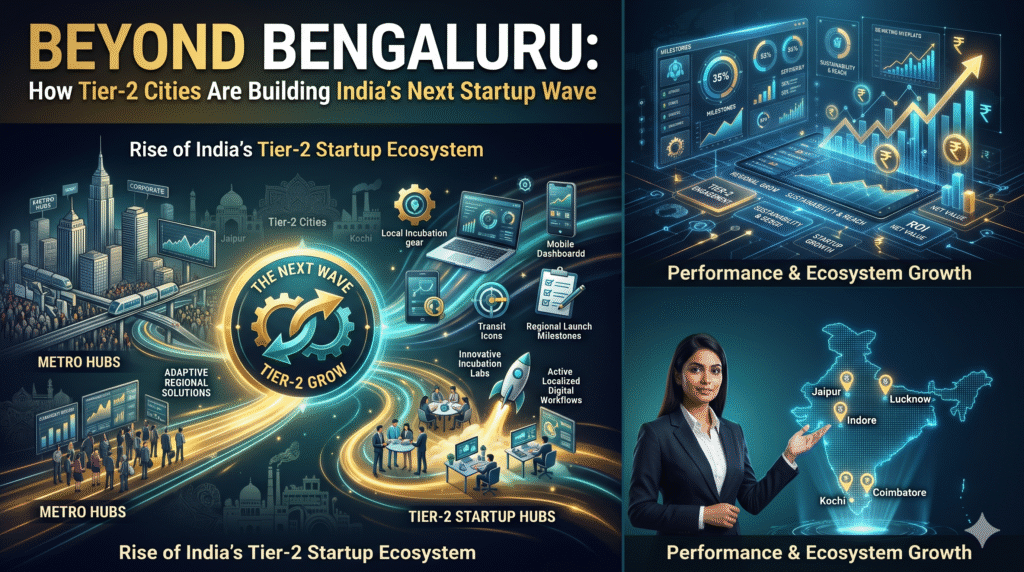
Smaller cities are emerging as promising startup hubs, powered by local talent, lower operating costs and digital access to national markets.
For years, Bengaluru, Delhi NCR and Mumbai dominated conversations about India’s startup ecosystem. These cities offered access to venture capital, experienced professionals, corporate customers and established founder networks. But India’s entrepreneurial map is gradually expanding. Founders from Tier-2 cities are increasingly exploring opportunities in technology, manufacturing, agriculture, healthcare, education and consumer businesses.
The shift is not simply about moving startups away from major metropolitan areas. It reflects a wider change in how entrepreneurs can build companies, reach customers and access business support across India.
Why Founders Are Looking Beyond Metros
One of the biggest advantages of launching a startup in a smaller city is the potential to reduce operating expenses. Office rentals and certain everyday business costs can be lower than in established technology hubs. For early-stage founders working with limited capital, these savings can extend their runway.
Smaller cities may also provide founders with a closer understanding of regional problems. Entrepreneurs familiar with local industries, languages and customer behaviour can identify opportunities that larger companies may overlook.
However, lower costs do not automatically make a startup successful. Access to experienced employees, specialised suppliers and investors can still be limited, depending on the location and sector.
Digital India Has Changed the Equation
Digital infrastructure has made it easier for businesses outside major cities to reach customers nationwide. Online marketplaces, digital payments, cloud software and remote collaboration tools allow founders to operate without building every capability locally.
A small business can sell products through digital commerce channels, manage customer relationships using cloud platforms and communicate with partners across different states.
Government initiatives also support this changing landscape. Founders can explore resources through the official Startup India portal, which provides information on startup recognition, schemes, learning resources and ecosystem support.
The Digital India programme also outlines initiatives focused on expanding digital access and enabling technology-driven services.
Local Problems Are Creating New Opportunities
Tier-2 cities are not simply producing smaller versions of metropolitan startups. Their economic environments can inspire businesses addressing distinct regional needs.
In agricultural regions, founders may build tools for farm supply chains, storage, logistics or market access. Manufacturing clusters can create opportunities in industrial software, automation and specialised components. Growing urban centres may support businesses in healthcare, education, mobility and organised retail.
These opportunities are especially valuable when founders combine local knowledge with a business model that can scale beyond their home market.
Funding Remains a Major Challenge
Despite the opportunities, raising capital can be more difficult outside established startup centres. Investors may have limited visibility into founders who are not connected to familiar networks, accelerators or industry communities.
Entrepreneurs can respond by maintaining clear financial records, demonstrating customer demand and building relationships with incubators, mentors and sector-specific investors.
The Atal Innovation Mission provides information about innovation and incubation initiatives, while the Ministry of Micro, Small and Medium Enterprises offers resources relevant to eligible small businesses. Founders should check individual programme criteria before applying, since not every scheme is available to every startup.
Talent and Networks Still Matter
Hiring is another important consideration. Smaller cities may offer strong graduates and specialised local expertise, but startups can struggle to recruit employees with experience in advanced technology, product management or scaling businesses.
Remote work, partnerships with colleges, internship programmes and distributed teams can help bridge the gap. Founders must also invest in professional networks rather than relying entirely on local contacts.
For many startups, the most effective approach may be to build operations in a smaller city while maintaining customer, investor or hiring relationships in larger hubs.
A More Distributed Startup Ecosystem
India’s next generation of successful startups will not necessarily emerge from one or two familiar cities. Smaller urban centres can become important entrepreneurial hubs when local talent, infrastructure, capital and business opportunities come together.
The real test is not where a startup is founded but whether it solves a meaningful problem, earns customer trust and builds a sustainable business.
As more founders look beyond traditional technology hubs, India’s startup story could become more geographically diverse and better connected to the needs of the country’s wider economy.