




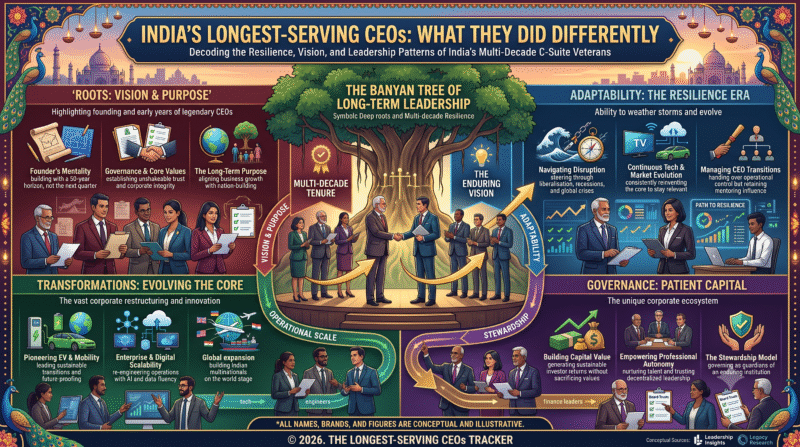
In corporate India, CEOs are often judged by quarterly earnings, market valuations, and how quickly they deliver growth. But some of the country’s most influential business leaders built their legacies over decades, not quarters. Aditya Puri spent 26 years leading HDFC Bank, Kumar Mangalam Birla took charge of the Aditya Birla Group in 1995, and N. Chandrasekaran has led Tata Sons through a period of major strategic transformation since 2017.
Their careers raise a critical question: what do long-serving CEOs do differently to keep businesses growing while markets, technology, and competition change around them?
Aditya Puri: Building a Banking Institution
Aditya Puri served as managing director and CEO of HDFC Bank from 1994 to 2020. During his tenure, the bank grew from a newly established private-sector lender into one of India’s largest banking institutions.
His leadership emphasised risk management, operational discipline, technology investment and consistent execution. Rather than pursuing growth without considering its consequences, HDFC Bank developed a reputation for focusing on asset quality and carefully managed expansion.
Puri’s tenure demonstrated how a financial institution can scale over decades while maintaining a strong focus on controls and customer relationships.
Narayana Murthy: Building Beyond the Founder
N. R. Narayana Murthy co-founded Infosys in 1981 and served as its CEO during its formative years. He helped establish the company as a global technology-services business while promoting professional management and transparent corporate practices.
Infosys became associated with governance standards, employee stock ownership and international client relationships.
Murthy’s leadership illustrated that building an enduring institution requires more than entrepreneurial ambition. It requires systems, professional talent and a culture that can continue beyond the founder’s direct involvement.
Harsh Mariwala: Turning Products Into Brands
Harsh Mariwala helped transform Marico into a major consumer-products company through sustained investment in branding, distribution and professional management.
The company expanded beyond its early product base into a wider portfolio of consumer brands. Its development reflected the importance of understanding changing consumer preferences and creating products that could compete in increasingly crowded markets.
Mariwala’s experience also highlights the importance of delegation. As businesses grow, founders must develop leaders who can manage operations independently rather than relying on a single individual to make every decision.
Kumar Mangalam Birla: Managing a Diversified Empire
Kumar Mangalam Birla became chairman of the Aditya Birla Group in 1995. Under his leadership, the group continued expanding across sectors including cement, metals, textiles, financial services and telecommunications.
Managing a conglomerate requires a different approach from leading a single company. Each business has its own competitive pressures, capital requirements and economic cycles.
Birla’s leadership has involved acquisitions, international expansion and decisions about where the group should invest its resources. His career illustrates how portfolio management can become a defining responsibility for leaders overseeing diversified businesses.
N. Chandrasekaran: Coordinating the Tata Group
N. Chandrasekaran became chairman of Tata Sons in 2017 after serving as CEO and managing director of Tata Consultancy Services.
His responsibilities extend across a business group with interests in technology, automobiles, aviation, steel, retail and consumer products.
Unlike the CEO of a single operating company, a conglomerate chairperson must balance group-wide priorities with the autonomy of individual businesses. Strategic coordination, capital allocation and leadership development are therefore central to the role.
Chandrasekaran’s tenure illustrates the complexity of leading a diversified business group through technological and industrial change.
Deepak Parekh: Building Institutional Trust
Deepak Parekh led HDFC Ltd for decades, helping establish it as one of India’s most prominent housing-finance institutions.
His leadership was associated with financial discipline, institutional credibility and the expansion of housing finance. HDFC developed a strong position in its sector before merging with HDFC Bank in 2023.
The merger represented a major structural change in Indian financial services. It also demonstrated that a successful institution may need to evolve beyond its original form as markets and competitive conditions change.
Parekh’s career highlights the importance of building an organisation that can adapt to a different financial landscape.
Comparing the Leadership Models
| Leader | Company | Leadership milestone | Distinctive approach |
|---|---|---|---|
| Aditya Puri | HDFC Bank | CEO, 1994–2020 | Risk discipline and operational consistency |
| N. R. Narayana Murthy | Infosys | Co-founder and early CEO | Professional management and transparency |
| Harsh Mariwala | Marico | Founder-led expansion | Brand building and delegation |
| Kumar Mangalam Birla | Aditya Birla Group | Chairman since 1995 | Acquisitions and portfolio management |
| N. Chandrasekaran | Tata Sons | Chairman since 2017 | Group-wide coordination and transformation |
| Deepak Parekh | HDFC Ltd | Long-serving institutional leader | Financial discipline and trust |
What Long-Serving CEOs Do Differently
These leaders operated in different industries, but their careers reveal several common principles.
They build systems rather than relying on personalities. Strong governance, financial controls and capable management teams allow organisations to operate beyond an individual leader.
They adapt to changing markets. Long tenures expose executives to multiple economic cycles. Successful leaders reassess strategies instead of assuming past achievements guarantee future performance.
They invest in people. Developing capable executives creates continuity and reduces dependence on one person.
They protect institutional credibility. Trust among customers, employees, investors and regulators can become a competitive advantage that takes years to establish.
When Longevity Becomes a Risk
Long tenure is not automatically beneficial. Extended leadership can concentrate authority, discourage disagreement and delay succession planning.
Boards must therefore balance continuity with accountability. Regular performance assessments, independent oversight and credible succession plans help ensure that a company does not become overly dependent on its CEO.
The objective should not be to keep a leader in office indefinitely. It should be to ensure that the organisation remains capable of succeeding under future leadership.
The Lasting Lesson for India Inc.
India’s longest-serving corporate leaders show that enduring success rarely comes from one dramatic decision. It is more often built through disciplined execution, strategic adaptation, strong institutions and the development of future leaders.
Their careers demonstrate that the real measure of a CEO is not simply how many years they spend in office, but how effectively they prepare a business for the years that follow.
For India’s next generation of corporate executives, that may be the most important leadership lesson of all.
Clarify CEO and chairman roles. Remove or replace redundant link-heavy citations