





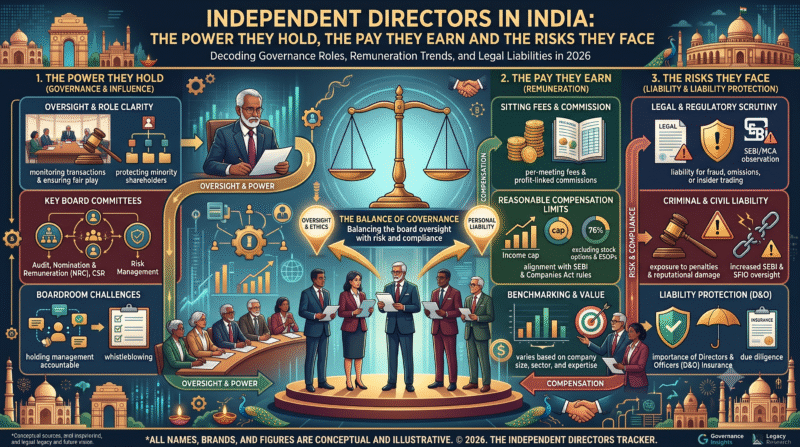
An independent director may not run a company’s daily operations, approve every expense or manage its employees. Yet when financial irregularities emerge, related-party transactions raise concerns or management decisions threaten shareholder interests, the board’s independent directors can become some of the most important people in the room.
In India, independent directors are expected to provide objective oversight, question management and protect the interests of shareholders, particularly minority investors. Their role has become increasingly significant as companies grow larger, corporate structures become more complex and investors demand greater transparency.
But the position comes with a difficult balancing act: independent directors must challenge powerful executives without becoming involved in routine management, and they may face legal consequences if they fail to fulfil their responsibilities.
Who Qualifies as an Independent Director?
Under the Companies Act, 2013, an independent director is a non-executive director who meets prescribed criteria intended to protect independent judgement.
The law places restrictions on relationships and financial interests that could compromise a director’s independence. These include certain connections with the company, its promoters, management and related entities.
For listed companies, the Securities and Exchange Board of India (SEBI) also sets corporate-governance requirements under its listing regulations.
The objective is to prevent board positions from becoming ceremonial appointments filled by individuals who are unwilling or unable to challenge management.
The Power Inside the Boardroom
Independent directors are not merely advisers. They participate in board decisions and can influence how companies approach risk, strategy, executive appointments and financial reporting.
Their influence is especially important through board committees.
Audit committees oversee financial reporting, internal controls, audit processes and relevant related-party transactions. Independent directors can ask questions about accounting practices, unexplained expenses and weaknesses in risk management.
Nomination and remuneration committees help evaluate director candidates, recommend appointments and review executive compensation policies.
Risk and governance oversight allows directors to question whether management has identified material business risks and established appropriate controls.
For listed companies, these responsibilities operate alongside specific requirements under SEBI’s listing regulations.
Protecting Minority Shareholders
Promoters and controlling shareholders may have substantial influence over a company’s direction. Minority shareholders, by contrast, often have limited ability to influence individual decisions.
Independent directors are expected to help ensure that board decisions consider the interests of shareholders as a whole rather than serving only the interests of a controlling group.
This becomes particularly important when companies enter transactions involving promoters, group companies or entities connected to senior management.
Such transactions are not automatically improper. However, they require appropriate scrutiny, disclosure and approvals under applicable law.
Independent directors must assess whether the terms are fair, whether conflicts have been managed and whether the decision is in the company’s interests.
How Much Do Independent Directors Earn?
Independent-director remuneration varies considerably depending on the company, its size, the number of board and committee meetings, and the director’s responsibilities.
Compensation can include sitting fees, reimbursement of eligible expenses and commission linked to profits, subject to legal requirements and shareholder approvals where applicable.
Section 149(9) of the Companies Act, 2013, provides that independent directors are not entitled to stock options. This restriction is intended to preserve their independent judgement rather than tie their financial incentives directly to the company’s share-price performance.
There is no single standard salary for independent directors. Some companies pay relatively modest meeting fees, while larger listed companies may provide more substantial annual commissions and other permitted remuneration.
The company’s annual report is generally the best place to examine the actual payments made to individual directors.
Accountability When Things Go Wrong
The position carries legal responsibilities. Independent directors are expected to exercise appropriate care, skill and diligence, and to use independent judgement when performing their duties.
However, they are not automatically responsible for every mistake or violation committed by a company.
Section 149(12) of the Companies Act provides a specific framework for the liability of independent directors and certain non-executive directors who are not promoters or key managerial personnel.
Broadly, liability may arise in respect of acts or omissions that occurred with their knowledge, attributable through board processes, and with their consent or connivance, or where they failed to act diligently, subject to the statutory conditions.
The practical implication is important: directors cannot rely solely on the argument that they were not involved in daily operations if they ignored warning signs or failed to carry out their oversight duties.
Why Independence Can Be Difficult
Formal eligibility does not always guarantee genuine independence.
A director may have no disqualifying financial relationship with a company but still face pressures arising from professional networks, repeated appointments, personal relationships or the influence of powerful promoters.
Boardroom dynamics can make matters more complicated. Challenging a CEO or promoter may create tension, particularly when management controls much of the information available to directors.
Independent directors therefore need access to reliable information, adequate time to prepare for meetings and the confidence to request explanations when something appears inconsistent.
Resigning from a board may sometimes be necessary, but it does not automatically erase responsibilities relating to earlier decisions.
The Lessons From Corporate Governance Disputes
India’s corporate history has repeatedly demonstrated why independent oversight matters.
The Tata-Mistry dispute, which began in 2016, highlighted tensions involving board authority, executive leadership and corporate governance in a major business group. Other corporate controversies have raised broader questions about financial disclosures, related-party dealings and whether boards respond effectively to warning signs.
These cases do not mean that independent directors are responsible for every corporate dispute. Instead, they show why boards need clear procedures, documented deliberations and meaningful challenge to management decisions.
An effective independent director must be willing to ask difficult questions before a problem becomes a public crisis.
What Makes an Effective Independent Director?
The strongest independent directors bring more than an impressive résumé or a prestigious professional background.
They understand financial statements, recognise potential conflicts of interest and have enough sector knowledge to challenge management assumptions. They also prepare for meetings, document concerns and follow up on unresolved issues.
Companies, meanwhile, must ensure that directors receive accurate information and have the freedom to perform their duties without inappropriate pressure.
The Future of Board Accountability
As Indian companies attract more institutional investment and face greater public scrutiny, independent directors are becoming central to the credibility of corporate governance.
Their value lies not in approving every proposal or opposing management by default, but in ensuring that decisions are properly examined, risks are understood and shareholders’ interests are considered.
The role is ultimately defined by a difficult principle: independence must be demonstrated through conduct, not merely declared in an appointment letter.
For India’s corporate boards, that distinction can separate meaningful oversight from governance that exists only on paper.
Useful links for readers