




India’s startup ecosystem is entering a more mature phase, and the public markets are becoming an increasingly important destination for companies that once depended almost entirely on private capital. In 2026, the startup IPO pipeline is being closely watched as founders, investors, and employees seek exits while public-market investors assess whether high-growth businesses can translate their private-market narratives into sustainable, publicly listed companies.
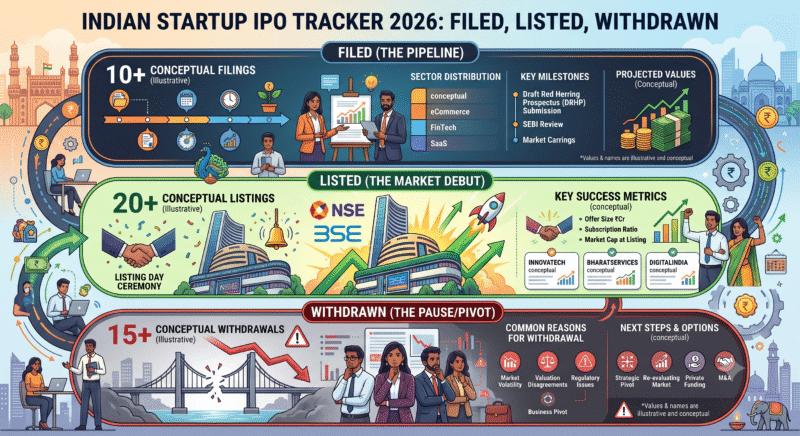
The year’s IPO activity is not simply about counting listings. Companies can sit at different stages of the process, from preparing financial statements and filing regulatory documents to receiving approval, launching an issue, listing shares, or stepping back from a proposed offering.
The IPO Pipeline Expands
For startups, an IPO represents a significant transition. Private companies typically have greater flexibility around fundraising, valuation expectations and shareholder composition. Public companies face continuous disclosure requirements, quarterly scrutiny and a much wider investor base.
The 2026 pipeline therefore includes companies at several stages of preparation. Some businesses have moved toward formal filings, while others remain in the planning or documentation phase.
A filing itself does not guarantee that an IPO will take place. Market conditions, valuations, regulatory observations and investor demand can all influence the final decision.
Filed Does Not Mean Listed
One of the most important distinctions in an IPO tracker is between a company that has filed its offer documents and one that has actually completed a listing.
The filing stage generally signals that a company has begun the formal public-market process. Regulatory review follows, and companies may need to respond to observations before proceeding.
Even after receiving regulatory clearance, the company and its advisers still have to determine the timing, issue structure and pricing strategy.
This makes the “filed” category an indicator of potential future activity rather than a confirmed listing.
The Listed Startups
Companies that successfully complete their IPOs enter an entirely different operating environment.
After listing, their share prices become publicly visible and can fluctuate based on earnings, growth expectations, sector sentiment, interest rates and broader market conditions.
For startup investors, a listing can create an important liquidity event. Employees holding eligible shares or options may also gain a potential route to monetisation, subject to applicable rules and lock-ins.
For the company itself, the IPO can provide access to a larger pool of capital and increase visibility with institutional and retail investors.
Why Some IPOs Get Delayed
The journey from filing to listing is rarely linear.
A company may postpone an offering if market conditions deteriorate or if valuations available in the public market fall below expectations. Weak demand in comparable stocks can also influence timing.
Startups operating in highly competitive sectors face an additional challenge: public investors often demand clearer evidence of revenue quality, profitability or a credible path toward sustainable earnings.
Consequently, delaying an IPO can sometimes become a strategic decision rather than a sign that the underlying business has stopped growing.
Withdrawn IPO Plans
The “withdrawn” category is equally important in tracking India’s startup public-market story.
A withdrawn or shelved IPO does not necessarily mean that a company has abandoned its growth ambitions. It can reflect changes in market conditions, valuation disagreements, business priorities or a decision to pursue private funding instead.
For investors, withdrawals demonstrate that the IPO pipeline is dynamic. Companies can move forward, pause or change direction as circumstances evolve.
What Investors Are Watching
Investors are increasingly looking beyond headline valuation when evaluating startup IPO candidates.
Revenue growth remains important, but questions around customer acquisition costs, contribution margins, cash generation, profitability and governance have become central to public-market analysis.
The quality of financial reporting also becomes more significant once a startup moves toward an IPO. Public investors need consistent information to evaluate performance against expectations.
For companies with previously aggressive growth strategies, the transition can require a substantial change in financial discipline.
A New Phase for Indian Startups
The 2026 IPO landscape reflects a broader evolution in India’s startup ecosystem. The focus is gradually moving from fundraising milestones and private valuations toward public-market accountability.
An IPO can provide capital, liquidity and visibility, but it also exposes startups to continuous scrutiny.
That makes the Indian Startup IPO Tracker more than a list of companies. It is a snapshot of how businesses move through the final stages of the venture-capital lifecycle — from private funding and regulatory filings to public ownership, delayed offerings or withdrawal.
As the year progresses, the key story will not simply be how many startups reach the stock exchanges. It will be how successfully these companies adapt their growth models, governance structures and financial performance to the demands of public markets.