





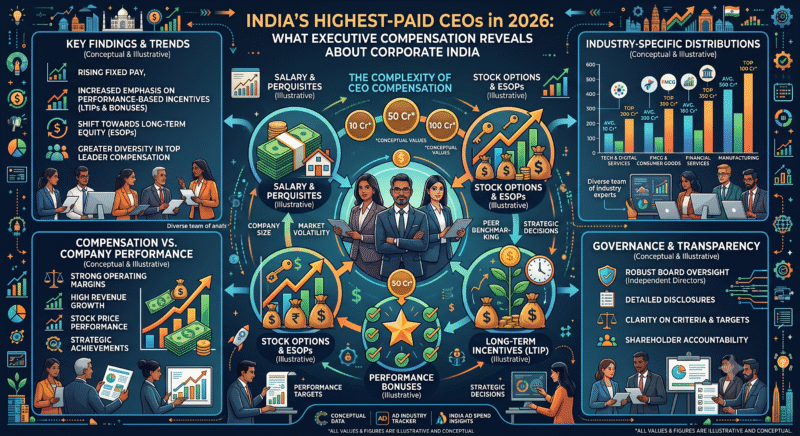
CEO compensation remains one of the most closely watched indicators of corporate power in India. Every year, annual reports and regulatory disclosures reveal how much the country’s top executives earn through salaries, allowances, commissions, stock-linked benefits and other forms of remuneration.
In 2026, the conversation around CEO pay extends beyond a single salary figure. Executive compensation increasingly combines fixed pay with performance incentives and long-term wealth creation through shares or stock-linked awards.
For investors, employees and shareholders, understanding that structure can be more useful than simply identifying the largest headline package.
Salary Is Only One Part
A CEO’s reported remuneration can contain several components.
The basic salary is generally accompanied by allowances, benefits, bonuses and performance-linked incentives. Some executives may also receive commissions linked to profits or other corporate performance measures.
Long-term incentive plans can make compensation considerably larger in certain years, particularly when share-based awards vest or when performance conditions are achieved.
As a result, two executives with similar annual salaries can have very different total compensation packages.
Large Companies, Larger Packages
India’s biggest listed companies tend to dominate discussions around executive compensation.
Large banking, technology, pharmaceutical, automobile, consumer and infrastructure businesses operate at enormous scale. Their CEOs are responsible for organisations with thousands of employees, extensive assets and operations that can span multiple countries.
Compensation packages therefore often reflect the size and complexity of the businesses being managed.
However, company size alone does not determine executive pay. Ownership structures, board policies, industry norms and individual employment contracts can all influence remuneration.
Performance Linked Pay
One of the biggest changes in executive compensation has been the increased importance of variable pay.
Boards may link bonuses to revenue growth, profitability, shareholder returns, operational targets or other strategic objectives.
This structure is intended to align management incentives with corporate performance.
But the relationship is not always straightforward. A company’s share price can be influenced by factors beyond management control, including interest rates, currency movements, commodity prices and broader economic conditions.
Stock Awards Change the Picture
Equity-based compensation has become particularly important in technology and new-economy businesses.
Executives may receive restricted stock, stock options or other equity-linked awards as part of their compensation. These instruments can create significant long-term value if the company’s market capitalisation increases.
At the same time, equity compensation can fluctuate sharply because its eventual value depends on the company’s share price and applicable vesting conditions.
This is why headline compensation numbers need to be read alongside the underlying structure.
Professional CEOs and Promoter Leaders
India’s corporate landscape includes both professional managers and promoter-led businesses.
Professional CEOs generally operate under compensation structures approved by boards and shareholders, with remuneration linked to employment agreements and performance criteria.
Promoter executives can have a different economic profile because their personal wealth may come primarily from their ownership stake rather than their annual salary.
A relatively modest salary therefore does not necessarily indicate a small economic interest in a company.
Why Investors Watch CEO Pay
Executive compensation can provide useful information about corporate governance.
Investors may examine whether pay is aligned with company performance, whether incentives encourage long-term decision-making and whether remuneration policies are clearly disclosed.
The comparison between CEO compensation and employee pay is another frequently discussed metric.
However, compensation ratios should be interpreted carefully because companies operate across different industries, geographies and workforce structures.
The Transparency Factor
Listed Indian companies are required to disclose significant information about managerial remuneration through their corporate filings and annual reports.
These disclosures make it possible for shareholders to examine the components of executive pay rather than relying solely on headline figures.
They also allow investors to track how compensation changes from year to year.
A sharp increase may result from a larger bonus, a change in employment terms, the vesting of equity awards or exceptional performance-linked payments.
What the 2026 Pay Landscape Shows
India’s highest-paid CEOs represent a wide range of industries and leadership models. Their compensation reflects not only annual salaries but also incentives designed to reward performance and retain senior executives.
The most meaningful comparison is therefore not simply who receives the biggest number in a particular year.
A fuller assessment considers fixed compensation, variable pay, equity awards, company performance, ownership and the duration of the executive’s role.
As Indian companies become larger and increasingly global, CEO compensation will remain an important part of the corporate-governance conversation. The 2026 compensation landscape offers investors a detailed look at how India’s largest businesses value, incentivise and retain the executives responsible for leading them.