




When two or more founders start a company, splitting ownership may seem straightforward. One founder might take 60%, another 40%, and everyone begins building the business.
But what happens if one founder leaves six months later?
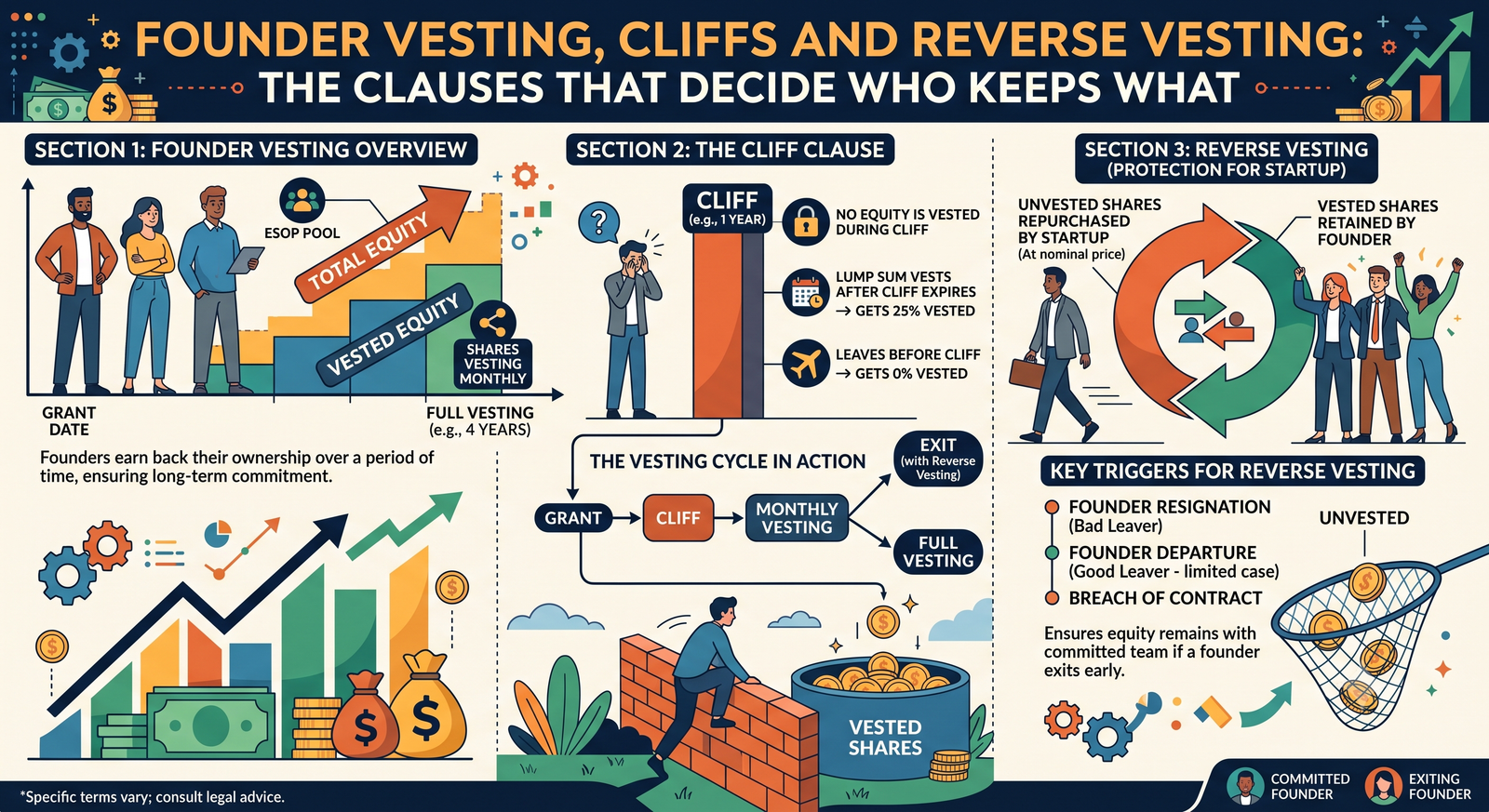
This is where founder vesting, cliffs and reverse vesting become important. These provisions determine how founder equity is earned over time and what can happen to shares when a founder leaves.
For first-time founders, understanding these clauses before incorporation or fundraising can prevent serious disputes later.
What Is Founder Vesting?
Founder vesting means a founder’s equity becomes fully earned over a specified period rather than being treated as permanently secured from day one.
A common structure is four-year vesting.
Under such an arrangement, a founder may technically hold shares from the beginning, but those shares are subject to contractual restrictions that determine what happens if the founder leaves before the vesting period is complete.
The purpose is to align long-term ownership with long-term contribution.
Why Investors Care About Vesting
Investors generally want confidence that the people responsible for building the company will remain involved.
Imagine three founders own equal portions of a startup.
If one founder leaves shortly after a major investment, that person could potentially retain a substantial ownership stake while no longer contributing to the business.
Founder vesting can reduce this problem.
It creates a mechanism through which unearned founder equity can potentially return to the company or be dealt with according to the agreed terms.
The One Year Cliff
A cliff creates an initial period during which no equity vests.
A common example is a one-year cliff followed by monthly or quarterly vesting.
If a founder leaves before completing the first year, none of the equity may vest under that arrangement.
Once the founder reaches the cliff date, a specified portion may vest, followed by additional vesting over the remaining period.
The exact structure depends on the founders’ agreement and company documents.
A Simple Example
Suppose a founder has 20% of the company subject to a four-year vesting schedule with a one-year cliff.
If the founder leaves after six months, the agreement may provide that none of the subject equity has vested.
If the founder leaves after 18 months, a portion may have vested, while the remainder remains subject to the vesting arrangement.
The precise calculation depends on the contract.
This is why founders should not rely on informal understandings.
What Is Reverse Vesting?
Reverse vesting works somewhat differently.
Under a reverse-vesting arrangement, founders may receive or hold their shares upfront, but the company or other shareholders retain a contractual right to repurchase or reclaim the portion that has not yet vested if the founder leaves.
In practical terms, the founder may appear to own the shares from the beginning, but those shares remain subject to vesting restrictions.
This structure can be particularly relevant when founders incorporate a company and issue shares before raising institutional funding.
Why the Distinction Matters
Traditional vesting and reverse vesting can produce similar economic outcomes while being structured differently legally.
The difference can matter for taxation, documentation, shareholder rights and the mechanics of what happens when a founder exits.
Founders should therefore understand the actual legal provisions rather than focusing only on the phrase “four-year vesting.”
What Happens When a Founder Leaves?
The outcome depends on the agreements.
Unvested shares or options may be forfeited, repurchased or otherwise dealt with under the relevant documents.
Vested equity may generally remain with the departing founder, although additional contractual provisions can affect the treatment.
The circumstances of departure can also matter.
Agreements sometimes distinguish between different types of exits, such as voluntary resignation, termination for cause, disability or other circumstances.
Good Leaver and Bad Leaver Provisions
Some founder agreements include good leaver and bad leaver provisions.
These clauses establish different consequences depending on why and how a person leaves the company.
For example, a founder who leaves because of circumstances outside their control may be treated differently from someone who breaches significant contractual obligations.
The definitions and consequences vary considerably between agreements.
Founders should examine the exact wording rather than assuming that “good” or “bad” has a universally accepted meaning.
Acceleration Clauses
Another important concept is vesting acceleration.
Acceleration can cause some or all unvested equity to vest earlier than scheduled when specified events occur.
One possible trigger is a change of control, such as an acquisition.
Some agreements use single-trigger acceleration, while others use double-trigger structures involving both a change of control and a subsequent termination or significant change in the founder’s role.
These provisions can materially affect founder equity during an acquisition.
What Founders Should Check
Before signing founder-equity documents, founders should understand:
- Total equity subject to vesting
- Vesting period
- Cliff period
- Frequency of vesting after the cliff
- Treatment of vested and unvested shares
- Repurchase rights
- Good-leaver and bad-leaver provisions
- Acceleration provisions
- Treatment during an acquisition
- Tax implications
- What happens if a founder resigns or is removed
Why These Clauses Matter Before Fundraising
Founder vesting often becomes part of investor discussions during institutional fundraising.
Investors may want to ensure that key founders remain economically aligned with the company.
If founder equity has no vesting mechanism, investors may ask for the structure to be changed as part of the financing process.
Negotiating these provisions before a major funding round can therefore reduce uncertainty later.
The Bigger Picture
Founder equity represents more than a percentage on a cap table.
It can determine who continues to benefit from a company’s growth and how ownership changes when a founder leaves.
Vesting creates a connection between time, contribution and ownership. Cliffs establish an initial commitment period. Reverse vesting provides another contractual mechanism for handling founder shares over time.
For first-time founders, the important lesson is simple: never treat vesting language as routine paperwork.
Before signing, understand exactly when equity becomes secure, what happens if someone leaves, what rights the company has over unvested shares and how exceptional events such as acquisitions are treated.
A few clauses signed at the beginning of a startup can have consequences for founder ownership years later.