




India’s startup funding market has entered a more selective phase. Large rounds continue to attract attention, but investors are increasingly examining revenue quality, cash burn, margins and the path to profitability before committing capital.
That makes a funding tracker more useful than simply maintaining a list of headline-making deals.
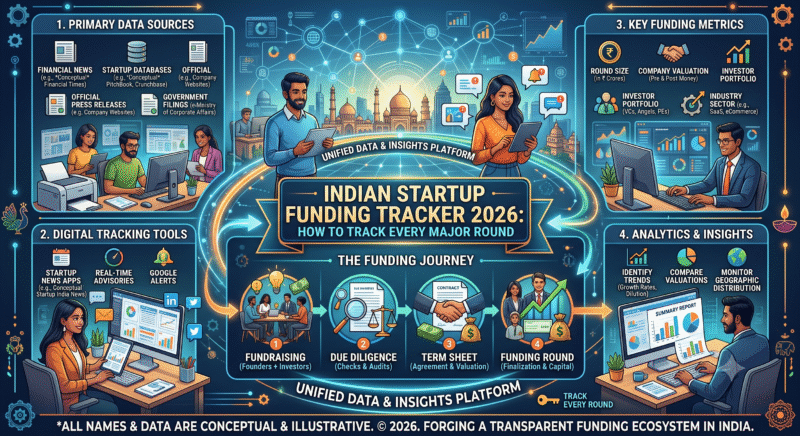
A serious tracker needs to show who raised money, how much was raised, which investors participated, what stage the company is at and what the funding is intended to achieve.
What a Funding Tracker Actually Measures
A startup funding tracker records financing transactions over a defined period.
The most common information includes the company’s name, sector, funding stage, amount raised, lead investor, participating investors and date of announcement.
For companies that have raised multiple rounds, the tracker can also show their funding history.
This helps readers distinguish a first institutional round from a later growth-stage financing.
Seed Rounds Remain Important
Seed funding is often the first significant institutional capital a startup receives.
These rounds can finance product development, early hiring, customer acquisition and market testing.
Seed deals are generally smaller than later-stage rounds, but they can be particularly important because investors are often backing a combination of founders, technology and market opportunity rather than an established financial track record.
Series A Changes the Conversation
By the time a startup reaches Series A, investors typically have more operating information to examine.
Revenue, customer growth, retention, unit economics and product-market fit can become increasingly important.
The funding may be used to expand the team, enter new markets, increase marketing or strengthen technology infrastructure.
The size of the round can vary considerably depending on the sector and the company’s stage.
Growth Capital Looks Different
Later-stage startups can raise substantially larger rounds.
Investors may examine revenue growth, margins, cash generation and the company’s ability to reach profitability.
At this stage, funding can support acquisitions, geographic expansion, technology investments or preparation for a public listing.
A large round does not necessarily indicate the same thing for every company.
The purpose of the capital matters.
The Sector Story
A useful 2026 tracker should also categorize funding by sector.
Artificial intelligence, fintech, healthtech, climate technology, consumer businesses, SaaS, logistics and deep technology can attract very different types of investors.
Sector-based tracking makes it easier to identify where venture capital is concentrating.
It can also reveal categories where funding activity has slowed.
What Investors Are Watching
The funding environment has become more focused on business fundamentals.
Investors may examine:
Revenue growth: Is the company expanding?
Customer economics: Does each customer generate sustainable value?
Burn rate: How quickly is the company consuming cash?
Runway: How long can the existing capital support operations?
Margins: Are economics improving as the business scales?
Path to profitability: Can the company eventually operate without continuous external funding?
These factors help explain why two startups raising identical amounts can be viewed very differently by the market.
Funding Does Not Equal Revenue
One of the most common mistakes in startup coverage is treating funding as evidence of business performance.
A company raising ₹100 crore has received ₹100 crore of investment capital.
That does not mean it generated ₹100 crore in revenue.
Funding is financing.
Revenue comes from customers.
The distinction is essential when comparing startups.
Valuation Matters Too
A funding round should ideally be tracked alongside valuation information when that information is publicly available.
A company can raise a large amount while giving up a relatively small percentage of equity if its valuation is high.
Another company may raise less capital but experience greater dilution.
The amount raised therefore tells only part of the fundraising story.
New Investors Versus Existing Investors
Funding announcements often mention several investors.
A tracker should distinguish between new investors joining a company and existing investors participating in another round.
Existing investors putting more capital into a startup can signal continued financial support, while new institutional investors can broaden the company’s shareholder base.
Secondary transactions should also be distinguished from primary fundraising.
Why Secondary Deals Are Different
In a primary funding round, new shares are generally issued and the company receives the capital.
In a secondary transaction, existing shareholders sell shares to another investor.
The company may not receive the proceeds.
This distinction becomes especially important when analyzing how much fresh capital is actually available for business operations.
How to Build a Reliable Tracker
A useful funding database can contain columns for:
- Startup name
- Sector
- Funding stage
- Amount raised
- Date
- Lead investor
- Other investors
- Previous funding
- Reported valuation
- Primary or secondary transaction
- Intended use of funds
- Founder or leadership information
Keeping these fields consistent makes comparisons much easier.
Why Weekly Updates Matter
Startup funding information changes quickly.
A round announced today may be followed by another transaction next week.
Some deals are announced without revealing the complete financial terms, while others are disclosed through regulatory filings or company statements later.
A weekly tracker can therefore provide a more current picture than an annual funding list.
Looking Beyond the Biggest Rounds
The biggest funding announcements naturally attract attention.
But a complete tracker should not focus only on billion-dollar companies.
Seed-stage businesses, regional startups and specialized technology companies can provide important signals about where new ideas are emerging.
Tracking smaller rounds can also reveal industries before they become major investment themes.
The Bigger Picture for 2026
India’s startup funding market is increasingly being shaped by discipline.
Investors continue to finance companies with ambitious growth plans, but the conversation has expanded beyond valuation and headline funding.
Revenue, margins, cash efficiency and sustainable growth are becoming increasingly important parts of the story.
A good startup funding tracker should therefore do more than answer “Who raised how much?”
It should help answer the more useful questions: Why did the company raise the money, who invested, what changed in its ownership, where will the capital go, and what does the round reveal about India’s evolving startup economy?