




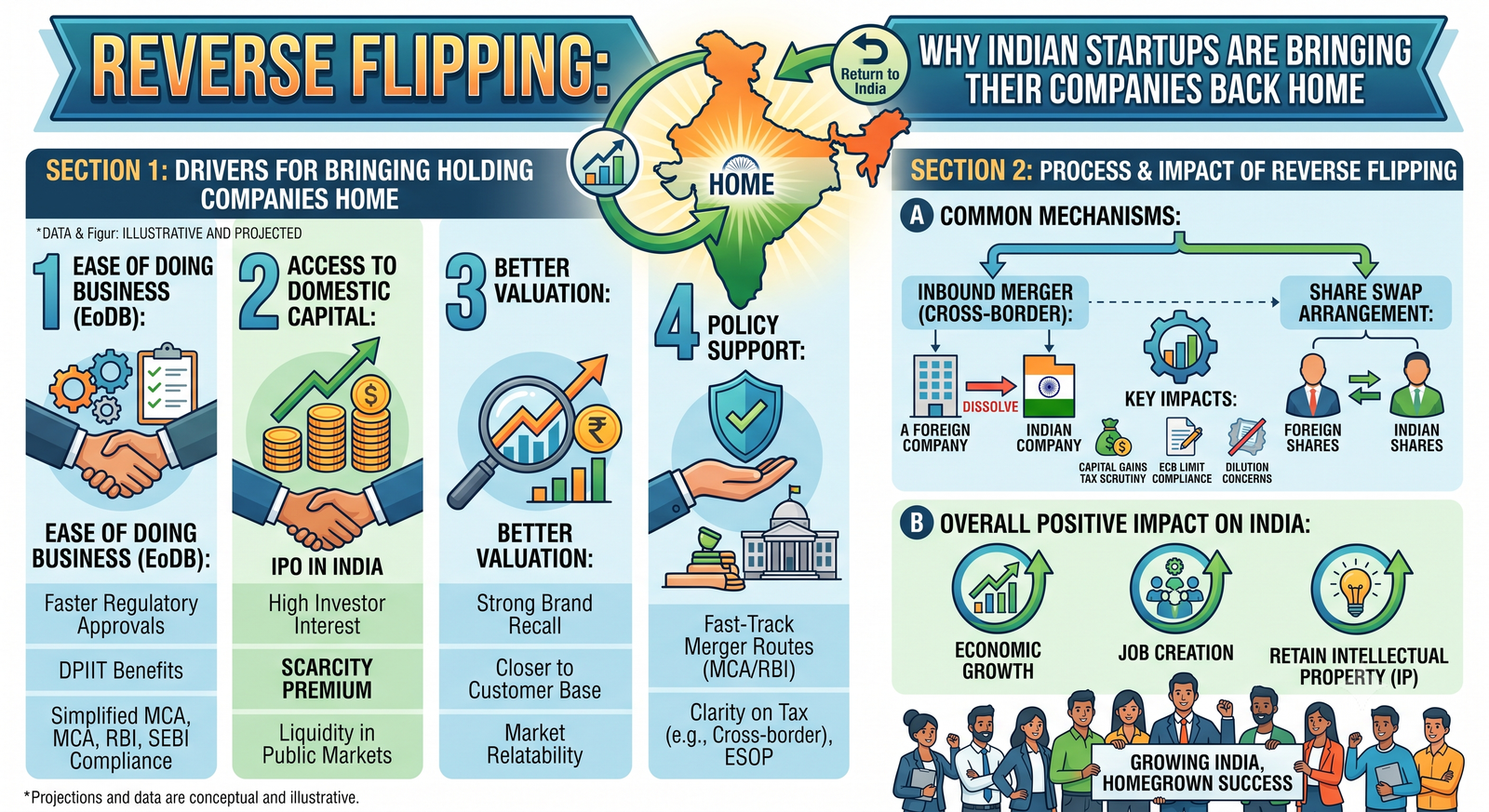
For years, some Indian startups chose to incorporate their parent companies outside India before building large businesses in the domestic market. Locations such as Singapore, the United States and other international jurisdictions were often used for holding structures, fundraising and access to global investors.
Now, a different trend is emerging.
Some Indian startups are exploring reverse flipping the process of shifting their holding or parent company structure back to India.
The move reflects changes in India’s startup ecosystem, capital markets and the ambitions of companies that increasingly see the domestic market as central to their long-term growth.
What Is Reverse Flipping?
A traditional “flip” generally involves an Indian operating company becoming part of a foreign parent structure.
For example, a startup may establish a holding company overseas, with its Indian business operating as a subsidiary.
A reverse flip effectively moves that structure in the opposite direction.
The foreign holding company is reorganized so that an Indian company becomes the parent.
The exact legal and tax structure varies from one transaction to another.
Why Did Startups Flip Overseas?
The original decision to incorporate overseas was often driven by practical considerations.
International investors were familiar with certain jurisdictions and their corporate laws.
Foreign incorporation could also make it easier to raise capital from global venture funds or structure international acquisitions.
For startups targeting global investors, having a parent company in a widely used investment jurisdiction could simplify fundraising.
At the time, India’s venture-capital ecosystem was considerably smaller than it is today.
India’s Startup Market Has Changed
The environment is now different.
India has developed a much larger venture-capital and private-equity ecosystem.
The country also has a growing pool of domestic institutional investors and a deeper public equity market.
As startups mature, founders may increasingly consider whether maintaining an overseas holding company still provides the same advantages it did during the company’s early years.
Public Markets Are Part of the Equation
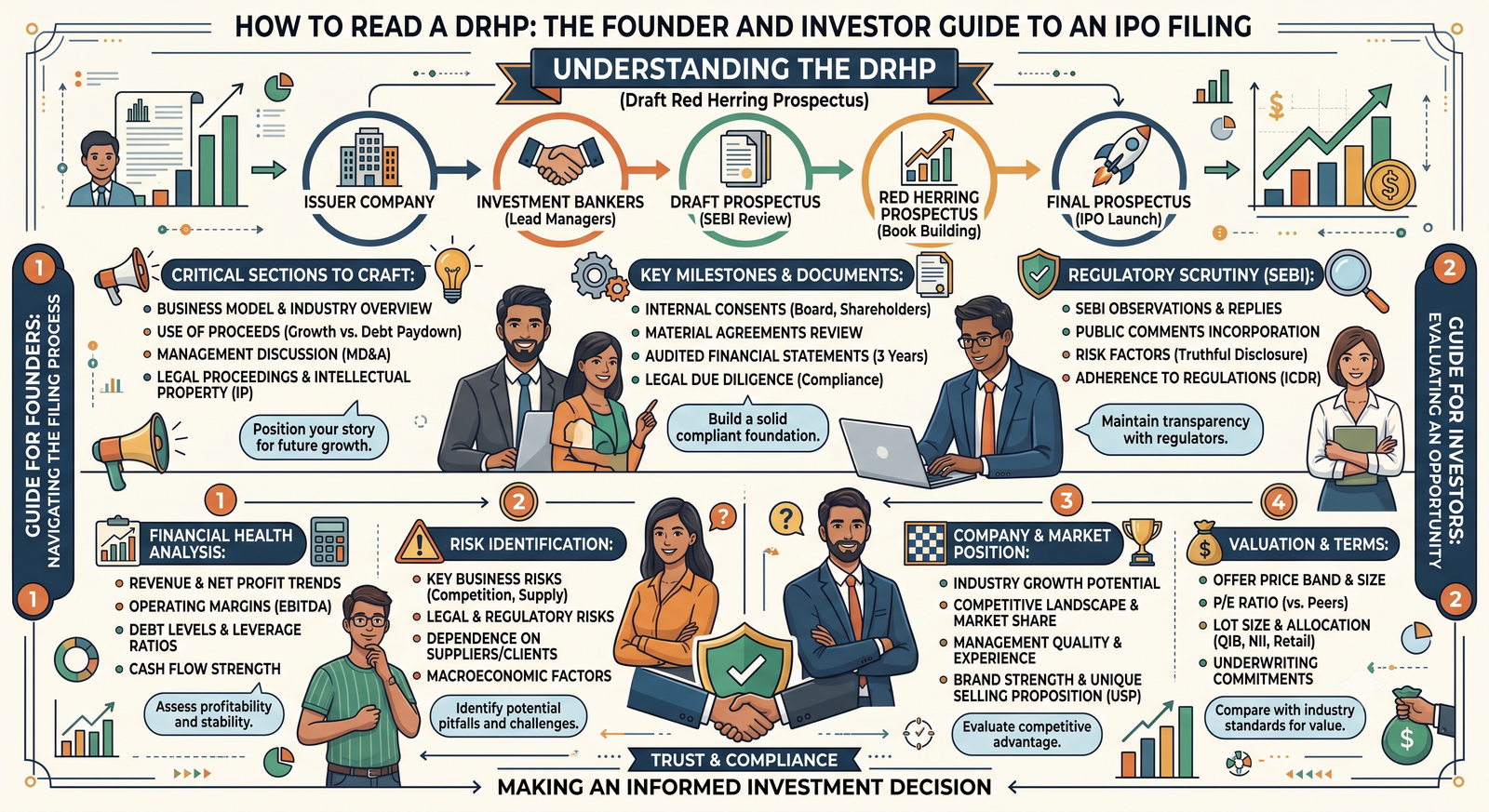
One major factor behind reverse flipping is the growth of India’s public markets.
Several technology companies have demonstrated that Indian stock exchanges can accommodate large listings from new-age businesses.
For a startup expecting its long-term shareholder base to be largely Indian, having the parent company domiciled in India can make a future domestic listing structurally more straightforward.
A company does not necessarily need to be Indian-domiciled to pursue every type of listing, but corporate structure can become an important consideration as an IPO approaches.
Investors Are Also Changing
India’s investment ecosystem now includes a larger number of domestic funds, family offices and institutional investors.
These investors can provide capital at different stages of a company’s development.
As the domestic capital base expands, startups may have less need to maintain an overseas parent purely for fundraising convenience.
The decision still depends on the company’s investor mix and future plans.
The Tax and Legal Question
Reverse flipping is not simply an administrative change.
Moving ownership structures between jurisdictions can involve taxation, regulatory approvals, valuation requirements and legal restructuring.
Companies must examine how shares are transferred, how existing investors are treated and whether the restructuring creates tax obligations.
For founders and shareholders, the details can be as important as the headline announcement.
What Happens to Existing Investors?
A reverse flip can require careful coordination with existing shareholders.
Investors who originally invested in the foreign parent may need to receive shares in the newly structured Indian entity or participate in another approved arrangement.
The objective is generally to preserve the economic interests of shareholders while changing the corporate structure.
However, the precise mechanism differs from company to company.
Employees Can Be Affected Too
Employee stock options can make corporate restructuring more complicated.
Employees may hold options in the overseas parent company rather than directly in the Indian operating entity.
A reverse flip may therefore require the company to restructure or replace existing equity awards.
The treatment of vested and unvested options, exercise prices and taxation can vary depending on the transaction.
For employees, understanding the revised ESOP terms is important.
Why Founders Are Looking Homeward
For founders, reverse flipping can represent a shift in the company’s long-term identity.
A startup that began by targeting international investors may eventually become primarily an Indian business with Indian customers, employees and capital-market ambitions.
Bringing the parent company back to India can align the legal structure with where much of the company’s economic activity takes place.
It can also simplify the relationship between the company and its domestic stakeholders, depending on the structure.
A Sign of Maturity
The reverse-flipping trend reflects a broader change in India’s startup ecosystem.
A decade ago, many startups were building businesses in an environment where global capital was scarce and domestic technology markets were still developing.
Today, India has a much deeper technology sector, a larger investor base and more mature public markets.
That does not mean every startup should move its domicile to India.
For some companies, an international structure may remain useful because of overseas operations, global investors or international expansion plans.
The Road Ahead
Reverse flipping is ultimately a corporate-structuring decision rather than a simple declaration of national preference.
Startups need to weigh taxation, regulation, investor requirements, employee equity, future fundraising and potential IPO plans before making the move.
But the growing discussion around reverse flipping reveals something important about India’s startup economy.
Indian startups are increasingly reaching a stage where their founders and investors can consider India not merely as the place where the business operates, but also as the long-term home for ownership, capital and public-market ambitions.
The direction of the corporate structure is changing as the ecosystem itself matures.