




When a startup is small, corporate governance can feel like paperwork that can wait. Founders are focused on building products, hiring teams, raising capital, and finding customers.
As the company grows, however, governance becomes much more important.
Board meetings, shareholder approvals, related-party transactions, financial controls, and statutory filings may appear administrative, but they can directly affect fundraising, acquisitions, employee trust, and the company’s ability to scale.
What Is Corporate Governance?
Corporate governance is the system through which a company is directed, controlled and held accountable.
It covers the responsibilities of founders, directors, shareholders and management.
For an Indian startup, governance can involve board procedures, statutory compliance, financial reporting, shareholder rights, related-party transactions and internal controls.
The exact requirements depend on the company’s legal structure, size, funding history and applicable laws.
Why Startups Often Treat It as an Afterthought
Early-stage founders frequently operate with small teams.
A few people may handle finance, legal matters, operations and fundraising simultaneously.
Informal decision-making can work when the company is tiny.
Problems emerge when the startup raises institutional capital and ownership becomes more complex.
Investors expect formal records and clear decision-making processes.
The Board Is More Than a Formality
A startup’s board is responsible for important oversight and decision-making functions.
As institutional investors join, the board may include founder representatives, investor nominees and independent directors where required or appropriate.
Board meetings should not simply be a formality.
Important decisions, financial performance, risks and strategic matters need appropriate discussion and documentation.
A well-functioning board can provide oversight without taking away management’s responsibility for running the business.
Shareholder Approvals Matter
Certain corporate actions require shareholder approval under applicable law or the company’s governing documents.
These can include matters such as issuing securities, changing share capital or approving particular transactions.
A common governance mistake is treating approvals as something to obtain after the transaction has already been completed.
Proper sequencing matters.
Founders should understand which decisions require board approval, shareholder approval or regulatory filings before taking action.
Cap Tables Need to Be Accurate
The cap table is one of the most important records in a venture-backed startup.
It should accurately reflect founders, investors, employee equity and other securities.
Errors can become serious problems during future funding rounds.
If the ownership records do not match signed agreements and statutory records, investors and lawyers may have to spend significant time resolving inconsistencies.
Good governance therefore starts with accurate ownership records.
Related Party Transactions
Founders often have other businesses, investments or family-linked entities.
Transactions between the startup and such connected parties may fall within related-party rules depending on the circumstances.
Examples can include renting property from a connected entity, purchasing services from a founder-linked company or entering into other commercial arrangements.
These transactions are not automatically improper.
The important issues are disclosure, approval, documentation and whether the transaction is conducted on appropriate terms.
Financial Controls Become Critical
A startup can grow rapidly while its internal financial systems remain informal.
That can create problems.
Companies need appropriate controls over payments, expenses, payroll, vendor contracts, bank accounts and accounting records.
As the amount of money flowing through a business increases, relying entirely on one person’s oversight becomes increasingly risky.
Good controls protect the company as well as its founders.
ESOP Governance Matters Too
Employee stock options can become a significant part of startup compensation.
Companies need accurate records of grants, vesting schedules, exercise terms and approvals.
Employees should also receive appropriate documentation explaining their equity arrangements.
Errors in ESOP records can become particularly complicated when the company raises a new funding round or prepares for an acquisition.
Founder Conflicts Can Become Governance Problems
Many startups begin with friends, colleagues or family members.
The relationship may be strong initially, but disagreements can emerge over strategy, roles, compensation or ownership.
Founder agreements can establish expectations around responsibilities, equity vesting, intellectual property, exits and dispute resolution.
Putting these matters in writing can reduce ambiguity later.
Compliance Is Not Just About Penalties
Corporate compliance is sometimes viewed purely as a legal obligation.
In reality, good records can become a business advantage.
During fundraising, investors conduct due diligence.
During an acquisition, buyers investigate the company’s legal and financial history.
During an IPO process, disclosure and governance requirements become substantially more demanding.
A startup with organized records can navigate these processes more efficiently.
Where Startups Commonly Slip
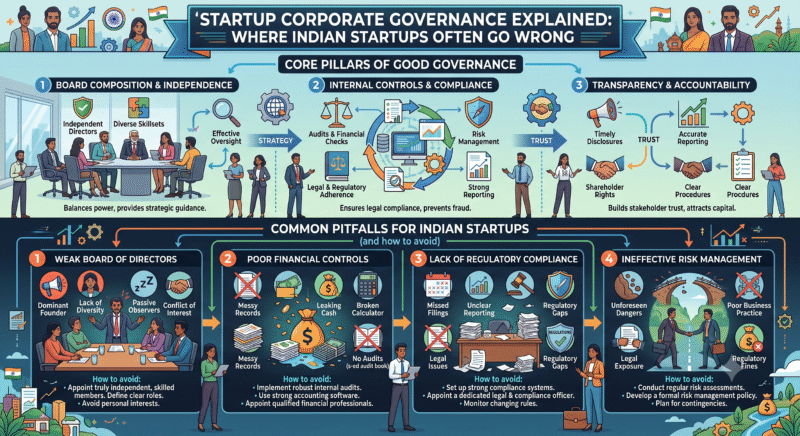
Some recurring governance problems include:
- Informal board decision-making
- Outdated cap tables
- Missing corporate approvals
- Poor documentation of related-party transactions
- Incomplete ESOP records
- Weak financial controls
- Unclear founder agreements
- Intellectual-property ownership issues
- Delayed statutory filings
- Mixing personal and company expenses
These problems may appear minor when a company is small but become expensive to fix later.
Governance Should Scale With the Company
A startup does not need the same governance infrastructure at ₹1 crore in annual revenue that it may need at ₹500 crore.
But governance should evolve as the company grows.
New investors, employees, subsidiaries and larger financial transactions increase the need for formal systems.
The objective is not to create unnecessary bureaucracy.
It is to make sure important decisions are documented, ownership is clear and financial information can be trusted.
The Founder’s Role
Good governance ultimately begins with the founders.
They set the tone for how the company treats records, approvals, conflicts and accountability.
Delegating finance or legal responsibilities does not remove the founder’s responsibility to understand the company’s governance structure.
Founders do not need to become lawyers or accountants.
They do need to know which decisions require formal processes and ensure the company has the right professionals and systems supporting them.
The Bigger Lesson
Corporate governance may seem less exciting than product launches, fundraising announcements or revenue growth.
But as a startup becomes a serious company, governance becomes part of the infrastructure supporting everything else.
Clean records can make fundraising smoother. Clear ownership can prevent disputes. Strong financial controls can protect capital. Proper board processes can improve accountability.
For Indian startups, the lesson is straightforward: governance should not begin when an IPO or acquisition is approaching. It should develop alongside the company.
A startup may be built on an idea, but a scalable company also needs systems capable of supporting that idea as the business becomes larger, more valuable and more complex.