



Gorur Ramaswamy Iyengar Gopinath, popularly known as Captain G. R. Gopinath, was born on November 13, 1951, in Gorur, a village in Karnataka.
He grew up in a rural environment where his father worked as a teacher. His early education took place in a village school before he joined the Sainik School in Bijapur.
Gopinath later entered the National Defence Academy and trained for a career in the armed forces. He served as an officer in the Indian Army, eventually attaining the rank of Captain.
After approximately eight years of military service, he took voluntary retirement in 1979 at the age of 28.
His decision to leave the Army marked the beginning of an unconventional entrepreneurial journey.
From Farming to His First Business Ventures
After leaving the Army, Gopinath returned to Karnataka and explored different business opportunities.
He started an agricultural venture focused on sericulture, the production of silk through silkworm cultivation. He experimented with environmentally sustainable farming practices and worked towards improving productivity.
His efforts earned him the prestigious Rolex Award for Enterprise in 1996 for his work in ecological silk farming.
He also explored other ventures, including a motorcycle dealership and hospitality-related businesses.
These experiences taught him about managing costs, dealing with customers and building businesses in markets where resources were limited.
Entering Aviation: The Birth of Deccan Aviation
Gopinath’s entry into aviation began in 1997 when he co-founded Deccan Aviation, a helicopter charter company.
The business offered services such as aerial photography, geological surveys, pipeline inspections, medical evacuation and other specialised aviation operations.
His experience in the Army and his connections with former military pilots helped him identify an opportunity in the charter aviation market.
The company began with limited resources but gradually developed its operations.
According to a University of Pennsylvania Wharton School interview, the idea for Deccan Aviation emerged after Gopinath recognised the availability of trained pilots and the growing need for specialised aviation services in India.
The Big Idea: Making Every Indian Fly
While building Deccan Aviation, Gopinath began thinking about a much larger opportunity.
At the time, air travel in India was largely associated with wealthy businesspeople and affluent families. Most ordinary Indians relied on trains and buses for long-distance journeys.
Gopinath believed that a large section of the population could become air travellers if ticket prices were made affordable.
His vision was simple: flying should not remain a luxury.
He wanted to create an airline that would connect smaller cities and towns while offering fares that could compete with the cost of some long-distance train journeys.
This idea became the foundation of Air Deccan.
The Launch of Air Deccan in 2003
In August 2003, Gopinath launched Air Deccan, widely recognised as India’s first major low-cost airline.
The airline began operations with a leased 48-seat ATR aircraft, connecting cities and regional destinations.
Its business model focused on reducing operating costs, improving aircraft utilisation and offering affordable fares.
The company introduced a pricing approach that made air tickets accessible to passengers who had never considered flying before.
One of its most memorable brand identities was the image of R. K. Laxman’s Common Man, reflecting the airline’s ambition to serve ordinary Indian travellers.
The IMD Business School case study describes how Air Deccan grew rapidly and helped change the competitive landscape of Indian aviation.
Changing the Indian Aviation Industry
Air Deccan’s affordable fares attracted passengers from different income groups.
The airline expanded its network to smaller cities and towns, helping bring new destinations onto India’s aviation map.
Its growth encouraged other airlines to introduce low-cost models and rethink their pricing strategies.
The Indian aviation industry began experiencing a major shift as budget carriers competed to attract middle-class passengers.
A Government of India aviation report identifies 2003 as the year low-cost carriers entered the Indian aviation market with Air Deccan.
By 2007, Air Deccan had become one of the country’s largest airlines by passenger traffic and route coverage.
The Kingfisher Deal and a New Chapter
In 2007, Vijay Mallya’s United Breweries Group acquired a controlling stake in Air Deccan.
The airline was subsequently integrated with Kingfisher Airlines’ operations, and the Air Deccan brand was phased out.
The deal marked the end of Gopinath’s leadership of the original Air Deccan venture.
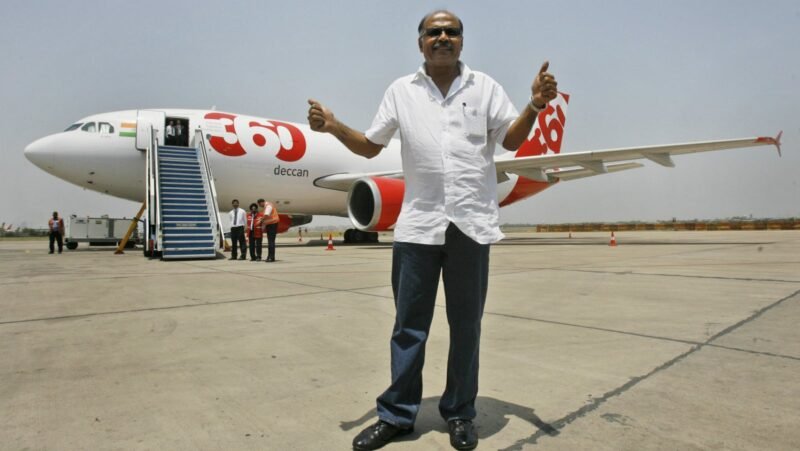
However, his entrepreneurial journey continued. He later launched Deccan 360, a cargo and logistics business, exploring opportunities in India’s freight transportation sector.
His experiences demonstrated both the opportunities and financial challenges involved in building businesses in capital-intensive industries.
From Air Deccan to a National Inspiration
Gopinath’s story later reached a wider audience through the book Simply Fly: A Deccan Odyssey, in which he described his journey from the Army to farming and aviation.
His entrepreneurial journey also inspired the Tamil film Soorarai Pottru and its Hindi adaptation Sarfira, although the films are fictionalised interpretations rather than exact biographies.
His book and personal journey provide further insight into his experiences, business philosophy and aviation ambitions.
The Legacy of Captain G. R. Gopinath
Captain G. R. Gopinath’s contribution to Indian aviation went beyond establishing an airline.
He challenged the belief that air travel was meant only for wealthy passengers and demonstrated the potential of serving India’s enormous middle-class market.
Air Deccan’s low-cost model influenced the development of budget aviation in the country and helped make flying a more familiar option for ordinary travellers.
His journey from a village in Karnataka to the cockpit of India’s aviation transformation remains an important chapter in Indian entrepreneurship.
His central idea continues to resonate: business innovation can create opportunity when it makes something once considered exclusive accessible to more people.