





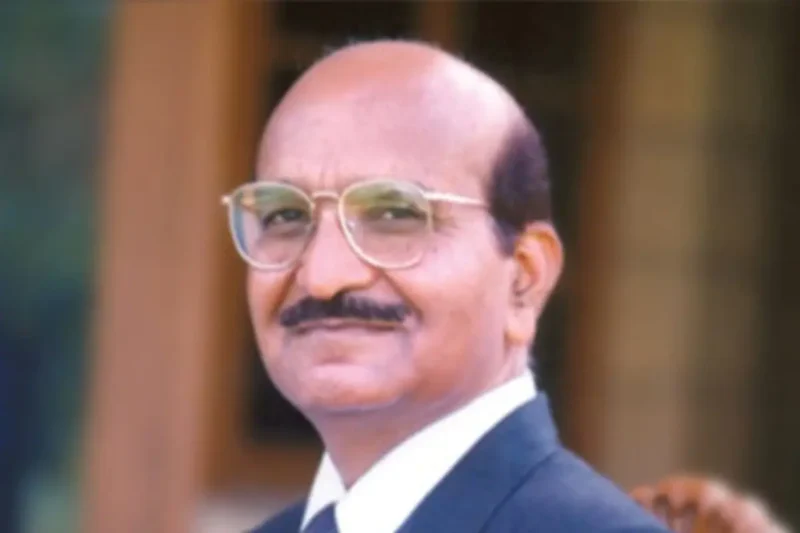
He started by making washing powder at home and selling it door to door. Decades later, Karsanbhai Patel had built Nirma into one of India’s recognised industrial groups. His journey is a remarkable example of how an affordable product, smart marketing and an understanding of ordinary consumers can reshape an entire market.
Humble Beginnings in Gujarat
Karsanbhai Khodidas Patel was born in 1945 in North Gujarat. Coming from a farming family, he pursued a Bachelor of Science degree in Chemistry before beginning his professional career.
He worked at New Cotton Mills in Ahmedabad and later joined the Gujarat government’s Department of Geology and Mining. His scientific background gave him useful knowledge of chemicals and manufacturing experience that would eventually become central to his entrepreneurial journey.
But Patel had ambitions beyond his government job. He wanted to create a product that could make everyday life more affordable for Indian families.
The ₹3 Idea That Changed the Market
In 1969, Patel began manufacturing detergent powder on a small scale at home. After completing his regular work, he would package the powder and sell it directly to households, often travelling by bicycle.
At a time when the detergent market was dominated by expensive products, he introduced Nirma at around ₹3 per kilogram. The significantly lower price made detergent accessible to consumers who could not afford premium alternatives.
He named the product after his daughter, Nirupama, whose nickname was Nirma. What began as a small after-hours venture soon developed into a growing business.
The company’s official history describes how its low-priced detergent created a new market segment and challenged established multinational brands.
Winning Customers Through Quality and Affordability
Patel understood that a low price alone would not build a lasting brand. Customers also needed a product that delivered value.
Nirma’s strategy combined affordable pricing with an emphasis on product performance. Its direct selling approach helped Patel understand consumer expectations, while word-of-mouth recommendations supported its expansion.
The brand’s advertising also played a major role. Its memorable television commercials and familiar jingle helped Nirma become a household name.
The company did more than compete with existing detergent brands: it helped expand the market by bringing more price-conscious households into the category.
From a Small Venture to a Corporate Company
As demand increased, Patel moved from small-scale production towards organised manufacturing. In 1980, Nirma Limited was formally established, with a manufacturing facility at Trikampura in Gujarat.
The company gradually expanded its product range to include soaps, beauty products and other consumer goods. It also entered industrial chemicals, including soda ash and linear alkyl benzene.
This diversification reduced its dependence on a single consumer product and created the foundation for a larger industrial business.
According to Nirma’s official journey, the company evolved from a single-product consumer business into a multi-location, multi-product group.
Taking on Established Brands
Nirma’s rise is often discussed as an important chapter in Indian marketing history. It challenged the assumption that detergent had to remain a premium-priced product and demonstrated the commercial potential of serving mass-market consumers.
Its success came from a combination of cost-conscious manufacturing, accessible pricing, distribution and memorable advertising.
The company also pursued backward integration, developing capabilities in the production of important raw materials. This helped strengthen control over costs and supply.
A Business Standard profile examines Patel’s entrepreneurial approach and his role in nurturing the Nirma brand.
Building an Industrial Group
Over time, Nirma expanded far beyond detergents. Its business interests grew to include chemicals, salt, cement, healthcare and other industrial activities.
The group also pursued acquisitions to strengthen its position in the chemicals sector, including the acquisition of Saurashtra Chemicals and the US-based Searles Valley Minerals.
The company’s official business overview describes its expansion into industrial chemicals and the development of large-scale manufacturing operations.
Education and Social Contribution
Patel’s contribution also extends to education. He established the Nirma Education and Research Foundation in 1994, which helped create institutions that later became part of Nirma University in Ahmedabad.
The university has developed into an educational institution offering programmes across engineering, management, law, pharmacy and other disciplines.
The Nirma University website provides details about its academic institutions and educational initiatives.
In recognition of his contribution to industry and society, the Government of India awarded Karsanbhai Patel the Padma Shri in 2010.
The Legacy of Karsanbhai Patel
Karsanbhai Patel’s journey began with a simple observation: millions of Indian families needed an affordable alternative in the detergent market.
By combining chemistry, manufacturing knowledge, direct selling and mass-market branding, he turned that observation into a business that grew across industries.
His story offers an enduring lesson for entrepreneurs: sometimes, the biggest opportunity is not in creating an entirely new need, but in making an existing product accessible to people who have been overlooked.
From a small batch of washing powder to a diversified industrial group, the Nirma journey remains one of India’s notable home-grown business stories.