


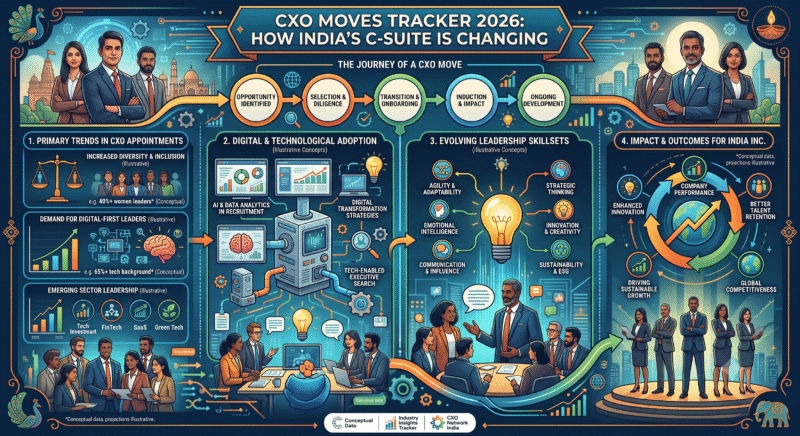
India’s corporate leadership landscape is undergoing a steady reshuffle in 2026, with companies across technology, banking, consumer goods, healthcare, manufacturing and financial services changing the people at the top.
CEO, CFO and CTO appointments often signal more than a personnel change. They can indicate a company’s next strategic priority, whether that means accelerating growth, improving profitability, strengthening technology, preparing for an IPO or managing a major transformation.
The growing movement of senior executives also reflects a competitive market for experienced leadership talent.
CEOs Driving the Next Phase
Chief executive appointments remain among the most closely watched leadership changes.
Companies typically look for CEOs with experience in scaling businesses, managing complex organisations and navigating changing market conditions. For startups transitioning into larger enterprises, the role can also involve introducing more structured governance and operational discipline.
In established companies, a CEO transition can mark the beginning of a new strategic cycle.
The appointment may follow retirement, resignation, internal succession or the creation of a new leadership structure.
CFOs Take Centre Stage
The role of the chief financial officer has expanded considerably.
CFOs are no longer responsible only for accounting, financial reporting and compliance. They increasingly participate in capital allocation, fundraising, mergers and acquisitions, investor relations, risk management and long-term strategy.
This has made CFO appointments particularly important for companies preparing for public-market activity.
For startups approaching an IPO, an experienced finance leader can play a central role in strengthening financial controls, reporting systems and governance processes.
CTOs and the Technology Mandate
Technology leadership has become equally important as companies increase spending on artificial intelligence, cloud infrastructure, cybersecurity and digital platforms.
A CTO appointment can therefore provide clues about a company’s technology priorities.
Indian companies across traditional industries are investing heavily in digital transformation. Manufacturing, retail, banking, healthcare and logistics businesses increasingly depend on technology infrastructure that once belonged primarily to software companies.
The CTO is consequently becoming a strategic business leader rather than simply the head of engineering.
Internal Promotions Gain Importance
Not every major C-suite change involves an external hire.
Companies frequently promote senior executives who already understand their products, customers and organisational culture.
Internal succession can reduce transition risks and preserve institutional knowledge. It can also create a clearer leadership pipeline for companies that want to develop executives over several years.
For investors and employees, an internal appointment may also provide continuity during periods of strategic change.
Executive Mobility Across Sectors
Another feature of the 2026 leadership market is movement between industries.
Technology executives are increasingly moving into traditional businesses, while executives from banking, consulting, consumer companies and industrial organisations are taking roles at technology-led businesses.
This cross-sector movement reflects the growing importance of digital capabilities across the economy.
An executive with experience in scaling a technology platform, for example, may bring different approaches to customer acquisition, automation and data-driven decision-making when moving into a traditional industry.
Why CXO Changes Matter
Leadership changes can influence everything from corporate culture to capital allocation.
A new CEO may review business priorities. A new CFO may change the company’s approach to costs or fundraising. A new CTO may accelerate investments in artificial intelligence or modern infrastructure.
However, an appointment by itself does not determine future performance.
The impact of a leadership change depends on the executive’s mandate, the company’s financial position, market conditions and the resources available to implement the strategy.
Tracking India’s Leadership Market
The CXO market is becoming increasingly important as Indian companies grow larger and more internationally connected.
For startups, senior leadership changes can mark the transition from founder-led operations to professional management. For established companies, they can form part of succession planning or a broader transformation programme.
In 2026, tracking these movements provides a useful view of how corporate India is preparing for its next phase.
The biggest story may not always be the most prominent appointment. A finance executive joining before an IPO, a technology leader arriving during an AI transformation or an internal executive moving into the CEO role can each reveal how a company is positioning itself for the years ahead.
The CXO tracker is therefore more than a record of who moved where. It is a window into the changing priorities, capabilities and leadership structures of Indian business.