





Indian startups have spent years being measured by user growth, funding raised and valuation. But as the ecosystem has matured, another question has become increasingly important: How much money does the business actually make?
That question sounds simple until different financial metrics enter the conversation.
Contribution margin, EBITDA, adjusted EBITDA and adjusted profit can all describe different aspects of the same company. A startup may look profitable under one measure and deeply loss-making under another.
For founders and investors, understanding what each metric includes—and leaves out—is essential.
Start With Revenue
Before discussing profitability, it helps to understand revenue.
Revenue is the money a company earns from selling its products or services, before deducting expenses.
But revenue alone says little about the efficiency of a business.
A company generating ₹100 crore in revenue could be highly profitable, barely break even or lose significant money depending on what it costs to generate that revenue.
That is where margins become important.
What Is Contribution Margin?
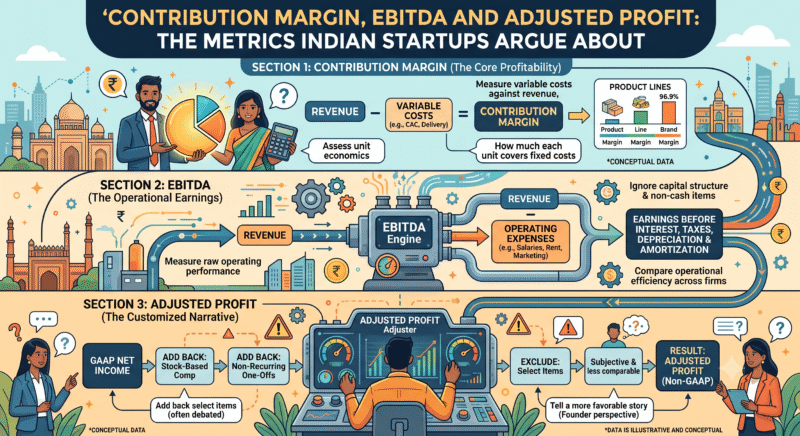
Contribution margin attempts to show how much money remains after deducting costs directly associated with delivering a product or service.
Suppose a startup sells a product for ₹1,000.
If the direct costs of producing, acquiring and delivering that sale total ₹700, the contribution is ₹300.
The contribution margin would therefore be 30%.
The exact costs included in contribution-margin calculations vary by business.
For a delivery company, they could include delivery expenses, payment costs, packaging or other variable costs.
Why Startups Focus on Contribution
Contribution margin is particularly useful for businesses that are still investing heavily in growth.
A company may lose money overall because it spends significantly on employees, technology, marketing and expansion.
But if each additional customer or order contributes positively toward covering those fixed expenses, the underlying business model may have a path toward profitability.
The opposite is also important.
If every additional transaction creates a loss even before major corporate expenses are considered, rapid growth can increase losses rather than solve them.
The Problem With Definitions
There is no single universal startup definition of contribution margin.
One company may include delivery costs and payment fees.
Another may exclude certain customer-acquisition expenses.
A third may calculate several versions, such as contribution margin before and after marketing.
Therefore, investors should always ask what costs are included in the company’s calculation.
The percentage by itself is not enough.
EBITDA Enters the Picture
EBITDA stands for earnings before interest, taxes, depreciation and amortization.
It is commonly used as a measure of operating performance before certain financing, tax and non-cash accounting expenses.
For example, a company may generate ₹50 crore in revenue and have ₹45 crore of operating expenses included in the relevant calculation.
Its EBITDA would be ₹5 crore before the specified adjustments.
EBITDA can help investors compare operating performance, but it is not the same as cash flow or net profit.
EBITDA Is Not Cash
This distinction matters.
A company can report positive EBITDA while still consuming cash.
Capital expenditure, working-capital requirements, interest payments, taxes and other cash expenses can affect the company’s actual cash position.
A founder who says, “We are EBITDA positive,” is therefore not necessarily saying, “We generate free cash.”
The two statements mean different things.
What Is Adjusted Profit?
The word “adjusted” requires particular attention.
Companies sometimes modify reported earnings to exclude expenses they consider unusual, exceptional or non-recurring.
These adjustments can make it easier to understand what management believes represents the underlying business.
But adjustments can also make profitability appear stronger if significant expenses are repeatedly excluded.
That is why investors need to examine the reconciliation between reported and adjusted numbers.
A Simple Example
Imagine a startup reports:
- Revenue: ₹100 crore
- Reported loss: ₹20 crore
- EBITDA: ₹5 crore
- Adjusted EBITDA: ₹12 crore
At first glance, the adjusted number looks considerably better.
But suppose the ₹7 crore difference comes from expenses that management describes as exceptional.
The important question becomes whether those expenses really are exceptional.
If similar costs appear every year, excluding them may provide a less complete picture of the economics.
Why Investors Debate These Metrics
Different stakeholders naturally focus on different numbers.
Founders may highlight contribution margins to demonstrate that individual transactions are becoming more profitable.
Investors may examine EBITDA to understand operating efficiency.
Accountants and public-market investors may focus on reported profit and cash flow.
Employees may care about whether the company’s financial position can support future growth.
None of these measures automatically tells the complete story.
Unit Economics Versus Company Economics
This distinction is especially important for startups.
Contribution margin can tell you whether an individual customer, order or transaction contributes toward fixed costs.
EBITDA looks at the company’s broader operating performance.
Net profit goes further by incorporating additional expenses and accounting items.
Cash flow examines the actual movement of cash.
A healthy company needs to understand all of these layers.
What Founders Should Track
A useful startup financial dashboard can include:
Revenue growth—is the business expanding?
Contribution margin—Does each transaction generate economic contribution?
EBITDA—How does the core operating business perform?
Net profit or loss—What remains after broader expenses?
Operating cash flow—Is the business generating or consuming cash?
Cash balance and burn—How long can the company continue operating at its current spending level?
Looking at these metrics together gives a more complete picture than relying on one headline number.
The Bigger Lesson
Contribution margin, EBITDA and adjusted profit are not competing definitions of success.
They answer different questions.
Contribution margin asks whether the underlying transactions can contribute toward the company’s fixed costs.
EBITDA asks about operating performance under a particular accounting framework.
Adjusted profit attempts to show an alternative view of earnings after specified adjustments.
The key for founders and investors is transparency.
Whenever a startup presents a profitability metric, the next question should be, “What exactly is included, what has been excluded, and why?”
Understanding that calculation can reveal far more about a startup’s financial health than the headline percentage itself.