




From bootstrapped beginnings to venture-backed growth, Indian startup founders must balance personal financial stability with runway, investor expectations and the company’s long-term survival.
One of the most uncomfortable decisions for a startup founder is deciding how much to pay themselves. Pay too little, and personal expenses can become a source of stress. Pay too much, and the business may run out of cash before reaching its next milestone.
Unlike employees, founders do not have a universally applicable salary benchmark. The right amount depends on the company’s funding, revenue, cash reserves, location and the founder’s responsibilities. The objective is simple: pay yourself enough to work sustainably without weakening the business you are building.
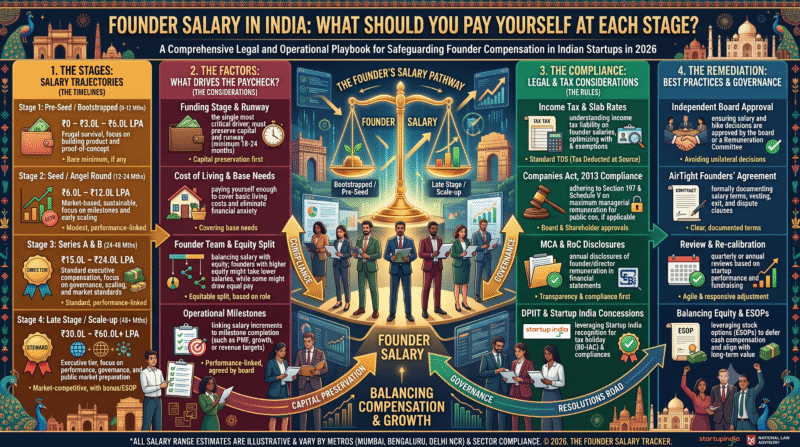
1. Pre-Revenue Stage: Protect Your Runway
At the idea or prototype stage, a startup may have little or no revenue. Founders often rely on savings, personal investments or limited external capital.
At this point, salary decisions should be conservative. A founder who has sufficient personal savings may choose a minimal salary, while someone supporting a family may need a more realistic monthly amount.
As an illustrative planning range, a founder might budget ₹0–₹50,000 per month, depending on personal circumstances and available capital. This is not an official industry benchmark or a universal recommendation.
The priority is to preserve enough cash to build the product, test demand and reach the next milestone. Founders should calculate essential operating expenses before deciding what remains available for compensation.
2. Early Revenue Stage: Pay for Full-Time Commitment
Once a startup begins generating revenue, founders can reassess compensation. The key question is whether the business can support a predictable salary without relying on continuous fundraising.
For an early-stage startup with initial customers, an illustrative range might be ₹40,000–₹1.2 lakh per month for a full-time founder. The appropriate figure can be substantially lower or higher depending on the company’s financial position and the role involved.
Founders should consider customer retention, gross margins, working-capital requirements and recurring expenses before increasing pay.
A business with rising sales but delayed customer payments may still face cash shortages. Revenue alone does not establish that a higher salary is affordable.
3. Seed-Funded Startup: Establish a Sustainable Salary
After raising a seed round, founders often move from survival-mode compensation towards a more stable salary.
For planning purposes, ₹75,000–₹2 lakh per month may be a useful illustrative range for some Indian seed-stage founders, although actual salaries vary significantly by sector, city, experience and funding terms.
The amount should be included in the operating budget and discussed transparently with the board or investors where required.
The Startup India portal provides information about government startup support, while the Ministry of Corporate Affairs provides official company-law resources relevant to corporate governance and statutory obligations.
Funding should not be treated as permission to increase personal spending without considering how long the capital must last.
4. Series A and Beyond: Compensation Should Reflect Responsibility
At a more mature startup, founders may manage larger teams, complex operations and significant revenue targets. Their compensation may increasingly resemble that of professional executives with comparable responsibilities.
An illustrative planning range could be ₹1.5–₹4 lakh per month or more, depending on the company’s scale and financial capacity. This is not a verified market average, and many founders may earn less or more.
At this stage, compensation should be supported by an established budget, documented approval procedures and appropriate corporate governance.
Founders should also distinguish salary from bonuses, equity ownership and other benefits. Equity can create long-term wealth, but it is not a substitute for the cash needed to meet regular expenses.
5. Understand Tax and Compliance
Founder compensation must be structured according to the company’s legal form and the individual’s role.
For example, remuneration paid to a director or working director of a company may have different legal and tax implications from payments to a partner in an LLP. The treatment also depends on the applicable law and the nature of the payment.
Founders should consult a chartered accountant and review official guidance from the Income Tax Department before finalising salary, reimbursements, bonuses or other payments.
They should avoid mixing personal and business expenses or treating informal withdrawals as automatically permissible.
6. A Practical Formula for Setting Your Salary
Before approving a salary increase, founders should answer three questions:
- Runway: How many months of operating cash will remain after the salary is paid?
- Personal needs: What is the minimum sustainable amount required for essential living expenses?
- Business priorities: Will the additional compensation delay hiring, product development or other critical milestones?
Review the decision at regular intervals, such as after a funding round, a major revenue milestone or a significant change in operating costs.
The Final Verdict
The founder’s salary is not a competition to see who can live on the least money. Nor should it become a reward disconnected from business performance.
The right salary supports the founder’s ability to make good decisions while protecting the company’s financial future. Early-stage founders generally need to prioritise survival; funded founders can plan for greater stability; and mature businesses should formalise compensation through transparent governance.
Pay yourself enough to build sustainably, but never confuse the money raised by a startup with money the business can afford to spend.