




From building an investor-ready pitch to negotiating valuation, Indian founders need a sharper fundraising strategy in a market that increasingly rewards traction, capital discipline and clear business models.
Raising a seed round is one of the most important milestones in a startup’s journey. The capital can help founders develop a product, hire their first employees, acquire customers and test whether their business model can scale.
But in 2026, fundraising requires more than an ambitious presentation. Investors want evidence that a startup solves a meaningful problem, understands its market and can use capital efficiently. For Indian founders, the process begins well before the first investor meeting.
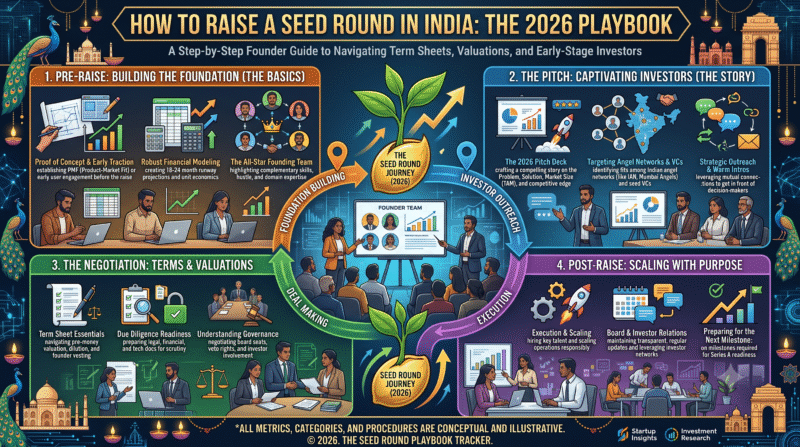
1. Build Proof Before Approaching Investors
The first step is to demonstrate that the business deserves funding. Depending on the startup, this evidence could include a working product, early revenue, paying customers, pilot projects, user retention or letters of intent from credible customers.
Founders should identify the problem they are solving and explain why existing alternatives are inadequate. A startup without revenue can still raise seed capital, particularly in technology-intensive sectors, but it needs a convincing product vision and credible evidence of demand.
Entrepreneurs can explore the Startup India initiative, which provides information about government programmes, startup recognition and ecosystem resources.
2. Target the Right Investors
Not every investor is suitable for every startup. Some specialise in software, fintech or consumer businesses, while others focus on climate technology, healthcare or deep technology.
Founders should research an investor’s portfolio, preferred investment stage, typical cheque size and experience in the relevant industry. A focused list of investors is usually more productive than sending the same pitch to hundreds of contacts.
India has an established network of venture capital firms and angel investors. Platforms such as Indian Angel Network and LetsVenture provide routes for founders to explore investor connections and fundraising opportunities.
Warm introductions can help, but a clear, concise outreach message explaining the business, traction and funding requirement can also open doors.
3. Prepare a Pitch Deck That Answers the Hard Questions
A seed-stage pitch deck should explain the business without overwhelming investors with information.
A strong presentation typically covers:
- The problem and target customer.
- The product and its competitive advantage.
- Market size and the initial target segment.
- Revenue model and pricing.
- Traction, customer evidence and key metrics.
- Competitors and differentiation.
- Founding team and hiring priorities.
- Funding requirement, planned expenditure and milestones.
Avoid relying on enormous market estimates without explaining how the company will reach its first customers. Investors need to understand the practical route from today’s business to the next stage of growth.
Founders can also review Y Combinator’s official fundraising guidance for advice on investor outreach, pitch preparation and running a fundraising process.
4. Decide How Much Money to Raise
A seed round should be linked to a specific business plan rather than an arbitrary headline amount.
Founders should estimate operating expenses, salaries, technology costs, customer acquisition and other essential investments. They should then determine what milestones the capital will fund and how long the money is expected to last.
For example, a software startup might use its seed funding to complete product development, establish repeatable sales and demonstrate customer retention. A consumer brand may need working capital, distribution and evidence of repeat purchases.
The amount raised should provide enough time to achieve meaningful progress while limiting unnecessary dilution.
5. Understand Valuation and Deal Terms
Valuation is only one part of a seed investment. Founders should also examine dilution, liquidation preferences, board or observer rights, information rights and other provisions that could affect future financing.
A high valuation can appear attractive, but it may create difficulties if the company cannot meet the expectations implied by that price. Conversely, giving away too much equity early can limit founders’ flexibility in later rounds.
Before signing, seek qualified legal and financial advice. India’s Securities and Exchange Board of India provides regulatory information relevant to the country’s capital markets, while company incorporation and compliance requirements can be explored through the Ministry of Corporate Affairs.
6. Run a Disciplined Fundraising Process
Fundraising can distract founders from building the business. To reduce that risk, prepare a data room containing financial projections, incorporation documents, cap tables, customer information and relevant intellectual-property records.
Schedule investor conversations within a defined period, record feedback and follow up professionally. Be transparent about risks, competing offers and business performance.
Most importantly, keep operating while fundraising. Improving revenue, retention or product quality during the process can strengthen the investment case.
The Final Playbook
Raising a seed round in India in 2026 is about demonstrating that a startup can convert capital into measurable progress. The strongest founders combine a compelling vision with credible evidence, careful investor selection and realistic financial planning.
Investors may fund the potential of a young company, but they need a clear reason to believe that its next milestone is achievable.