





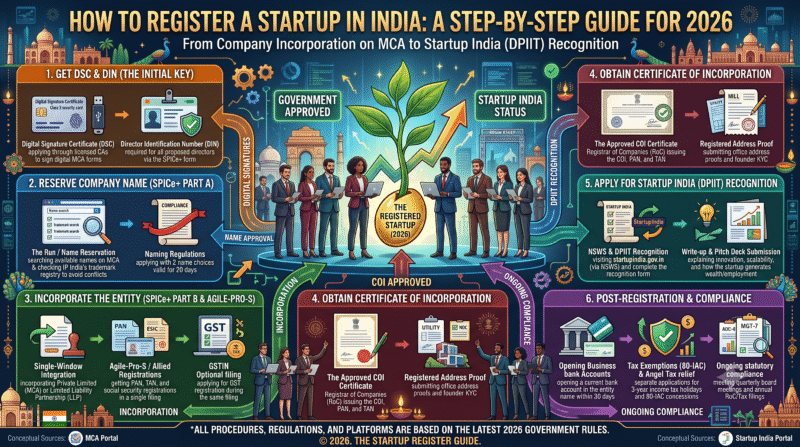
From choosing a legal structure to obtaining Startup India recognition, entrepreneurs must complete several registrations and compliance steps before building a fully operational business.
Starting a business in India involves more than developing a product or finding customers. Founders must choose an appropriate legal structure, register the entity, obtain tax registrations where applicable, and meet industry-specific requirements. They may also qualify for government initiatives designed to support eligible startups.
The process depends on the business model, ownership structure, and sector. However, most founders can follow a clear sequence to establish their company in 2026.
Step 1: Choose the Right Business Structure
The first decision is whether to operate as a sole proprietorship, partnership, limited liability partnership (LLP), or private limited company.
A proprietorship is relatively simple to establish but does not create a separate legal entity. An LLP offers limited liability with a different compliance framework, while a private limited company is often preferred by startups planning to raise equity funding.
Founders should consider ownership, liability, taxation, compliance costs, and future fundraising before deciding. The Ministry of Corporate Affairs (MCA) provides the official framework and services for company and LLP incorporation.
Step 2: Obtain Digital Signatures and Director Identification
For company incorporation, proposed directors and subscribers generally need Digital Signature Certificates (DSCs) to authenticate electronic filings. Individuals appointed as directors may also need a Director Identification Number (DIN), subject to the applicable rules and incorporation process.
These requirements help establish the identity of individuals submitting statutory documents online.
Founders should ensure that their names, identity details, and supporting documents are consistent across applications to reduce the risk of delays.
Step 3: Register the Company Online
A private limited company is generally incorporated through the MCA’s official company-services portal.
The incorporation process commonly uses the SPICe+ system, which combines several applications into a streamlined electronic process. Depending on the case, the filing may cover company name reservation, incorporation, DIN allotment, PAN and TAN applications, and related registrations.
Founders must provide details such as the proposed company name, registered office, directors, shareholders, authorized capital, and constitutional documents.
After the Registrar of Companies approves the application, the company receives a Certificate of Incorporation. This confirms the company’s legal formation; it does not automatically satisfy every license or operational requirement.
Step 4: Obtain PAN, TAN and Open a Business Bank Account
A company needs a Permanent Account Number (PAN) for tax-related purposes and may require a Tax Deduction and Collection Account Number (TAN) if it must deduct or collect tax at source.
PAN and TAN applications are generally integrated into the applicable incorporation process for companies, subject to the relevant requirements.
Once incorporated, founders can approach a bank to open a business current account. Banks typically request incorporation documents, PAN, details of authorized signatories, and other know-your-customer information.
Keeping business and personal transactions separate helps maintain reliable accounts and simplifies financial reporting.
Step 5: Apply for Startup India Recognition
Incorporation and startup recognition are separate processes. Eligible businesses can apply for recognition through the official Startup India portal.
Under the Department for Promotion of Industry and Internal Trade (DPIIT) framework, eligibility depends on factors such as the entity’s legal form, age, turnover, and whether it is working towards innovation, development, or improvement of products, processes, or services, or has a scalable business model with potential for employment or wealth creation.
The current eligibility criteria and application requirements should be checked on the official portal before applying.
Recognition may provide access to certain government schemes and benefits, subject to individual eligibility and approval. It does not automatically grant every tax exemption or funding benefit.
Step 6: Complete Tax Registrations and Business Licenses
Not every startup requires the same registrations. Depending on its activities, a business may need:
- GST registration: When registration is required under applicable GST law, considering turnover thresholds, supply types, and other conditions.
- Udyam registration: For eligible micro, small, and medium enterprises through the official Udyam portal.
- FSSAI registration or licensing: For eligible food businesses through the Food Safety and Standards Authority of India.
- Import Export Code: For businesses undertaking covered import or export activities, through the Directorate General of Foreign Trade.
- Local and sector-specific licenses: Depending on the business location, premises, employees, and industry.
Founders should also check applicable employment, professional tax, Shops and establishments, environmental and data-protection requirements.
Step 7: Set Up Accounting and Ongoing Compliance
Registration is only the beginning. Companies must maintain accounting records, meet applicable tax deadlines, file annual returns and financial statements, and comply with board and shareholder requirements.
The precise obligations depend on the entity type and business activities. A qualified chartered accountant or company secretary can help establish a compliance calendar and avoid missed deadlines.
The Final Checklist
Registering a startup in India becomes more manageable when founders follow the correct order: choose the structure, complete incorporation, establish banking and tax arrangements, obtain applicable licenses, and, if eligible, apply for Startup India recognition.
The key is to register correctly from the beginning. A legally compliant foundation makes it easier to hire employees, sign contracts, raise investment, and scale the business.