





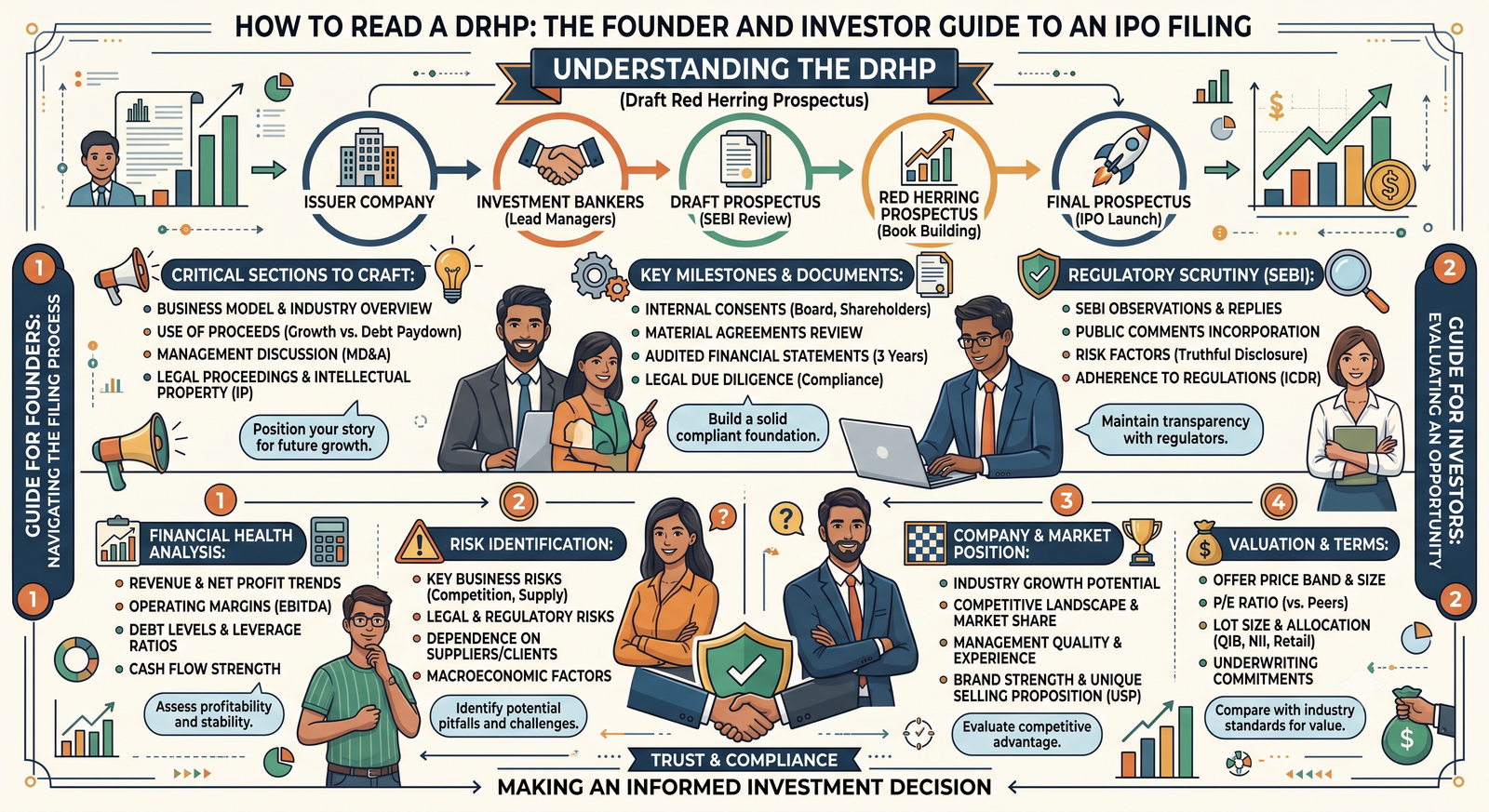
When a private company prepares to go public in India, one of the most important documents investors encounter is the Draft Red Herring Prospectus, commonly known as the DRHP.
It can run into hundreds of pages and contain financial statements, business risks, promoter information, legal proceedings, industry data and details about how the company plans to use the money raised.
For first-time readers, the document can appear overwhelming.
But a DRHP becomes much easier to understand when it is approached as a structured map of the company rather than read from beginning to end.
What Is a DRHP?
A DRHP is a draft offer document prepared by a company planning a public issue.
It contains information intended to help potential investors understand the company and the proposed offering.
The document is filed with the Securities and Exchange Board of India as part of the IPO process.
It is called a “draft” because the offer document can undergo changes during the regulatory review process.
The final prospectus contains the information applicable to the public issue.
Start With the Business
The first section to examine is the company’s actual business.
Ask simple questions:
What does the company sell?
Who are its customers?
How does it make money?
What are its major products or services?
Where does revenue come from?
A startup can have impressive growth numbers, but understanding the underlying business model is essential before examining the valuation.
Understand the IPO Structure
A DRHP usually provides details about the proposed issue.
The offering may contain a fresh issue, an offer for sale, or a combination of both.
In a fresh issue, the company raises new capital by issuing shares.
In an offer for sale, existing shareholders sell some of their shares.
The distinction matters because money raised through a fresh issue goes to the company, while proceeds from an offer for sale generally go to the selling shareholders.
Follow the Money
One of the most important sections is the proposed use of proceeds.
If the company plans to raise fresh capital, the DRHP explains how it intends to use the funds.
Possible uses can include capital expenditure, debt repayment, working capital, acquisitions or general corporate purposes.
Investors can compare those plans with the company’s current financial position.
A business carrying significant debt may have a very different capital requirement from a company with a strong cash balance.
Read the Financial Statements
The financial statements are among the most important parts of the DRHP.
Look at revenue growth, gross profit, operating expenses, EBITDA, profit or loss and cash flow.
Do not focus on a single year.
Compare several years to identify trends.
A company may report strong revenue growth while continuing to generate losses.
Another may report accounting profits but weak operating cash flow.
The relationship between these numbers can reveal important information about the business.
Revenue Quality Matters
Growing revenue is not necessarily enough.
Investors should examine where revenue comes from and whether growth is concentrated among a small number of customers or products.
Recurring revenue can have different characteristics from one-time sales.
The DRHP may provide information about customer concentration, geographical exposure and major business segments.
These details can help readers understand how durable the reported growth may be.
Read the Risk Factors
The risk-factor section is often long, but it deserves careful attention.
Companies are required to disclose material risks, which can include regulatory changes, dependence on key customers, competition, supply-chain issues, technology risks, litigation and dependence on particular individuals.
Not every disclosed risk will occur.
The purpose is to identify potential factors that could materially affect the company.
Reading this section alongside the company’s growth story can provide a more balanced picture.
Look at Promoters and Shareholding
The DRHP also provides information about promoters and major shareholders.
Readers can examine how ownership is distributed before and after the issue.
Changes in promoter ownership, institutional holdings and the percentage of shares being offered can provide useful context.
For founders, understanding the post-IPO ownership structure is equally important because going public changes the company’s shareholder base and reporting obligations.
Examine Related Party Transactions
Related-party transactions deserve attention because they involve dealings between the company and entities or individuals connected to it.
These transactions can be legitimate and common, particularly in founder-led businesses.
The important questions are their size, nature, terms and relevance to the company’s operations.
Understanding these relationships can help investors assess how independently the business operates.
Check Legal Proceedings
The DRHP contains disclosures relating to material legal and regulatory matters.
Readers should examine significant litigation, regulatory actions and other disputes involving the company, promoters or subsidiaries.
A legal case does not automatically mean that a company has committed wrongdoing or that it will lose the case.
The purpose is to understand the potential exposure and its possible financial or operational implications.
Study the Competitive Landscape
A company’s description of its market should be compared with its actual competitive environment.
Look at competitors, market size, growth assumptions and barriers to entry.
A rapidly expanding industry can attract new competitors.
Likewise, a company claiming a strong market position should be examined through the supporting data provided in the filing.
Valuation Comes Last
One common mistake is focusing on valuation before understanding the business.
The DRHP provides information that can help investors calculate metrics such as price-to-earnings, price-to-sales or enterprise-value-to-EBITDA once the relevant IPO pricing information is available.
But those numbers are meaningful only when compared with appropriate companies and the company’s growth, profitability and risk profile.
A Practical Reading Order
For a faster review, readers can follow this sequence:
1. Business model — understand what the company actually does.
2. IPO structure — identify fresh issue versus offer for sale.
3. Financial statements — study revenue, profitability and cash flow.
4. Use of proceeds — determine where new capital will go.
5. Risk factors — identify the major business vulnerabilities.
6. Promoters and ownership — understand who controls the company.
7. Legal and related-party disclosures — identify potential complications.
8. Competition — examine the company’s position within its industry.
9. Valuation — assess the proposed pricing only after understanding everything above.
The DRHP as a Reality Check
A DRHP is not simply an IPO brochure.
It is a detailed disclosure document containing both the company’s business narrative and information about risks, finances, ownership and legal matters.
For founders, reading a DRHP can explain what changes when a private company becomes publicly accountable.
For investors, it provides a structured way to investigate the business before making an investment decision.
The most useful approach is to read the optimistic growth story and the detailed disclosures together.
The goal is not to find one number that decides whether an IPO is attractive. It is to understand how the company makes money, what could go wrong, how it plans to use capital and what investors are actually buying.