




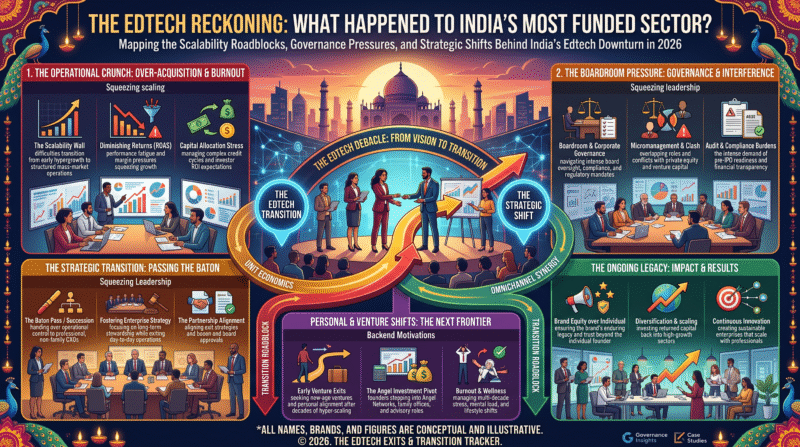
From BYJU’S financial crisis to Physics Wallah’s expansion, India’s edtech industry is learning that technology, funding and aggressive growth cannot replace sustainable education businesses.
India’s edtech boom promised to transform how millions of students learned. Online classes, recorded lectures, personalised learning apps and digital test preparation attracted students, parents and investors. During the pandemic, when classrooms closed, the sector experienced extraordinary demand.
But the reopening of schools and coaching centres exposed the weaknesses of a business model built around rapid digital adoption. Funding became harder to secure, customer acquisition grew expensive and several companies struggled to turn their popularity into sustainable profits.
1. BYJU’S: The Warning Sign
BYJU’S became the symbol of India’s edtech ambitions, building a large learning platform and acquiring businesses across education and technology. Its aggressive expansion reflected investor confidence that digital learning would become a permanent part of education.
However, financial difficulties, governance controversies, debt disputes and insolvency proceedings severely damaged the company’s position. Its experience exposed the risks of expanding through expensive acquisitions before the underlying business had established durable financial stability.
The crisis also affected confidence across the wider sector. Investors began paying closer attention to financial reporting, corporate governance, cash flow and the quality of revenue rather than relying primarily on user growth and valuations.
The Pandemic Growth Trap
Lockdowns accelerated online education, but the extraordinary demand was not entirely permanent. Once schools, colleges and coaching centres reopened, students returned to familiar offline learning environments.
Online platforms suddenly had to compete with classroom teaching, established coaching institutes and hybrid education models. Businesses that had expanded their teams and marketing budgets during the pandemic faced pressure to reduce costs.
The lesson was not that online learning had failed. Rather, companies had mistaken a period of exceptional demand for a guarantee of permanent consumer behaviour.
2. Unacademy: From Hypergrowth to Restructuring
Unacademy grew rapidly through live classes, educator-led content and competitive-exam preparation. It attracted substantial investor funding and expanded into several education categories.
As competition intensified and funding conditions tightened, the company shifted its focus towards efficiency and profitability. Its strategy increasingly emphasised core learning products and a more disciplined approach to offline operations.
The broader lesson is that even a recognised brand with a large learner base must continually demonstrate that its business model can support its operating costs. Scale is valuable only when it creates durable customer relationships and sustainable economics.
3. Physics Wallah: A Different Route to Scale
Physics Wallah built its reputation by offering accessible education, particularly for students preparing for competitive examinations. Its combination of digital learning and physical coaching centres helped it reach students seeking different levels of support.
Unlike a model dependent entirely on online subscriptions, its hybrid approach demonstrates how technology can complement established learning formats.
The company’s trajectory also highlights the importance of price sensitivity in India. Students and parents often compare educational value carefully, making affordability, teaching quality and examination outcomes central to the purchasing decision.
Its experience suggests that edtech companies do not necessarily need to eliminate offline education. In many categories, combining online convenience with in-person support may offer a more resilient business model.
Why the Funding Model Broke Down
The sector’s difficulties can be traced to several recurring problems.
High customer-acquisition costs: Heavy spending on advertising, sales teams and discounts can make growth expensive.
Weak retention: Students may subscribe for a particular examination or course and leave once that need is met.
Unclear profitability: High revenue and large user numbers do not automatically translate into positive cash flow.
Operational complexity: Managing educators, technology, content, customer support and physical centres creates substantial costs.
Governance failures: Weak financial controls and unclear accountability can undermine investor confidence, particularly when companies raise large amounts of external capital.
These problems became harder to ignore once investors stopped rewarding expansion at almost any cost.
What Comes Next for Indian Edtech?
India’s education market remains enormous, and digital learning continues to offer benefits in accessibility, flexibility and personalisation. Artificial intelligence may further improve practice exercises, tutoring, assessment and content delivery.
However, technology alone will not determine which businesses succeed. Companies must demonstrate learning value, protect student data, maintain teaching quality and build products that customers are willing to pay for repeatedly.
The next generation of successful edtech businesses is likely to focus on specific learner needs, efficient distribution and measurable outcomes rather than expanding into every possible category.
The Final Lesson
India’s edtech reckoning is not the end of digital education. It is a correction in how the sector measures success.
The pandemic proved that students could learn online at scale. The years that followed showed that adoption alone cannot sustain a company. Strong teaching, affordability, responsible management and sound financial planning remain essential.
The next edtech winners will not simply be the companies that raise the most money. They will be the ones that help students learn better while building businesses capable of surviving beyond the next funding cycle.